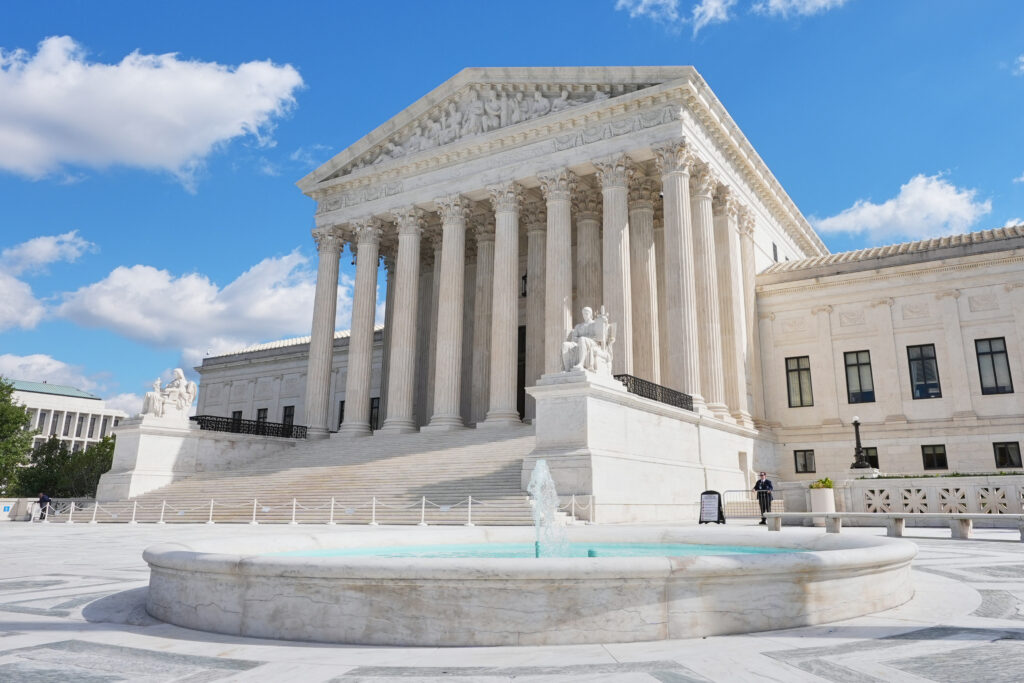
The Supreme Court on Tuesday grappled with arguments about whether federal labor regulators can directly impose hundreds of thousands of dollars in fines on a New Jersey farm they allege mistreated workers.
The case before the justices could have far-reaching consequences for the power of federal agencies to enforce labor laws. The high court’s conservative majority has pared back the power of federal regulators in a series of recent cases.
In 2015, the Department of Labor accused Sun Valley Orchards, a family farm in New Jersey, of failing to provide adequate working and living conditions for its immigrant laborers who had been brought into the United States under the H-2A visa program. According to the department, Sun Valley did not provide the workers with adequate meals and they had to use bathroom sinks without hot water.
Sun Valley also allegedly forced some workers to go home before the end of their contracts, which left them short of pay, the Labor Department found. This violated the conditions of Sun Valley being able to employ workers under the visa program, the department said, and it fined the farm over $400,000.
But Sun Valley has argued that the fines were unconstitutional. The fines were imposed through an in-house tribunal in the Labor Department that can be unfair, Sun Valley said.
Instead, Sun Valley said it should have a chance to fight its case in front of jurors in federal court, arguing that the Constitution guarantees the right to a jury trial in civil disputes.
At times during oral arguments in the case Tuesday, some justices appeared to struggle with Sun Valley’s argument and whether it supported a clear rule for which types of civil penalties should be heard in federal court.
“If we’re looking for clarity, what you’re proposing there is really at war with clarity,” Justice Brett M. Kavanaugh said. “There’s going to be a lot of guesswork about where exactly within, let’s say, the immigration exception or within the other exceptions the line’s drawn.”
As Sun Valley’s attorney, Robert E. Johnson, appeared to struggle with some of the justices’ line of questioning, Justice Neil M. Gorsuch jumped in and appeared to help the lawyer clarify his argument that the visa arrangement is similar to a private contract that should be heard in federal court.
“The problem here is we’re adjudicating a contract or something that looks an awful lot like a contract between an employer and an employee?” asked Gorsuch, who has been outspoken about his belief that federal agencies have overstepped their authority.
“Correct,” Johnson replied.
For the last several decades, the Department of Labor has relied on in-house judges to adjudicate proceedings and impose “appropriate penalties” — including recovering back wages — on employers that the agency alleges violate the terms and conditions of employment under the visa program.
The H-2A visa program grants employers the “privilege” of hiring temporary foreign agricultural workers on the condition that they provide certain standards of living and working conditions, required to offset foreign workers’ potential to undercut domestic laborers.
Sarah M. Harris, an attorney with the Justice Department, argued that the Labor Department has the authority to adjudicate violations of the program’s conditions.
The conditions “ensure that importing particular aliens for particular work won’t distort U.S. wages or working conditions for those jobs,” Harris told the justices. “Agencies, not just courts, unquestionably adjudicate violations of those conditions.”
The Sun Valley case follows a ruling two years ago, in SEC v. Jarkesy, that limited the power of the Securities and Exchange Commission to impose fines.
The ruling invalidated the SEC’s use of in-house legal proceedings to discipline those it believes have committed fraud. Critics feared it was one in a series of cases that would significantly curb the enforcement power of a host of other federal agencies.
The post Supreme Court grapples with arguments over federal agencies’ power to impose fines appeared first on Washington Post.