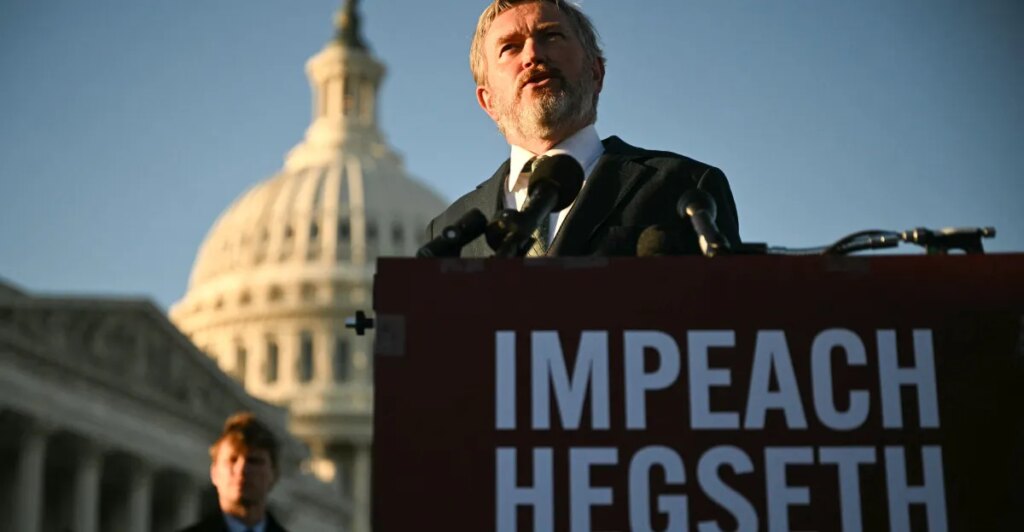
Defense Secretary Pete Hegseth may be on track to become just the third Cabinet member in history to be impeached, after Republican Rep. Thomas Massie introduced eight articles of impeachment against him on Monday.
Some articles of impeachment, which accuse Hegseth of high crimes and misdemeanors, focus on Hegseth’s conduct during the Iran war, including waging war without congressional authorization. Others accuse Hegseth of carrying out unlawful military strikes against boats carrying alleged drug traffickers in the Caribbean and the Pacific, suppressing free speech, kidnapping former Venezuelan President Nicolas Maduro, and waging unlawful war in Yemen.
The articles are poised to move quickly in the House, with a procedural vote set for Tuesday evening and impeachment votes following as soon as Wednesday. Republicans still hold a slim House majority until January following last week’s Democratic tsunami in the midterm elections — but it’s possible that enough of them could join with Massie and House Democrats to impeach Hegseth anyway.
Hegseth, so far, has been defiant. On Tuesday, he defended his tenure atop the Pentagon in a rare press conference, calling the impeachment effort a “political spectacle, a personal manifesto driven by ego and resentment.”
Following the press conference, President Donald Trump posted online that Hegseth deserves an “A PLUS PLUS PLUS” for defending himself.
To figure out what awaits for Hegseth and what it could mean for the Iran war, Today, Explained co-host Sean Rameswaram spoke with the Washington Post’s Dan Lamothe about the impeachment effort, how the Pentagon is feeling after eight months of the Iran war, and whether there’s an off-ramp in sight.
Below is an excerpt of their conversation, edited for length and clarity. There’s much more in the full podcast, so listen to Today, Explained wherever you get podcasts, including Apple Podcasts, Pandora, and Spotify.
What are the vibes in the Pentagon in Washington, DC? Did the Iran war lose Republicans these midterms?
I don’t think it is the only deciding factor, but I think it is a significant factor in two ways.
One, there is a group of Republicans who voted for Donald Trump because he said he would not get us into any more protracted wars. The Iran war is eight months and counting. There seems to be no easy off-ramps even now. We’re not really fully at war. We’re certainly not at peace.
And as a result, the second issue — affordability, cost of living — a significant deciding factor in that is the price of gasoline, which then affects the price of groceries and everything else. So yes, there is a direct line between the war and a lot of the issues that were a factor.
A lot of Democrats have been saying that they want to impeach Pete Hegseth if they take control. Now they will. Future [House] Speaker Hakeem Jeffries came out this weekend and said that he’s into the idea. Remind us, why Hegseth?
I think there’s a couple of things going on. One, you’re likely to see an impeachment vote this week: the Rep. Thomas Massie-led effort to impeach. There are a lot of angry Democrats, obviously, but there are a number of Republicans likely to cross the aisle on this and it may very well pass the House. I don’t know if it’s going to pass the Senate. That seems like a much bigger leap.
Either way, you’ve got an on-the-record rebuke, and you also have a forcing function to get every single member either on the record voting for it or on the record that they avoided voting for it. So that’s going to be a messy situation.
What are the actual grounds for impeachment of Hegseth?
On the Iran issue, it’s a little more complicated because you can think the policy of going into the war with Iran is problematic, detrimental to the national security of the country based on the amount of munitions we’re using, a variety of things. There’s not necessarily anything straight-up illegal in that.
Where I think they’re going to dig in is, they’re going to say that Iran went [on] longer than you’re allowed without having any kind of authorization.
Hegseth appears to be kicking off some sort of PR campaign in defense of his tenure. Is that just for the president or is that for Congress as well?
I think it’s primarily for the president. I do think there is a secondary audience of members on the Hill — Republicans on the Hill in particular — who are not sure how to handle this going forward. But I think foremost, this was meant for the president. It was very Trump-esque in terms of its feel. It had a defiance to it. It had a grievance in it and it had the feel of they’re coming after me and I’m not going anywhere.
I initially was like, this feels like that scene in Wolf of Wall Street where Leonardo DiCaprio says, “I’m not leaving.”
And then within a day — I guess I should have seen it coming — the White House put out a video with a series of clips in it and sure enough, that was one of the clips. So that’s the vibe.
Even last week, when we saw Susie Wiles get pushed out at the White House as President Trump’s chief of staff — [new chief of staff] Stephen Miller is much closer with Hegseth and you saw messaging from both sides, both the Pentagon and the White House, making the point that Hegseth continues to enjoy the support of both Stephen Miller and Donald Trump.
And I think we’re all left wondering, does that continue into the new year with Democratic majorities in both chambers of the Congress at that point?
How does it feel inside the Pentagon right now? What is the state of the war at this point?
I think there’s exhaustion.
Not unlike some of the other earlier wars that we’ve covered, you go in with good intentions, you go in with a goal, there’s markers up on the board, there’s a campaign plan. And then at some point when it starts to go wrong, you can explain away some of the earlier problems. But the challenge is over time, when you say, “Hey, we won back in April,” and yet you still have vessels getting hit all the time.
The Strait of Hormuz, they say it’s open. There are still vessels getting through, but it’s under duress. There’s still missile fire coming at a lot of vessels. This is not easy. This is not going normally. Everything is a drain.
There has been an increasing finger-pointing within the government, within the military where people say, “Hey, Hegseth is a participant in this. He’s a player in this.” There is at least a discussion of whether or not the president got the information he should have got, whether or not there was some gilding of the lily there in terms of what the US military could effectively do.
And I think there are military officers there who are caught in the middle. Do you gussy it up on the front end or leave out some of the information that’s a little difficult for the president to digest in the first weeks of the war? And is that a factor on where we are now?
Is anyone seriously talking about just ending this very unpopular quagmire situation of a war we’ve got in Iran?
Certainly people are talking about it. And I think how you get there is the challenge in it. I think when you’re looking at things like whether or not to strike again, are we talking one big night, a couple of days?
Most of the people I’m talking to who are tracking this issue that are still in government say they can’t do this for weeks on end. So this is not going to be a return to what we saw in March and April.
There are people telling the president, “Quit now, declare victory and get out.” There are people telling the president, “Do these handful of things, then declare victory and get out.” And there are other people that say, “Keep going.”
Who wins that argument? I think it remains to be seen. And that’s one of the reasons that you had the election landslide you had, because now you’re going to have pressure from the Congress in a way you simply have not for the last two years.
The post What to know about the Republican-led effort to impeach Pete Hegseth appeared first on Vox.