At the very first rehearsal of the new Off Broadway play “This World of Tomorrow” our director, Kenny Leon, stopped us after two minutes — two minutes. “I don’t want to hear how you are saying the lines,” he told us actors. “I want to hear what you are saying.”
We may have been focused on our dialects, but he was listening for the language of the play. And that language? It had evolved from prose on the page, my prose.
The play was based on a collection of short stories I’d written, and now my words were being spoken by the members of our all-star cast, including Kelli O’Hara, Ruben Santiago-Hudson, Jay O. Sanders. I was not only acting along side them, but I was also responsible for what was coming out of their mouths. Would my words inspire them? Would they help my castmates convey the language Kenny was listening for?
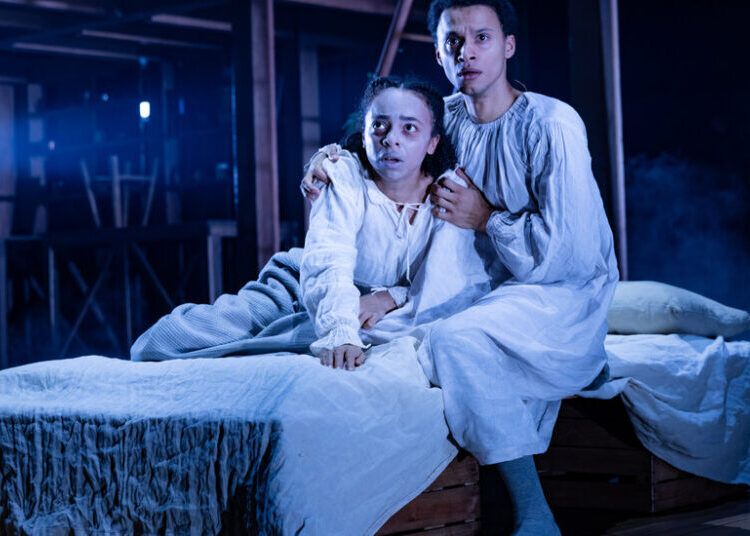
In our rehearsal room, the rewriting never ended. The script that my collaborator, the playwright James Glossman, and I had pored over for months now sounded completely different coming from the cast. It was a little surreal to hear Ruben as a tech genius from the future explaining the perils of time travel or Kelli as a bookkeeper from the Bronx telling the story of her magical day at the 1939 World’s Fair in Queens. Both sounded just as we had imagined but also completely different as we went from table reads to rewrites to rehearsals and more rewrites before finally freezing the script.
These words have been with me for over a decade. My stories were published in 2017 in a collection titled “Uncommon Type.” Then, over the past three-and-a half years, in the form of a script adapted from two of these stories. I’m no stranger to commitment. I’ve devoted months of my life to working on films and, back in 2013, the Broadway play “Lucky Guy.” But this would be different; this was years.
After quieting some internal doubts, I embarked on this endeavor, partly fueled by a desire to bring to life onstage a sense of lives caught between the certainties of the past and the unknowable future. I wanted theatergoers to ponder the possibilities of each present moment.
It all started during the Covid shutdown, when Jim presented a staged reading of my work at a fund-raiser for Shadowland Stages in Ellenville, N.Y. (Though we had never met, Jim and I had traveled in concentric theater circles in the 1970s and ’80s.) His reading combined two stories from my book: “The Past Is Important to Us,” about a tech titan of the future who takes a sort of time travel vacation to 1939, and “Go See Costas,” inspired by my father-in-law’s escape from the Communists in postwar Bulgaria and his arrival in New York City.
Jim thought the stories could work as pieces of theater: Two men leaving their pasts behind them, starting new lives in a new world and being changed by what they find in pre- and post-World War II America. I saw no reason to deny Jim that challenge.
What he called “Safe Home” evolved from a one-time reading into a full production at Shadowland. Opening night was in July 2022, and I was rather thrilled by the production — though the play was crammed to the rafters with ideas and plot, and burdened with dialogue, monologues and explanations.
Still, given our overlapping pasts and affection for the prose of the short stories, we felt a desire to revisit the work. But where to begin — again? Jim and I exchanged pages for two years, rewriting each other, struggling to produce coherent dialogue, debating phrases and scenes. This is a science fiction story, but even we realized we were really pushing the logic of the science, the reasoning, the physics.
Then at an invaluable weeklong workshop in 2024 at Portland Stage in Maine, it became clear that James and I needed to work together in person in order to wrestle the play into shape. We settled on my agent’s offices in the Chrysler Building in Manhattan. Would it be the crucible of creativity we needed?
We revisited our research about the 1939 World’s Fair, and kept landing on a didactic bit of narration: “The present is but an instant between an infinite past and a hurrying future…” This came from the designer Norman Bel Geddes’s “Futurama,” a vast design for a future world, presented by General Motors in what was the fair’s most popular attraction.
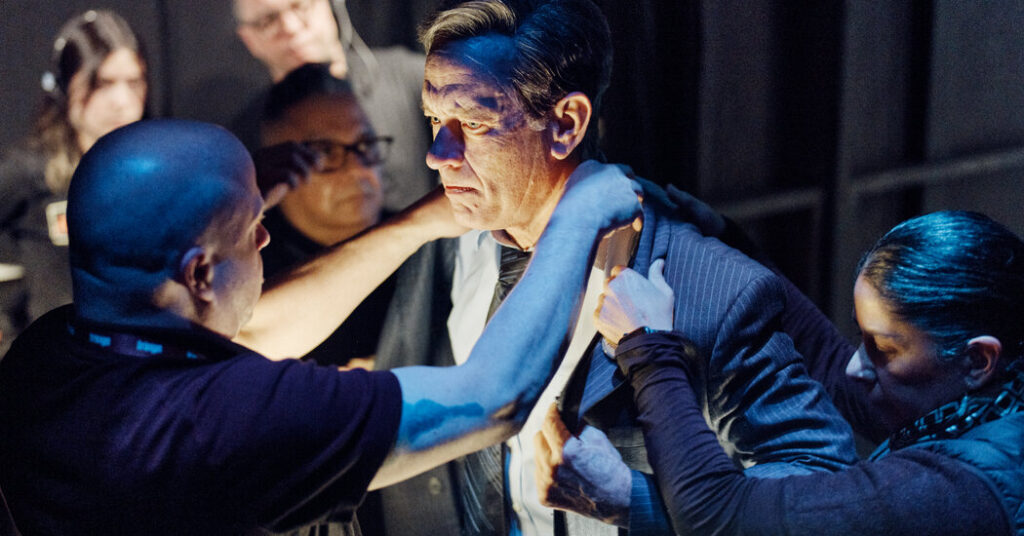
We forged ahead, developing back stories for each character, figuring out which speeches resonated, and testing the number of jokes audiences would tolerate. We wanted to get the era right. One character played by Sanders owns a Greek diner just off Sheridan Square; another, Carmen Perry (O’Hara), works at a handbag factory, and lives with her brother’s family in the Bronx. Virginia, Carmen’s niece (Kayli Carter), is the president of her school’s radio club and obsessed with the advent of television. I portray a wealthy tech entrepreneur from 2089 who meets these characters when he travels back in time.
Sometime in the summer of 2024, we let some trusted minds read the latest rendering of our work. Debating innocuous wording was slightly excruciating (Do audiences respond better to “we have a situation” or “we have a problem”?), but the reactions landed like a gut punch: “Interesting!” “Huh?” “You might have something here.” Translation: There is more work to be done.
Somehow the manuscript made its way to Alex Poots and Laura Aswad at the Shed, who offered an official workshop — a staged reading. Jim and I gulped at the reality of what this deep throw would mean, then thought ‘Well, yeah, why not?’ We slapped the date on our calendars and rushed headlong into more revisions.
Now, how is this for timing? The reading of “This World of Tomorrow” was held at the Shed the day after the 2024 presidential election. Just as we were taking an audience back to 1939 — which held its own uncertainty around war and the financial rebound from the Great Depression — there was a looming uncertainty, in 2024, of what the next four years would mean for the United States. Then came the realities of our endeavor: constructive criticism of what remained cloudy in the play’s narrative, theme and language.
As Jim and I dove back into the script, we were guided by notes from Alex and Todd Kreidler, the dramaturg and associate director; the reactions of the folks who attended the workshops; and friends who had read (and reread) it. Despite the work to be done, the Shed offered this fall for a production. Jim and I agreed to take the leap.
As rehearsals began at Gibney Center downtown, missing beats were revealed. More revisions were made. The writing felt endless. New pages greeted the team each morning. Oftentimes the actors’ work the day before informed these new passages, their stone-cold authority illuminating moments that needed adjustments. Kenny kept stopping us, wanting to hear what the play was saying, in the language of the theater.
Previews arrived, and I eventually surrendered all but my actor hat. Jim and I handed over the final script to the cast to perform.
It’s electrifying to be a playwright — as terrifying a creative experience as I’ve ever had. It has also been a pleasure and an honor to join a cast and crew with such dedication, joy and brass. Some days, amid the rush of performing for a live audience, I feel as if our reality is forcing us to engage with the play’s themes: Staying present by embracing the moment, while also hurrying toward our inevitable future — the play’s final performance on Dec. 21.
The post Tom Hanks on the Electrifying (and Terrifying) Experience of Writing a Play appeared first on New York Times.