At the only co-ed group home for at-risk youth in Alexandria, Virginia, it’s hard to find a bare wall.
On Sheltercare’s entryway walls, butterflies soar across a lavender sky. Oreo Jorge, the shelter’s black-and-white pet bunny and mascot, rests in the grass next to tulips, sunflowers and white orchids.
Around the corner, children stamped their handprints in a hallway leading to the living room, where teenage girls have small group sessions, kids sometimes gather for dinner, and a wall has been cleanly divided into bright geometric shapes.
“A kid was having a bad day and was like, ‘I need to do something tangible,’” Director Annie Reiney said. So, she offered him tape to make the lines and paint to fill in the empty space.
“If a kid wants to paint a wall, that’s like, ‘So what?’” she said. “We could always paint over it, I guess, but add color. Kids live here.”
The refrain reflects the philosophy Reiney has used since she was tapped in 2023 to run the facility for youth ages 10 to 17. Before that, she was an intern and reentry coordinator for the local juvenile detention center next door. Both are managed by the Northern Virginia Juvenile Detention Center Commission.
The group home, importantly, is not a detention center. Some of its young residents have been ordered to live there by a judge. Others find themselves at Sheltercare awaiting a foster home or a parent’s return from jail or a treatment program.
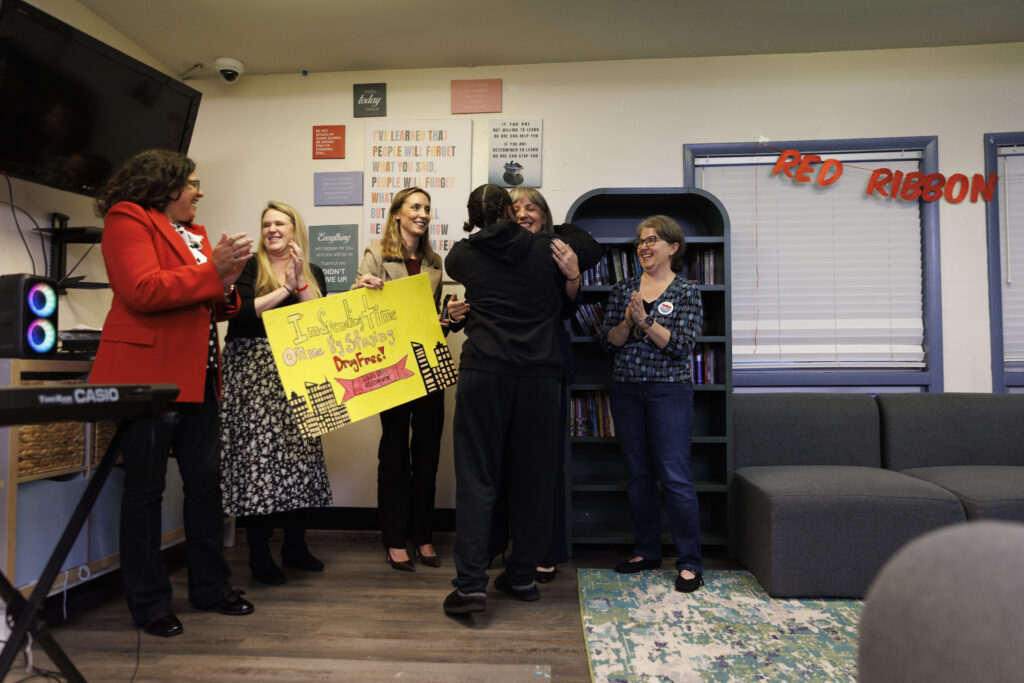
At an art contest last month commemorating Red Ribbon Week, an annual substance abuse awareness campaign, Amy Wilker traced the tables lined with more than 95 drawings, paintings and poems reflecting the children’s experiences.
Most of the kids “have experienced some form of trauma,” said Wilker, who is the director of child and family well-being at Northern Virginia Family Services.
One pencil drawing depicted a young girl standing in the foreground with her hair tied in pigtails. Behind her, a woman is slouched on a couch. A hand reaches for a needle, pills and a liquid spilled on a table. “Momma uses these candies,” is written in the corner.
“They have to go through that … and find the thing that makes them shine,” Wilker said.
No matter what brought them to the group home, the kids here have agency. They shop for necessities such as toothpaste, deodorant and cereal during regular runs to BJ’s. They decorate their rooms with posters and family photos. The pet bunny’s name came from their own indecision to choose between Oreo and Jorge.
Ten children — nine girls and one boy — currently live at the shelter, which has a lengthy wait list. Each child is assigned two counselors who coordinate with courts, schools and families while guiding residents through treatment. During a stay, kids work through required and individualized goals, such as skills to handle substance abuse, feelings of anger, relationships and healthy communication.
While similar facilities may operate on a three-strike rule, Reiney described Sheltercare’s approach as “addressing the underlying issues that bring youth to the juvenile justice system and equipping them with the skills and support needed to successfully transition back into their communities.”
Reiney said a child’s first time at the facility may not be enough for successful intervention. “It might be two Sheltercare stays down the road where we get to you.”
That philosophy can make success difficult to measure.
Residents are also students, and staff at the group home either transport them to their home school or walk with them downstairs, where the lower floor has been turned into classrooms for instruction by an Alexandria City Public Schools teacher.
Partnerships between local businesses and organizations provide the kids with weekly access to programming such as art therapy, yoga, music lessons and CrossFit. On the weekends, they screen print T-shirts and take trips, like to a trampoline park. Some made their first attempts at ice skating and sledding or went to the zoo for the first time.
Continued support is a crucial step for successful reentry back into their communities. Even after a stay at Sheltercare, which can last months to years, Reiney’s cellphone number is available when they’re in need. Rather than shoplifting when desperate, she said, they call her. She has thrown baby showers for former (and current) residents who are expecting.
The Community Resource & Reporting Center, an after-school program at the shelter, was born from that need, Reiney said.
In fiscal year 2026, the program served 40 young people, while the group home saw 92 kids, a nearly sixfold increase compared to fiscal year 2021, according to the shelter’s annual report.
Over the years, the shelter’s population has grown younger, Reiney said, and she sees more children struggling with alcohol, nicotine and THC vapes these days than riskier substances like fentanyl.
“Every time I thought I’d quit, that hope of mine fell in a ditch,” one poem written for Red Ribbon Week began, before marking progress on the road to recovery.
In Spanish, one child painted a refrain three times against a blood orange background: “Drug free, that’s how it has to be.”
The art contest ended with a performance. A teenage girl stood at a mic, prepared to recite a poem and sing a song.
“Your look silences the noises in my head and pulls me out of hiding/when you’re close, it’s like I can finally breathe,” she said, as a pianist began the opening chords to Alessia Cara’s “A Little More.”
“So I hold onto this moment/just a little bit tighter/yes still just one thing, a little bit more,” said the girl, before belting in front of more than two dozen of her peers, counselors, nonprofit leaders and local officials.
When she finished, the room roared in applause.
The post How a Northern Virginia youth group home is trying to get it right appeared first on Washington Post.