Every finance team member has some experience with a suspense account, the place where money/transaction remains parked when nobody can match it to an owner. Controllers watch it closely, because a balance you can’t trace to a person isn’t really an asset yet. America has just opened tens of millions of children’s accounts that will need the same kind of matching.
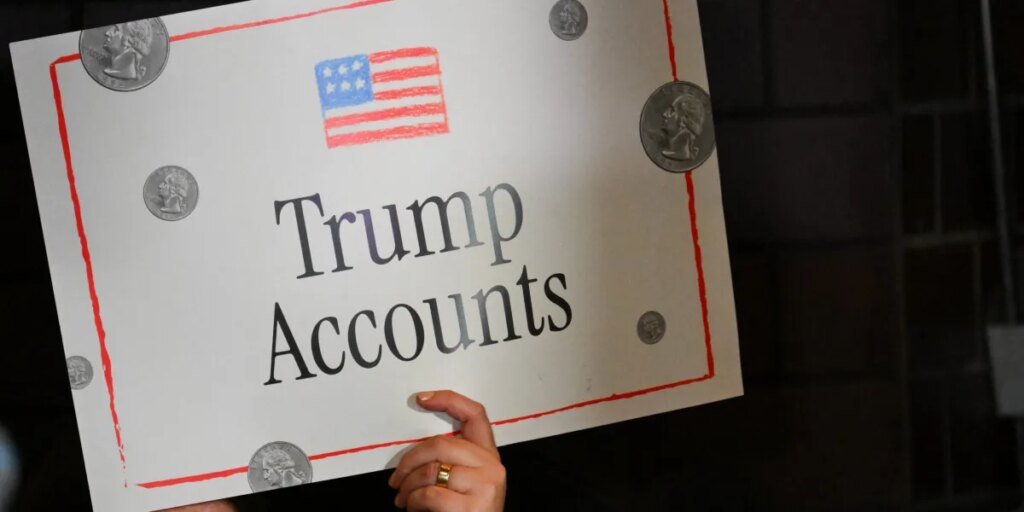
On Oct. 1 the Treasury said it had finished automatically creating investment accounts for more than 60 million children; with those opened earlier, the total is about 70 million. Babies born from 2025 through 2028 qualify for a $1,000 federal deposit. Michael and Susan Dell say they have now put $250 into the accounts of almost 25 million children. Unlike the federal seed, which arrives only after a parent claims the account, the Dell money was deposited without any claim. The money sits in low-cost U.S. stock index funds. BNY runs the initial accounts as the Treasury’s financial agent, with Robinhood as broker and initial trustee.
A week later, according to Bloomberg Law, Helen Morrison, Treasury benefits tax counsel, speaking in her personal capacity at an American Bar Association tax meeting, said roughly 164,000 of the 60 million new accounts had been claimed. That’s less than 1%. It’s early. The program will succeed or fail at the claim, not the deposit.
Two failures are already built into the design. The first is an account a parent never claims. Under the Treasury’s rules, a parent has to claim the account in an app, verifying identity and relationship, before the $1,000 federal seed arrives or relatives and employers can contribute. Without that claim, the federal money never arrives. An unclaimed account that received Dell’s $250 holds that deposit; one that got neither the federal seed nor Dell money is an empty shell opened automatically. The second is an account that was funded but lost at 18, when a young adult has to find it and prove it’s theirs. Both depend on paperwork families often lose.
Britain’s Child Trust Fund shows how the second failure plays out. Children born between 2002 and early 2011 got a fund seeded with at least £250; the state opened one when parents didn’t. In September, HM Revenue & Customs said that of roughly 3.8 million accounts matured since 2020, around 827,000, more than one in five, were still unclaimed, averaging £2,310 each. That’s roughly £1.9 billion still waiting to be handed back. Britain has set up a government-and-industry taskforce to find the owners. In the U.S., the National Association of Unclaimed Property Administrators estimates that about one in seven Americans has property sitting unclaimed with a state.
The firms holding these accounts should care for two reasons. One is compounding. A $1,000 seed earning 7% a year would be worth about $3,400 at 18 if left invested. What happens to a Trump Account that loses touch with its owner is still an open question. These are federally created IRAs for minors, and state unclaimed-property clocks typically don’t start until an account is payable or distributable, often not before adulthood, so the money probably stays invested. Growth is worthless, though, to an owner who never receives it. If America does no better than Britain, where more than a fifth of matured accounts sit unclaimed, millions of young adults will start out without the stake they were given.
The other is commercial. A custodian holding millions of tiny, unclaimed accounts carries the servicing cost and regulatory risk without the client relationship. A reachable owner is a future customer. A lost one is a liability.
The money abroad was stranded by a design that left tracking to the people least able to do it. Families move and lose letters; phone numbers change. Every institution knew whose money it was on day one, and over the years that link broke.
On a software go-live across seven entities across three continents, my team agreed with each stakeholder on who owned which activity, and major issues still arose months later. A sign-off before launch did not give us an owner for each balance; only a monthly check did. For a program that runs across the Treasury, the IRS and the custodian, bodies that do not always talk to each other, that monthly check matters even more.
The same discipline applies here. Each account should stay tied to the Social Security number, and whoever holds the account should check contact details against official records every year, as brokers already screen customers for identity and sanctions.
The rule I would change is the one that makes core money wait on a form. Israel’s savings plan for every child, running since 2017, deposits a monthly sum for every child receiving child allowance and pays the management fees until age 21. For about a third of children born in 2023, the National Insurance Institute reported, parents never chose a fund, so the money was placed by default, and still arrived.
The handover at 18 deserves the care a brokerage gives a product launch, not a letter in the mail. Well before that birthday, the young owner should be able to see the account on a phone, with a plain statement of what it holds and what it has earned. Israel adds a grant of 582 shekels at 21 for savers who leave the money invested.
Done well, this could be a powerful investor-education tool. A statement showing $1,000 growing over 18 years teaches compounding better than any lecture. A forgotten account teaches nothing, and on a custodian’s books it is just another balance in suspense.
The opinions expressed in Fortune.com commentary pieces are solely the views of their authors and do not necessarily reflect the opinions and beliefs of Fortune.
The post 60 million children got Trump Accounts. Fewer than 1% were claimed in the first week appeared first on Fortune.