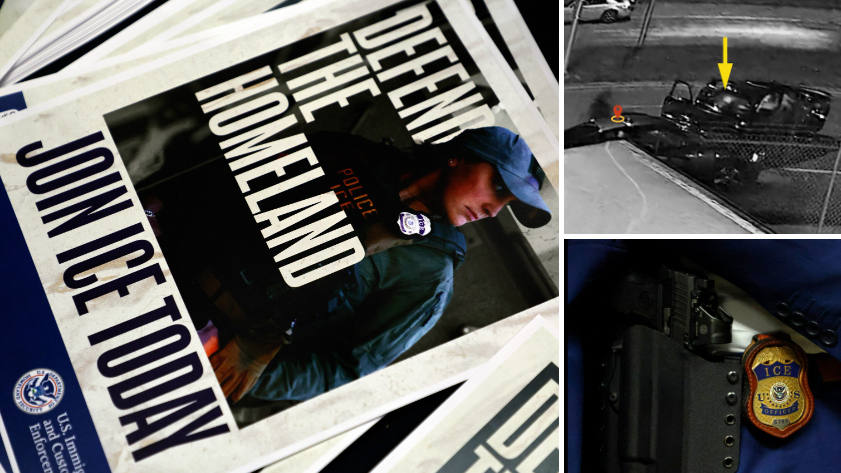
One officer in Detroit fired multiple shots at a fleeing teenage suspect, fatally striking him in the back in an incident that led to a $2.5 million settlement with his family.
An Arkansas officer was castigated by his supervisor for showing “unreasonable anger” while on the job, and fired after his boss expressed concern about what he might do “when he faces a civilian who he feels has disrespected him.”
Some officers went viral for embarrassing incidents, including a New York City detective who stole nearly $3,000 worth of high-end champagne at a music festival and a Mississippi officer who said under oath that he couldn’t remember core rights bestowed by the U.S. Constitution.
All of them share one thing in common: They were later hired as federal immigration officers to carry out President Donald Trump’s mass deportation campaign.
The Trump administration has onboarded thousands of new officers in an accelerated recruitment effort that has bypassed traditional background checks in favor of quickly putting people onto the streets to arrest undocumented immigrants. In recent months, at least two of those hires were involved in shootings, including one that resulted in the death of a 25-year-old Colombian father. Some have been fired after U.S. Immigration and Customs Enforcement discovered red flags in their backgrounds that initially went undetected.
The names of the officers hired to scour residential streets, courthouses and airports have been shielded by the Department of Homeland Security, which cites privacy policies designed to protect them from harassment, even in incidents where they are involved in fatal use of force.
But that cloak of anonymity was pierced in late October when activists hacked a DHS employee database and released information about thousands of workers, including about 1,500 ICE officers and agents hired since Trump took office in 2025. The Washington Post performed background checks on about 300 of the new hires using standard public record searches to uncover information. While most of the officers were chosen at random, others were selected for review after being flagged by artificial intelligence. The Post has verified the authenticity of the database with current and former DHS officials.
The review offers the most comprehensive look yet at whom DHS hired when it urged people to apply to “defend the homeland” and offered a signing bonus of up to $50,000 for top recruits.
The Post found at least 19 officers who had faced past allegations of misconduct or criminal charges, or had other employment red flags. At least five involved use-of-force incidents, and five officers were named in lawsuits that resulted in settlements. In at least six cases, the officers had been fired or decertified, or resigned under threat of dismissal. The leaked information represents a small fraction of the 12,000 officers DHS said it had hired as of January.
Three independent experts with knowledge of law enforcement hiring and standards reviewed anonymized summaries of the cases at the request of The Post. They agreed that most of the cases should have warranted additional scrutiny before ICE made the hires.
John Roth, a former DHS inspector general, was one of the three experts who reviewed the cases for The Post. He said several examples suggested that ICE didn’t vet candidates properly or loosened its hiring standards.
All federal government job candidates are supposed to undergo vetting and background checks, including a scrub of their employment and criminal histories. Not all incidents are disqualifying. But Roth said that ICE should pick the most qualified officers who pose the lowest risk.
“This is a pretty bad list of conduct,” Roth said. “Absent some other kinds of facts that would exculpate some of these people, they have no business having a gun and a badge in the federal workforce.”
The Post filtered the leaked personnel records to identify officers and agents shown as having “activated” after Jan. 20, 2025, the day Trump took office. While The Post wasn’t able to independently confirm that that date always correlated with an individual’s exact start date at the agency, in many cases, the officer or agent had left their previous employer prior to the date, sometimes just days or weeks before.
DHS declined to confirm the identities of officers named in the hack or comment on the past allegations of misconduct. The agency also would not verify how many remain employed by ICE. Two of the 19 officers told The Post that they no longer worked for the agency.
An ICE whistleblower urged officials last year to halt the massive expansion, saying in a memo to the Department of Homeland Security’s Office of Inspector General in August 2025 that the “overwhelmed” agency had hired officers without checking their fingerprints or their identities.
In a statement to The Post, DHS defended its hiring practices, saying ICE’s Office of Professional Responsibility “diligently applies the proper personnel vetting regulations.” The department added that officers are sometimes granted a “temporary status” while a full background check is pending. While the department said it was hiring “the best of the best,” it added that officers who don’t meet that standard could face employment repercussions.
A fatal shooting, a bloody pummeling
JeJuan Jetter was working undercover for the Detroit Police Department in August 2021 when the driver of a Dodge Charger lost control and struck his unmarked vehicle while allegedly drag racing.
Michael Contrell Adams III and several other passengers attempted to flee.
Jetter claimed that Adams raised a pistol and ignored commands to stop. He also said that he shot Adams multiple times before the 19-year-old turned and fled. A handgun was found near the front passenger side of the car, where Adams had been standing.
It is not possible to verify whether Adams resisted Jetter’s commands from the pixelated, black-and-white video of the incident, which has no sound. The security footage shows Jetter firing his first shot as Adams made a motion to flee. The next three shots were fired while Adams was running and at a distance from the car. The teen was pronounced dead at a hospital about 30 minutes later.
In a wrongful-death suit, Adams’s family denied that he was carrying a weapon. The Detroit Police Department settled with the family in 2024 for $2.5 million.
Jetter did not respond to requests for comment. The leaked database indicates he was hired as a deportation officer in Detroit last year.
The shooting wasn’t the only incident involving Jetter that occurred while he was with the Detroit Police Department. According to his disciplinary records, Jetter was suspended in 2018 for using “language of a profane nature” toward his child’s mother. He was suspended again the following year for using a Taser on a handcuffed detainee. In 2020, he was reprimanded for “purposefully turning off the in-car camera” while at a scene.
Jetter filed for bankruptcy in June 2025. Experts say a recent bankruptcy filing could be a red flag for law enforcement job candidates. While in some cases financial troubles are unavoidable, experts note that in others they can raise questions about judgment, and put someone at higher risk of being subject to blackmail or bribery.
David Robinson, an attorney who represented Adams’s family, said he wasn’t surprised to learn that Jetter was hired by ICE. During the course of his background investigation, Robinson said, he learned of what he believed were “personality issues” that made Jetter “the type of police officer that would have been characterized as over the top.”
“Officers like JeJuan Jetter act in brutal ways and largely without consequence,” Robinson said.
The Post found several other examples of ICE officers accused of excessive force in past jobs.
Jason Potter was working as an ICE deportation officer in Twin Falls, Idaho, in December 2025, according to the DHS data. Two years earlier, he was a police officer in Buhl, a nearby city home to 5,000 people.
In late December 2023, Potter helped force open the front door of a man’s home and drag him outside over a speeding violation, according to court records and officer body-camera footage of the incident. The Buhl Police Department chief used a Taser on the man as his wife screamed from inside the house. The couple’s young daughter was watching.
A federal magistrate judge ruled in September 2025 that the chief, Potter and another officer unlawfully entered the man’s house without a warrant. The family later settled with the city for $500,000.
Potter did not respond to requests for comment.
In another incident, in the town of Bel Air, Maryland, an officer investigating a report of a man arguing with neighbors was accused of tackling the man and smashing his forehead against a concrete sidewalk, leaving him bloody. A lawsuit was settled in January 2025 for an undisclosed sum. The officer, Logan Walsh, denied any wrongdoing. He and his lawyer did not respond to requests for comment.
Eight months later, Walsh was working for ICE, according to the DHS data.
Peter Mina, a former official in the DHS Office for Civil Rights and Civil Liberties, was among the experts who reviewed the cases for The Post. He said any lawsuit would at a minimum need to be disclosed to ICE and should trigger a review that looks for possible wrongdoing.
Red flags in plain sight
Several of the officers previously made headlines for committing crimes or for how they enforced the law. The incidents were easy to find through a Google search. The Post used public records and social media to determine that the ICE officers named in the leaked data were the same officers accused of misconduct.
In May 2023, Joseph Joffrion, then a sergeant with the police department in Waveland, Mississippi, approached a man holding a sign outside the town’s city hall that said, “God Bless the Homeless Vets.” Joffrion asked the man, Jeffrey Gray, for his ID and threatened to arrest him for allegedly committing vagrancy.
Gray, a civil rights protester who posts videos to YouTube of interactions with police, told Joffrion that he was engaged in constitutionally protected activity. Gray was not charged.
A year later, Gray sued the department, Joffrion and another officer, alleging they had infringed on his right to free speech.
During a deposition, Joffrion was repeatedly asked about his understanding of constitutional rights. His responses garnered millions of views on YouTube.
“What’s your understanding of the First Amendment in the United States Constitution?” Gray’s attorney, Michael Reed Martz, asked Joffrion.
“I don’t recall,” Joffrion said. “I’m not an expert.”
“Do you know what the First Amendment protects at all?”
“I don’t recall.”
He also said that he did not recall the basic meaning of the Fourth Amendment, which protects people against unreasonable searches and seizures.
Civil rights advocates have accused federal immigration officers of repeatedly infringing on the rights of protesters and immigrants who are being questioned about their status in the United States.
Joffrion resigned from the Waveland Police Department on Dec. 30, 2025, public records show. The DHS data indicates that he was working at ICE as a deportation officer the following Monday.
He did not respond to requests for comment.
Other new ICE hires had similarly drawn widespread attention on social media for misconduct in previous jobs.
Wojciech Czech was working as a New York Police Department detective assigned to narcotics enforcement at the Electric Zoo music festival in September 2022. The festival, held on Randall’s Island, drew tens of thousands of attendees.
Czech and two other officers were in the event’s VIP area around 7 p.m. when attendees ordered two bottles of Armand de Brignac, a high-end champagne commonly known as “Ace of Spades.”
When the attendees stepped away, one of the NYPD detectives took the unopened bottles, worth a combined $2,900, according to a related indictment by the New York district attorney announced in May 2023. Czech helped the other officer put them in a backpack.
A festival attendee saw them take the bottles and pursued them, the district attorney alleged. The officers attempted to go into a staff-only area but were confronted by a pair of attendees in front of an event security officer, who notified the NYPD.
Czech and the other officer were charged with grand larceny and criminal possession of stolen property. Czech pleaded guilty to petty larceny in August 2024 as part of an agreement that required him to resign from the NYPD, the district attorney’s office said.
As of January 2026, he was employed as an ICE deportation officer in Phoenix, the hacked records show. Czech did not respond to requests for comment.
Unfit for local police, hired by ICE
Records reviewed by The Post show that in several cases, other police departments had previously determined that an officer wasn’t fit to serve.
Dnae Reo Blow was hired by the police department in Springdale, Arkansas, a city north of Fayetteville, in 2013. He was assigned to a “special response team” in April 2016, but he was terminated in November of that year after a confrontation with his supervisor, according to personnel records.
Blow was told to relieve a colleague from duty at a nearby emergency room but did not go right away and instead began “cussing in an aggressive manner” at his supervisor, he acknowledged in a statement he submitted after the incident.
As the encounter escalated, another officer described Blow clenching his fists and saying he wanted to do “bad things,” which the supervising officer interpreted as a physical threat.
“His unreasonable anger and failure to compose himself at a supervisor concerns me as to what he will do when he faces a civilian who he feels has disrespected him,” the supervisor wrote.
Two months later, Blow was employed at the Lowell Police Department in Arkansas as a patrolman and sought promotion to sergeant.
Blow, who is Black, did not receive the promotion and later said, in a 2018 civil lawsuit against the city of Lowell, that it was because of his race. The city denied that claim and said Blow was fired for “several instances of insubordination.” The case was dismissed without a court ruling on the allegations.
Blow did not respond to a request for comment. The leaked records indicate that he had joined ICE by October 2025.
Another ICE officer named in the leaked data, Timothy Keske, resigned from the police department in Berwyn, Illinois, a Chicago suburb, in October 2023 following disciplinary measures over excessive force, inflating tuition reimbursement requests and falsifying a police report.
In a 2021 incident, Keske asked a man to step out of his car after smelling marijuana, which is legal to possess in Illinois. When the man didn’t comply within half a minute, Keske tried to pull him from the vehicle despite no clear reason for arrest, according to an investigative report into the incident.
Keske and another officer then struggled with the man for five minutes before backup arrived, the report said.
The report called the use of force “hasty” and said it put the officers in a dangerous situation: Keske and the other officer were injured and their weapons were exposed as they struggled inside the vehicle.
“The officers took an enormous unnecessary risk,” the report concluded. Keske was suspended for two days as a result of the incident, according to a grievance filed by a local police union on his behalf.
In another incident, in August 2023, Keske sideswiped an Amazon delivery truck that was parked on the side of the road for deliveries, according to the findings of an investigation by the Berwyn Police Department.
An initial police report from the scene said the Amazon driver had hit Keske’s vehicle, and the driver was issued a citation and liable for damages, the investigation found. But the next day, a police commander “obtained video showing that the Amazon truck had been parked the whole time and the driver not in the vehicle,” the investigation said.
The investigative report, issued by Deputy Chief of Police Michael Ochsner, said that Keske admitted during an interrogation to submitting false reports, omitting evidence and improperly investigating his own case, among other violations of department policy.
“Based on these findings and previous history of discipline, he should be terminated from employment as a police officer,” Ochsner wrote in the December 2023 report.
The recommendation had no immediate effect, since Keske had resigned from the department two months earlier.
The hacked DHS records show that Keske was working as an ICE deportation officer in Chicago by December 2025. He did not respond to requests for comment.
The cases unearthed by The Post stemmed from a review of a small portion of ICE’s new hires. Mina, who also worked as the chief of ICE’s labor and employment division prior to his job at DHS, said expedited hiring could bring on candidates who may not be suitable for the job, posing a risk to the public, ICE’s credibility and the officers themselves.
“When you have a hiring process like this — where it’s quick and you’re missing stuff, as we’ve seen — inevitably that results in hiring people that probably shouldn’t have been,” he said.
Andrew Ba Tran contributed to this report.
The post ‘No business having a gun’: Some ICE recruits had a record of red flags appeared first on Washington Post.