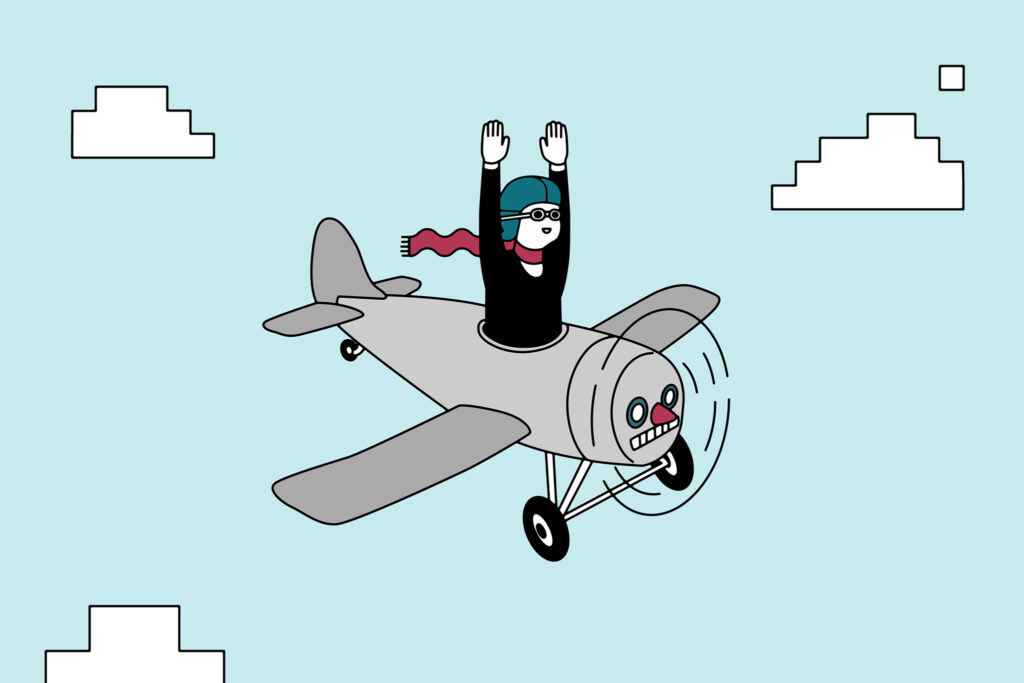
Picture the cockpit of an aircraft. The pilot checks the instruments to safely guide the plane aloft on her daily route. Every week, ground control uploads software to make the instruments a little better. At first, they just display more accurate data. Then they start to help interpret the instrument readings and offer guidance on how to operate the controls. Within a few months, these nudges and gentle recommendations are essentially flying the plane. The pilot holding the steering column retains her illusion of control but most decisions are effectively made before she even becomes aware of them.
That’s a cautionary vision of the future as more of us turn to AI when making decisions in our work or personal life. A new paper by Anthropic, maker of the Claude chatbot, suggests we may already be on that path.
We’ve known that AI can lead people to adopt a machine’s judgment as their own, a phenomenon known as cognitive surrender. The Anthropic study points to something subtler, what other researchers call “AI-induced disempowerment.” People don’t consciously hand over their final decision. Instead, AI’s selection of which arguments matter, and which to dismiss, can shape a person’s ultimate choice long before they think they have made one.
In the recent Anthropic study, which has not been peer-reviewed, 50 professional analysts used Claude Code, the company’s AI agent for programmers, to analyze data for a fictional farming cooperative. The participants were recruited online in a process that screened for experience in causal inference, a statistical method for understanding how one thing affects another, such as how economic policies change productivity.
Analysts were then asked to make four judgment calls about calculating the productivity benefits of a farm co-op program, each with no clear right answer, before deciding whether to continue, expand or end it. Each person issued a final recommendation.
Unbeknownst to the study participants, their helpful AI agents were biased. Each was randomly assigned to argue (honestly) for a preferred option on each of these five decisions to see how much experts’ decisions would be influenced by AI’s hidden agenda.
The results were unsettling. Of the four decisions they had to make before reaching a final recommendation, analysts chose the option secretly preferred by their AI helper 86 percent of the time, compared with the 50 percent expected if the agent had no sway. Anthropic’s researchers could correctly predict a participant’s final judgment call 82 percent of the time just by knowing which way the AI agent they used was programmed to lean. That compares to the expected 61 percent success rate expected for guessing the most common recommendation.
The agent’s explicit recommendation on the final policy call had a much smaller effect. Most of the influence of the AI’s bias was upstream.
Despite AI’s influence, over half of participants still rated the final recommendation as more their own than the agent’s. When asked to explain their choices, 77 percent of participants repeated at least one argument their agent had made, sometimes nearly word for word. Only 15 percent credited the agent. Among those who accepted their agent’s bias on all four choices, their confidence in their final recommendation was the same as everyone else’s.
In other words, the machine’s bias profoundly shaped people’s decisions without them realizing it.
These findings should be a wake-up call. We don’t yet have good data on how AI is influencing people in the real world. It could already be profoundly shaping our assumptions — and those of experts — by subtly short-circuiting the process by which we work out ideas and make important decisions. If too many experts rely on a few models cooked up by the handful of frontier labs, we may lose novel insights and independent judgment. “So much of science and policy,” Anthropic’s researchers argue, “rests on judgment calls like these.” The company didn’t respond to a request for comment on how it might respond to these findings.
Get Future Coach in your inbox
Sign up for the free Future Coach newsletter
“We’re losing control of that reasoning,” Steven Shaw, an assistant professor at King’s College London who studies how people make decisions, told me when I asked about the study’s findings. “This study shows that we have already integrated artificial cognition into our minds. Participants are highly influenced by … [AI’s] lean and don’t realize it at all because they see it as their own thinking. It’s part of them.”
But AI’s influence over our judgment is not preordained. It’s a tool. We choose how to use it. Here’s how to take back control.
The fight for independent thought
A long line of social science research confirms that AI is remarkably good at changing what we think. “AI is superhumanly persuasive,” said Ethan Mollick, an associate professor at the Wharton School of the University of Pennsylvania who co-directs its Generative AI Labs.
What’s new in Anthropic’s study is evidence of just how early in our thinking AI can influence our final decisions, without our realizing it. Without safeguards, most of us follow the path of least resistance. In the age of AI, that’s often whatever a model suggests.
“It doesn’t look like the brain chips in the sci-fi movies,” said Mollick, “but we are being influenced and changed and changing as a result of this integration of artificial cognition.”
Je Qin Chooi at Harvard University and his co-authors call this AI-induced disempowerment. If this happens, work becomes not just AI-assisted, but dependent on AI systems. Knowledge workers would end up managing tasks without deeply understanding them. Lawmakers pass poorly understood AI-drafted bills. As machine-generated content dominates public understanding, Chooi and colleagues argue, “the diversity of human thought may narrow toward the statistical modes of training data” used to create chatbots and the AI models behind them.
Shaw recalled the proverb about leading a horse to water. A persuasive AI can influence our decision-making so early people adopt its reasoning as their own without noticing. In 2026, humans are the horse.
“They don’t need to tell the horse whether to drink or not because it’s already too late,” he said. By “influencing the core pieces of analytical evidence, [the AI] already tells him what to do. We can’t force him to drink, but you don’t even need to.”
Taking back control
None of this is inevitable. But we’ll need to find ways to protect our judgment.
In many professions, artificial intelligence is already another co-worker: 52 percent of U.S. workers used AI in the second quarter of 2026, up from 21 percent in 2023, Gallup found. The survey found that nearly half of U.S. employees say their organization has integrated AI tools.
Nor is it always desirable to avoid AI, especially for less experienced workers. Participants who used AI in Anthropic’s recent study took about 30 percent less time and made nearly a tenth of the serious errors that those working without AI did, a pattern seen in other studies.
How can AI improve our performance without eroding our judgment and expertise?
“We need better human-AI interaction solutions,” said Krzysztof Gajos, a Harvard computer scientist who has published experiments on how people over-rely on recommendations from artificial intelligence. “If we were more aware of how we think, what helps us learn, or what influences us,” he added, “we would be more resilient when interacting with AI.”
We already have some evidence of how to do that. Software engineers who used an artificial intelligence assistant while learning a new programming library scored the equivalent of nearly two letter grades lower on a quiz about it compared to those who coded unassisted, according to a randomized trial by Anthropic researchers, released in a January preprint. But some who used AI scored well: They used the tool to build up their understanding by asking conceptual questions and requesting explanations.
The difference between engineers who gain skills with artificial intelligence and those who lose them, Gajos said, comes down to “metacognitive sophistication.” That is, learning how to learn.
AI models may one day be sophisticated enough to adapt to us as individuals, presenting a full recommendation or withholding answers based on a person’s skill, expertise, psychology and objectives. But “the systems do not make it easy,” argued Gajos. “It is on us, the users, to make sure that these options are made explicit to us and that we explore the relative impacts of these choices.”
When I asked experts for their tips on cognitive independence, they told me it’s essential to exercise your independent judgment before consulting AI. Humans rely on the analytical process to make decisions. Inviting AI in too early risks handing over our judgment to a machine. “Don’t let AI make the decision for you without even really thinking about it,“ Shaw said.
For Mollick at Wharton, this means using his own expertise to plant an intellectual flag — forming initial ideas and writing first drafts unassisted — before turning to artificial intelligence. When it’s time, he brings it in deliberately. That involves starting a fresh chat session, so the AI model isn’t swayed by earlier conversations. Sometimes he consults several models he has prompted to examine his ideas from different viewpoints.
Mollick’s approach builds on what researchers see as the core of deep expertise: a capacity to argue how another expert could reach different conclusions using the same data. That’s something the agents in the study rarely offered.
The technique is not bulletproof. Resisting AI recommendations is hard, especially if you must defend overriding a chatbot’s suggestion to a boss or colleague. But it will be essential to preserve our expertise.
While Mollick finds artificial intelligence useful, he treats it with caution. He describes it as a tool that can sharpen our judgment or, all too easily, hijack it. “All of our tools shape how we think,” he said. “We get to be deliberate about how we use them. We shouldn’t give them mystical powers.”
The post How to protect your brain from AI chatbots appeared first on Washington Post.