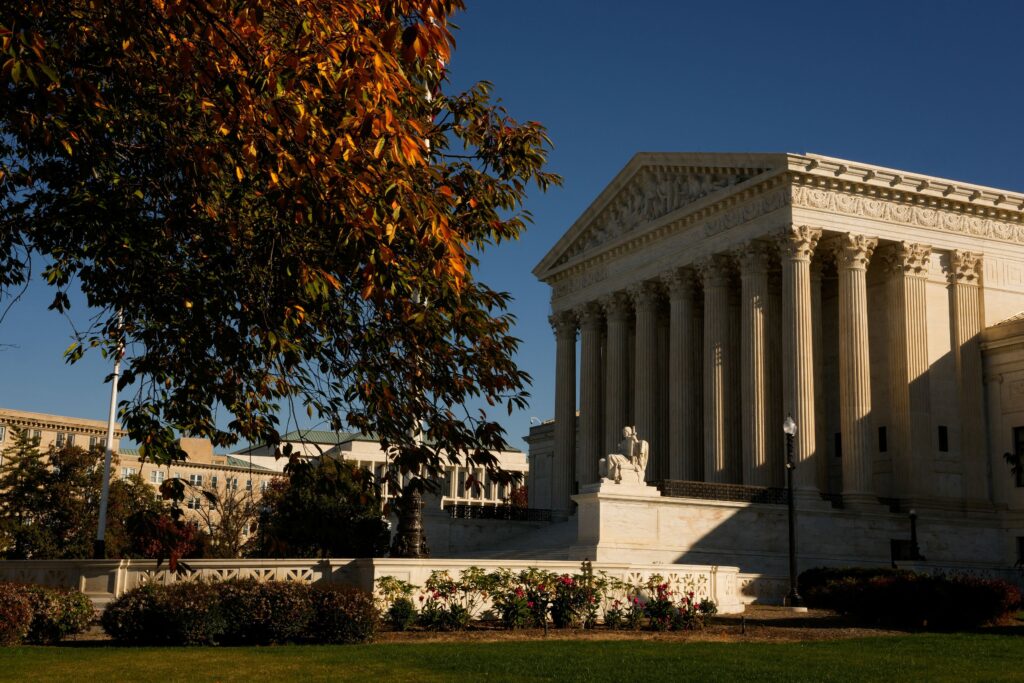
The Supreme Court appeared likely Monday to curtail lawsuits by federal inmates who claim they have received inadequate medical care from prison officials, which would further erode a legal precedent that has allowed people to hold federal law enforcement accountable for alleged constitutional violations for decades.
The justices seem inclined to nix a lawsuit brought by Kekai Watanabe, a former inmate who alleged that a prison nurse failed to give him proper treatment after his tailbone was broken in a gang-related assault during a riot at the federal detention center in Honolulu.
But the justices did not seem ready to make a more sweeping ruling overturning a 1971 precedent that established individuals harmed by federal officers in violation of their constitutional rights can sue for monetary damages.
Attorneys for the prison nurse in Watanabe’s lawsuit have advocated that position and sought to overturn the ruling in Bivens v. Six Unknown Named Agents of the Federal Bureau of Narcotics, the 1971 case.
That possibility has worried inmate and immigration advocates, who say the end of the Bivens precedent could make prison guards and other federal officials, including Immigration and Customs Enforcement agents, less accountable for violating the law. Watanabe’s case is playing out as claims against immigration officers have surged amid the Trump administration’s broader mass deportation campaign.
The high court has steadily limited the precedent established in Bivens in rulings in recent years.
The Trump administration wants the high court to do away with a later precedent that expanded on Bivens in allowing prisoners to sue for deliberate indifference to their medical needs under the Eighth Amendment, which bars cruel and unusual punishment. The administration is not advocating for overturning Bivens altogether.
Chief Justice John G. Roberts Jr., who is often in the majority, and some of the other justices seemed to endorse the administration’s position.
“It could be viewed as a cautious, incremental approach to such a fundamental question,” Roberts said during oral arguments Monday in Watanabe’s case.
Some of the conservative justices also pointed out inmates can seek remedies for poor medical care under other existing laws. One is the Federal Tort Claims Act that allows people to sue the federal government but not individual employees.
Lucas M. Walker, an attorney for the prison nurse Francis Nielsen, said the high court violated the separation of powers in the Bivens precedent.
“The power to create damages remedies belongs to Congress, not federal courts,” Walker said.
Joshua M. Wesneski, an attorney for Watanabe, said allowing lawsuits like his client’s are important because of the vulnerability of prisoners.
“Its principal virtue, is the deterrent effect on the individual officer,” Wesneski said.
The case began in July 2021 when Watanabe was “brutally assaulted” in a gang-related fight by a group of inmates who were wielding a lock in a sock, according to his court filing.
Watanabe suffered serious injuries and complained of a headache and severe pain to officers after he was placed in solitary confinement. Several days later Watanabe was seen by Nielsen, a nurse at the facility. Watanabe told the nurse he had severe back pain and asked to go to the hospital.
Nielsen told him to “stop being a cry baby” and that he was not going to the hospital, according to filings. Watanabe repeatedly requested medical care in the months that followed, but was only given over-the-counter pain relievers and anti-inflammatory injection.
Seven months after the attack, Watanabe was finally given an X-ray, which showed he had a fractured tailbone. Fragments of the bone had scattered into the surrounding soft tissue.
Watanabe was released from the detention center in 2024 and sued Nielsen for violating his Eighth Amendment rights to adequate medical care. He sought $3 million in damages. Watanabe remains in pain today, according to filings.
A federal district court dismissed Watanabe’s lawsuit before the U.S. Court of Appeals for the Ninth Circuit revived the case. Nielsen then appealed to the Supreme Court, setting up Monday’s arguments. The Supreme Court will likely issue a ruling in the case by June or July.
The post Supreme Court seems likely to limit prisoners’ ability to sue over claims of poor medical care appeared first on Washington Post.