Andrew Miller is a senior fellow of the Institute for Progress and author of the newsletter Changing Lanes.
The Teamsters union has half a point: Robots are indeed coming for trucking jobs. What it misses is that they’re jobs that truckers hate.
In August, three months after California began permitting heavy driverless trucks, the Teamsters sued, arguing that the state’s review process was flawed in part because it assumed the new rules would cost no trucking jobs. Leave aside whether the legal claim is valid. On the economics, the union is asking the right question: Roughly 2.2 million people drive heavy trucks for a living in America. Will self-driving trucks put them out of work?
The ride-hailing sector certainly offers some troubling signs. In Chicago, the busiest 45 percent of active drivers give 85 percent of the rides; in Toronto, the busiest drivers mostly give short trips inside city limits, according to my calculations based on both cities’ data. These are the rides that robotaxis in other cities such as San Francisco have begun to take. Inside its service areas in San Francisco, Los Angeles and Phoenix, Waymo already captures about 15 percent of what riders spend on ride-hailing services. The ride-hailing drivers who depend most on the work are the ones poised to lose it.
But the exact opposite is true of trucking. Driverless trucks are set to take over work that professional drivers avoid — and they’ll reach the desirable jobs last.
That’s because there are really two trucking industries. One industry consists of private fleets for big firms like Walmart, as well as smaller carriers delivering to businesses on regular routes. These jobs pay well, and drivers usually get to sleep in their own beds. Unsurprisingly, these are desirable jobs, with relatively low driver turnover.
The other consists of irregular, unpredictable long-haul trips. Here, turnover is rampant, averaging 93 percent a year among large truckload carriers for more than a quarter-century. These truckers can spend weeks away from home. They are mostly paid by the mile, meaning the hours they spend inspecting vehicles or doing paperwork go uncompensated. Drayage trucking around ports and railheads can be even worse. Drivers who shuttle containers around are typically paid by the load, not for the hours they idle at terminal gates, forcing them to hustle through multiple runs a day to make a living.
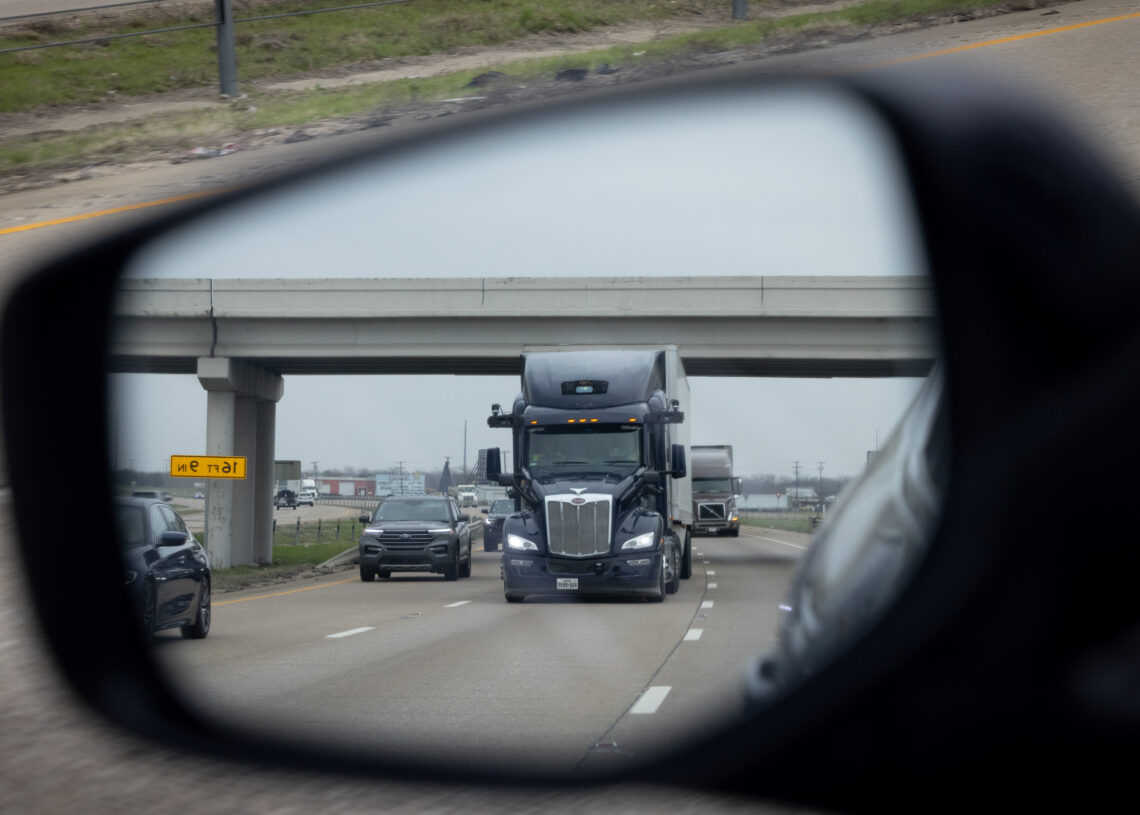
This work is so unpleasant that most drivers who find an alternative leave, causing a shortage. But robots excel at it, which is why these are the jobs that automation is poised to take over. Industry leaders, firms like Aurora and Kodiak, specialize in long-haul driverless runs. Today, much of this happens in Texas, where Aurora runs routes, including Dallas to Houston. Meanwhile, Humble Robotics, a California start-up, is building electric haulers without a cab to shuttle containers in and out of ports. In October, I interviewed Humble’s founder, Eyal Cohen, and he described the company’s mission plainly: “Find the most boring, repetitive route that nobody wants to do, and go do that.”
Another reality that ought to provide comfort to the Teamsters: Robots won’t even take these bad jobs quickly. There are millions of conventional heavy trucks on the road, some costing more than $150,000. At that cost, they won’t be retired until they can’t run anymore. Meanwhile, Aurora expects to end the year with just 200 driverless trucks in its fleet. Turning over America’s stock of big rigs will take decades.
That long lead time operates in truckers’ favor. Suppose driverless trucks eliminate as many as 50,000 driving jobs each year, more than 100 times the current number of driverless trucks in service today. In that case, about 75 percent of the 200,000 heavy-truck drivers who leave the occupation each yearwould still be replaced by humans. Self-driving trucks would slowly replace truckers who were leaving anyway. No one with a job would lose one.
So the task for lawmakers is a narrow one: Make sure driverless trucks are safe. So far, the evidence suggests that they are. Federal researchers who have studied serious truck crashes found that 13 percent of the drivers at fault were fatigued at the time of an incident, the predictable result of being paid by the mile and spending weeks on the road. This won’t happen with robot trucks. To date, despite its trucks logging hundreds of thousands of driverless miles, Aurora reports no collisions in which its system was at fault. That’s encouraging, but it isn’t proof of safety.
For greater confidence, lawmakers should push for a clear federal regulatory framework, one that not only requires operators to publish their safety records but also replaces today’s patchwork of state rules with a single consistent standard. Regulators will also have to keep adapting rules written for human drivers, like the Federal Motor Carrier Safety Administration did in October. In the event of a breakdown, a human is required to set out warning triangles on the road. But FMCSA decided to let driverless trucks use cab-mounted beacons in such cases. Lawmakers should also block bills — like the ones California Gov. Gavin Newsom (D) has twice vetoed — that would require driverless trucks to have a human on board.
For decades, trucking’s problem has been too few people willing to stay in the tough jobs. Driverless trucks are built to do them, and they leave the good work for people. This is an American success story. Let’s not get in its way.
The post Truckers hate these jobs. Let driverless trucks take them. appeared first on Washington Post.