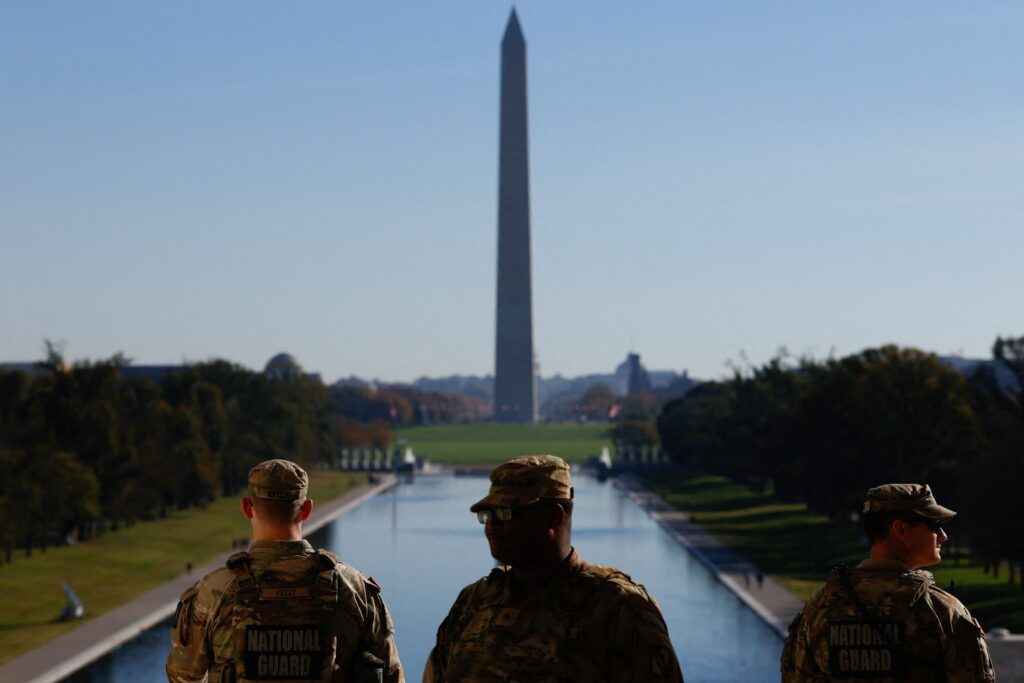
The Nov. 7 Metro article “Guard stuck in a sticky wicket” reported that Defense Secretary Pete Hegseth authorized fleet upgrades — including Humvees, tactical trucks, marked patrol cars, light towers and unarmed boats — for the National Guard troops patrolling D.C. through year’s end.
This describes a mission that is being reinforced rather than wound down. Though D.C. saw drops in property crimes after the National Guard was deployed, its presence has done little to reduce violent crimes. Nonetheless, roughly 3,100 National Guard members remain in D.C., down from a summer peak of about 5,000.
If measurable safety gains are the goal, clearer public metrics for these upgrades would help residents evaluate whether the added hardware is closing the remaining gaps.
Ronald Beaty, West Barnstable, Massachusetts
More equipment? Show us more results.
Defense Secretary Pete Hegseth continues to throw his weight around by beefing up the presence of the National Guard in D.C. There are armed troops using military cars and boats.
This type of equipment is used by U.S. troops on the battlefield. D.C. should not look like a war zone.
The plan is to continue having the National Guard in D.C. until 2029. Given the deployment’s cost of $1.4 billion for fiscal years 2027-2029, there should be greater scrutiny of its effectiveness. Certainly, questions will be asked by the new Congress in January, but shouldn’t this be addressed now?
Wendy Wands, Anacortes, Washington
In defense of a landmark study
I can empathize with Sarah McBride’s Nov. 3 online op-ed, “A landmark study was flawed. Now my mother is losing her memory.” Watching a loved one suffer through cognitive and memory decline is heartbreaking, and “what if” questions about a loved one can be haunting.
However, the rate of new dementia cases went down, not up, between 1988 and 2015. And look to hearing aid use and quitting smoking as some of the modifiable risk factors that decrease the risk of dementia.
I also think McBride’s criticisms of the Women’s Health Initiative are misplaced. The WHI set out to answer one of the most pressing questions about women’s health: Do women taking hormone therapy have better health outcomes compared with women taking a placebo? The answer was no. Yes, the average age of participants was 63, but WHI also remains the largest trial of women in their 50s ever conducted. The WHI memory study showed that combined hormone therapy increased the risk for dementia, and estrogen alone increased the risk of mild cognitive impairment in women aged 65 years or older. To date, no randomized controlled trial evidence supports the use of hormone therapy to prevent dementia, even in younger women.
Patricia Bencivenga, Washington
The writer is the special projects manager at Georgetown University Medical Center’s PharmedOut project.
How to fix the Reflecting Pool? Drain it.
Regarding the Nov. 6 Metro article “Wading in the deep: Reflecting Pool is already showing cracks”:
Why is the federal government wasting money fixing the Reflecting Pool? The pool has had issues long before the Trump administration took up repairs.
I think there are two options that would minimize maintenance costs. The first option is to install a semi-reflective hard surface with grid-based nonreflective pedestrian walkways. That would maintain the look of the Reflecting Pool as well as provide a new viewing area of that part of the National Mall. The second is to install raised-bed garden planters for growing native plants. Around the planters, there could also be pedestrian walkways.
Draining the water would save taxpayer money and supply a new way to enjoy the National Mall.
Cindy Luongo, Bethesda
Letter submissions
Send letters to [email protected].
Submissions must be exclusive to The Post and should include the writer’s address and day and evening telephone numbers. Letters are subject to editing and abridgment. Please do not send letters as attachments. Because of the volume of material we receive, we are unable to acknowledge submissions; writers whose letters are under consideration for publication will be contacted.
The post How will National Guard upgrades improve D.C.’s safety? appeared first on Washington Post.