Russia is already celebrating a strategic win — even before new talks on ending its war in Ukraine open Tuesday in Abu Dhabi — after Moscow succeeded in drawing the Trump administration into calling for a new framework for “a broader European security architecture” as part of any peace deal, Western and Russian officials and analysts said.
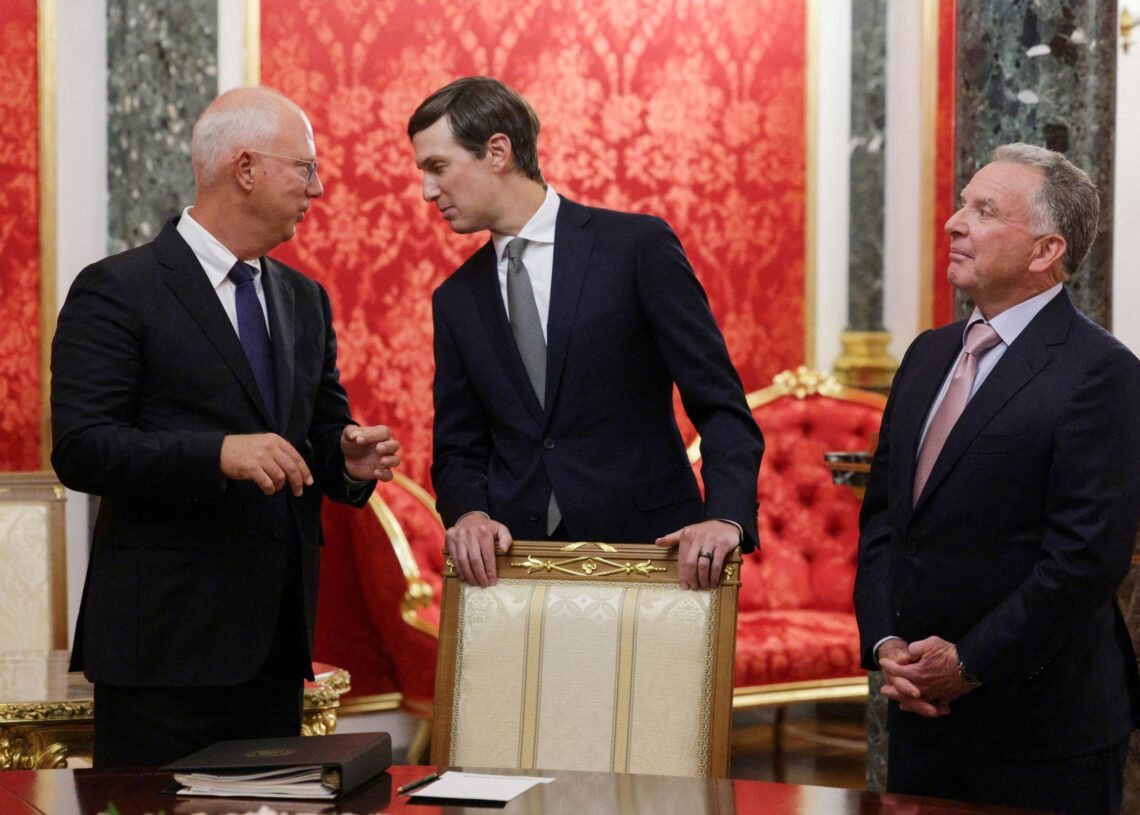
Tuesday’s talks offer President Donald Trump his first chance to reassert his position as a global power broker following bruising Republican losses in last week’s midterm elections. But his negotiators — led by special envoy Steve Witkoff and Jared Kushner, the president’s son-in-law — appear to have already bowed to Moscow by opening a broader discussion of European security.
Russian President Vladimir Putin has long sought to portray his full-scale invasion of Ukraine in 2022 as a necessary response to what he claimed were threats to Russian security by NATO’s eastward expansion, as well as the supposed persecution of ethnic Russians living in eastern Ukraine — contentions previously rejected as false by the United States and its allies.
Such a discussion could create the impression that the Trump administration endorses the Kremlin’s baseless claims, according to European officials, former U.S. officials and security experts, and risks conceding to Russia’s demands for a greater say in Europe’s security even as Moscow has blown up existing agreements by seeking to redraw borders by force. Witkoff and Kushner may be wading into a quagmire that they have little understanding of, these observers said.
European officials insist that Russia must halt its war against Ukraine before any discussion of the continent’s security is considered. “We already have European security architecture in place,” Europe’s top diplomat, Kaja Kallas, told reporters, pointing to NATO and the European Union. “The problem remains that Russia keeps breaking the treaties that underpin it.”
European officials — worried the U.S. will carry out such a discussion over their heads — are insisting that representatives of their countries take part in the talks in Abu Dhabi on Tuesday, according to French Foreign Minister Jean-Noël Barrot.
“For everybody across all administrations other than Trump, there is an appalling sense that Kushner and Witkoff don’t know what they’re looking at,” said Daniel Fried, a former assistant secretary of state for Europe during the George W. Bush administration. “It’s perfectly reasonable for the president to ask a friend to serve as a special envoy. … But you need to listen to the pros. And they are not doing so. Anyone could have told them that talking about postwar European security architecture is a Kremlin talking point.”
The decision to nevertheless put the discussion on the agenda marks another shift in Russia’s favor as the U.S. administration desperately seeks ways to end the war in Ukraine — something Trump, before returning to the White House in 2025, declared that he would do within 24 hours.
The administration has been struggling to bring the Kremlin back to the negotiating table, even as Moscow has refused to make any concessions and has intensified deadly strikes on Ukrainian cities, including a glide bomb attack on a humanitarian aid distribution point in the Zaporizhzhia region last week that killed at least 53 people.
Current and former U.S. security officials said they feared that Witkoff’s and Kushner’s lack of experience in high-level global security negotiations could be exploited by Russia, and that they had already been ceding too much ground by also appearing to offer the prospect of business deals before a ceasefire was agreed. This “lack of understanding … always happens if you put businessmen in charge of negotiations,” said one U.S. official, speaking on the condition of anonymity to discuss sensitive matters.
Further adding to the concerns that the U.S. administration could try to force through a deal favorable to Moscow, Trump said in an interview with CBS News’s “60 Minutes” that aired Sunday evening that he believed “we’re very close to making a deal” and that Ukraine probably would “end up with a little bit different shape” after the war.
In a social media post Thursday, Kushner said that the U.S. was seeking to establish “permanent security consultations, reliable crisis communications, greater military transparency, reciprocal measures to reduce escalation risks, and an enduring framework for long-term European security and stability,” and that any arrangement “must fully respect the sovereignty, territorial integrity, and independent decision-making of every nation.”
Former U.S. and European security officials said strategic agreements forged between Russia and the West following the Soviet Union’s collapse, including the NATO-Russia Founding Act of 1997, already established these provisions — until Moscow violated them when it invaded its neighbors, Georgia and Ukraine.
“It all sounds great. The problem is it’s exactly the security architecture Russia has been trying to destroy,” said Eric Ciaramella, a former acting senior director for Europe and Russia on the National Security Council. “These people have a lot left to learn. It just feels like they’re learning, that they’re in an undergraduate course on European security for the first time, and they just haven’t finished the course yet.”
Respecting territorial integrity and the freedom of countries to choose their alliances “is not anything close to what Russia wants,” he said. “I don’t think they are going to get very far.”
“The problem is not that there’s no security architecture. The problem is that the Russians blew it up and are trying to renegotiate it,” Fried added, noting that Russia had sought in security talks with the U.S. in 2021 to negotiate a retrenchment of NATO to pre-1997 borders. “We know what their position is, which is to reestablish the line of the Iron Curtain … as the limit of their sphere of dominance.”
An official familiar with the negotiations told The Washington Post that Kushner’s model is the NATO-Russia Council, which was established after the Cold War but suspended in 2014 after Russia invaded Ukraine and seized Crimea. But Fried said the provisions of the NATO-Russia Council were no longer viewed as adequate after Moscow invaded Ukraine and then began conducting hybrid operations against Europe.
“It’s a questionable start for negotiations. And underlying it is this ill-informed view that it’s just misunderstanding, and the Russians have legitimate security interests,” Fried said. “They do have legitimate security interests, but they have carried out their security interests in a way that suggests nobody else can be in the least bit secure.”
The U.S. administration’s shift to expand talks on securing peace in Ukraine to reexamining Europe’s security architecture is an outcome that Moscow has long been angling for, former U.S. officials and Russian analysts said. It also signals an increasing desperation on the Trump administration’s part to restart talks with Russia on Ukraine after months without any progress and after becoming bogged down in the war against Iran.
“Maybe Trump just wants a win,” Fried added.
Until this autumn the Trump administration had appeared to adhere firmly to a position that it would not be willing to go ahead with any business deals the Kremlin had been dangling as part of efforts to win U.S. favor, or discuss European security, until Russia had agreed to a ceasefire on Ukraine. But now “we are seeing at least erosion on these fronts,” said Nate Reynolds, a senior fellow at the Carnegie Endowment for International Peace and former Russia director at the National Security Council.
The Trump administration may be hoping that expanding the framework of talks could sway Moscow into making concessions on territorial demands — such as its long-standing insistence that Ukraine withdraw troops from the heavily fortified area in Donbas, eastern Ukraine — but it would probably be mistaken, Reynolds said.
“I suspect Moscow will see it differently. The Kremlin will see that the American resistance … is eroding,” he added. “It will think it can make side deals with Washington to create fissures with Ukraine and Europe. It can then try to exploit the cracks to get a better deal on Ukraine down the line.”
The post U.S. gives Russia an early win before Ukraine peace talks begin in Abu Dhabi appeared first on Washington Post.