Ask someone to name a few Russian novels, and they might rattle off the greatest hits: Anna Karenina, War and Peace, The Brothers Karamazov. Maybe they’ve read these classics and love them; maybe they just know they’re supposed to know them. Now ask the same person to name some Ukrainian novels: probably nothing. Even native Ukrainians might be more familiar with Russian books and writers than with their own literature; after the collapse of the Soviet Union, a pedestrian in Kyiv could still pass by Leo Tolstoy Square, or any number of gilded monuments to the poet Alexander Pushkin.
That changed in 2022, when Russia launched its full-scale invasion of Ukraine. Pushkin statues were razed; Tolstoy’s name was made verboten. A group of Ukrainian writers proposed a worldwide boycott of books by Russian authors. One proponent of the ban argued that “every prominent Russian name” was a way to exclude a Ukrainian. In May 2023, the free-speech nonprofit PEN America seemed to be swayed by this argument, abruptly canceling a festival panel of Russian dissident writers after protests from Ukrainian attendees. Books that merely had something to do with Russia became suspect too. Later that year, the American writer Elizabeth Gilbert announced that she’d asked her publisher to pull her forthcoming novel—a historical drama set in Siberia with no apparent relevance to the current conflict—after hearing from aggrieved readers in Ukraine.
Today, such dramatic displays of solidarity are no longer in vogue. As the war grinds on and international outrage recedes, debate over cultural boycotts seems to be focused elsewhere. In May, Cannes awarded one of its top prizes to a Russian director whose anti-war film has been criticized by Ukrainians for going too easy on President Vladimir Putin. Theaters across Europe are welcoming back Russian musicians—even some with Kremlin ties—who had their performances yanked in 2022. But for the French writer Emmanuel Carrère, Russia’s cultural dominance is still a vexed subject—and a profoundly personal one. “I know, in starting this book,” he writes in the opening pages of his new memoir, Kolkhoz, “that it will deal in no small part with Ukraine and the brutal war Russia is waging there, because for me Russia, for better or worse, is a family affair.” Kolkhoz renders the history of Carrère’s Russian-émigré family in fine detail, skittering backward and forward in time, and from one vantage point to another. Throughout, he picks his way toward his major question: Is it possible for him to oppose the war and still love Russia?
Carrère is best known in France for his lancing, digressive nonfiction, which often takes on controversial subjects: the 2015 Paris terrorist attacks, the lives of outlaws, his own experiences with bipolar disorder. He’s a memoirist, not a polemicist—“I prefer to rely on my experience,” he has said—but he has an abiding interest in how individuals come to believe grand narratives and insulate themselves from truth.
The 68-year-old’s “everything is copy” approach to writing has led to a few well-publicized imbroglios—as when he broke a legal agreement to write about his ex-wife in his 2020 book, Yoga, or when, in 2007’s My Life as a Russian Novel, he defied his mother, Hélène Carrère d’Encausse, a right-wing intellectual and historian of Russia, to reveal that her Georgian-born father had been a Nazi collaborator. Kolkhoz—published in France last year and newly translated into English by the discerning John Lambert—picks up on some of the threads of that family drama.
This time around, he’s focused more narrowly on Hélène and her maternal relatives, whose life stories, pieced together with the help of family records collected by his father, an avid Russophile, make up the heft of the book. (Its title refers to a type of Soviet collective farm, a word that Hélène used as a playful nickname for their family unit.) Hélène was descended from a family of aristocratic “White Russians” (named for their ties to the anti-Bolshevik White Army) who were living abroad in Italy before the Russian Revolution, cosseted among servants and gardens. Carrère’s portraits of these unrepentantly bourgeois people are lively and tinged with affection—they’re Tolstoyan, in that way—but as he recounts their ordeals, he’s struck by their apparent myopia. Insurgents had been agitating against them for decades, and yet they “hadn’t seen anything coming”; the revolution arrived as a sucker punch.
Once the Bolsheviks seized the family’s lands back in Russia, their fortunes evaporated. Hélène’s mother, Nathalie, ended up in Paris, along with a wave of other White Russian resettlers, defunct titles in tow. Someday, they assured one another, the Bolsheviks would be routed, and they’d be shuttled back into the highest echelons of Russian society, at the helm of a sprawling Slavic empire.
Hélène, born in Paris, grew up to be a scholar of Russia’s imperial past. But she also took an interest in its trajectory after the fall of the Iron Curtain. When it became clear, in the 1990s, that a squeaky-clean republic was unlikely to magically emerge, diplomacy between Europe and the Russian Federation flagged, and Hélène saw an opening for herself. She became France’s most prominent advocate for Russia, a “regular visitor to the Kremlin” who rubbed shoulders with President Boris Yeltsin, then Vladimir Putin (she loved the perpetually drunk Yeltsin and found Putin cold but respectable), and served on the “ethics committee” for Russia Today, the state-run news network.
From her perch on the French-talk-show circuit, Hélène routinely upbraided American and European leaders for humiliating Russia, which she claimed was well on its way to becoming a modern social democracy. Corruption, cronyism, a protester disappeared here or there: These were merely growing pains. Russia’s culture of hard-edged resilience would help it rightfully reassume its place among the great world powers. As for the “little people” who lived in the other post-Soviet states, including her father’s relatives in Georgia, they were “archaic, folkloric,” and largely deserving of their ancillary status.
Still, Carrère notes, she never expected Russia to invade Ukraine. Just a week before the attack, with Russian troops already congregating in the Donbas, Hélène assured a TV interviewer that the country was safely off-limits. Putin, she said, was “a rational man, aware of the risks, who would never take reckless action.” Then reality proved her wrong. “I’d never heard this woman, so optimistic by nature and principle, sounding so distraught,” Carrère writes. “She kept repeating: ‘I don’t understand. I just don’t get it.’”
Eventually, Hélène acknowledged the unfolding conflagration, but only to explain away her faulty reasoning—not to renounce her past statements. Putin’s motives were simply inscrutable, she insisted, even to an expert such as herself. The French media excoriated her, but she retorted that they were merely under the influence of le wokisme. Carrère returns continually to this episode throughout Kolkhoz, trying to make sense of Hélène’s intransigence. How could a woman who “prided herself on understanding the Russians” have missed the mark by so much? Why had she never interrogated her own beliefs?
Yet Carrère, too, had mostly shrugged off the possibility of an invasion. He’d inherited his mother’s love of Russia—or a skewed image of it. Growing up, Dostoyevsky’s propulsive stories about a murky, multifarious world astonished him, serving as a “rite of passage into adulthood.” From years of writing about Russia’s underworld, he’d amassed a collection of friends in Moscow: Putinists, mainly, and “adventurous foreigners” partial to the “libertarian” flavor of Russian gangsterism. Neither he nor his mother had ever made the time to visit Georgia—even though one of his Georgian cousins had been elected president, on a pro-Europe, anti-Russia platform, in 2018. “Russia remained my main focus,” he confesses, just as it had for Hélène.
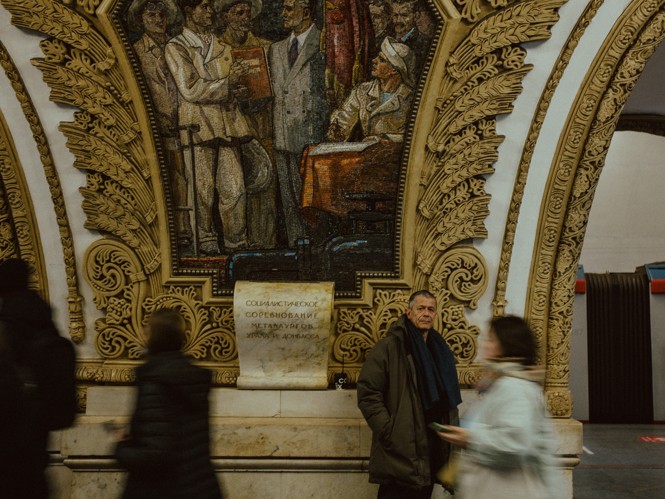
The invasion throws all of this into question, and forces Kolkhoz away from family history. Carrère introduces a series of vignettes from the early days of the war. First up is a trip to Russia, planned before the “special military operation” was announced. He arrives in Moscow, where he is supposed to shoot a cameo for a film adaptation of one of his books, on February 24, 2022, as tanks are rolling across the border. Almost immediately, the production is halted. Carrère is unsettled, but instead of returning home, he asks to stay and do some journalism; he wants to understand how Muscovites are reacting.
Over the next few days, he’s startled by what he hears from his friends, whom he’d considered reasonable people—“not very respectable,” sure, but not outright ideologues. The war could be “the end of the world,” they say, but it’s not the cost to human lives that frightens them: It’s the loss of their material comfort. For them, Carrère notes acerbically, news of sanctions rains down “like the missiles on Kyiv,” portending an end to foreign luxuries—“Disney, Netflix, Nike.” Russian TV, Carrère observes, broadcasts messages of hatred and hegemony on a loop.
With these experiences in mind, he is not exactly surprised when he learns about the Ukrainians who have begun advocating for a boycott of “everything Russian”—matching Russia’s programmatic efforts to overwrite their culture with hard lines of their own. By that point, he’s already begun an early version of Kolkhoz, and he visits Ukraine again in 2023 to gather material. On a trip to Kherson, he meets with the president of PEN Ukraine, Volodymyr Yermolenko—one of the people who objected to the Russian PEN America panel—who tells him, as Carrère summarizes, that “every Russian that’s honoured means a Ukrainian who’s forgotten.” Carrère is sympathetic, but he still tries to defend the literature that’s been central to his life. Dostoyevsky is worth preserving, he tells Yermolenko and his Ukrainian colleagues, because his novels allow “contradictory voices to unfold,” without privileging or co-signing any one of them. “Isn’t it the opposite of ideology?” he wonders. “Isn’t it the triumph of complexity?”
An academic in the group swiftly lights into him. “She’s had it,” Carrère writes, “with the eternal glorification of complexity as the alpha and omega of literature.” War, she argues, gives the lie to “complexity”; it cuts through gray areas and cleaves right from wrong. When his interlocutors ignore his trollish request to speak Russian, though it’s the one language in which they’re all fully fluent, he’s impressed—by the strength of their convictions, their willingness to engage in reasoned debate, and even their distaste for Dostoyevsky.
But has his relationship to Russia actually changed in any meaningful way? Although he’s intrigued by the Ukrainians’ commitment, it’s clear that he won’t be joining their boycott. Carrère soon returns to his comfortable life in France, chastened by the violence he’s seen, and less convinced that Russia’s defeat is inevitable. The last part of Kolkhoz is a painfully specific account of his mother’s death from cancer in 2023; apart from the offhand complaints about “sniveling” Ukrainians on TV that she offers from her sickbed, the war hardly plays a role. This is a tragic and affecting way to conclude the book, but an evasive one too; it reveals a limitation of Carrère’s fragmentary, distractible style. Historical pain, unbroken generational cycles, the endless struggles of nations: How much does all of this matter, Carrère seems to be saying, when one’s mother is dying? This line of thought might have been more convincing had he not spent the last 300-odd pages reflecting on those very matters—and describing a woman whose life was utterly bound up in them.
Carrère has one last swerve in store, however. He leaves us with a surprising postscript of sorts: an ode to his father, Louis, the Russophile who provided him with all of his material for the book, and who occupies a more shadowy place in it. Louis, a taciturn insurance executive, always played second fiddle to Hélène; he had no Russian roots, but he grew to love the country because he loved his wife. Later, when their marriage “deteriorated to the point of no return”—because this is France, they each had affairs but did not divorce—he retreated into his research and made his wife’s family history his “great passion.” Louis compiled exhaustive dossiers of documents, mapping out the cataclysms suffered by Hélène’s ancestors (including the neglected Georgian side of the family). In doing so, Carrère suggests, he confronted the darkness of Russian life—and the consequences of unfettered imperialism—in a way she never could.
If there’s a proper way to love Russia and still oppose the war, it might look something like this: a rigorous, sustained process of trying to understand. Such an approach would involve preserving history in its totality and rejecting any narrative that jettisons the unsavory bits. Kolkhoz is Carrère’s attempt to follow in his father’s footsteps, but he doesn’t quite have the attention span for it; for all of its maximalism, the project feels curiously truncated. Perhaps it’s up to readers, then, to pick up where he left off—to forge a pathway through the culture wars toward a fuller, clearer reading of history.
The post Can You Be an Ethical Russophile? appeared first on The Atlantic.