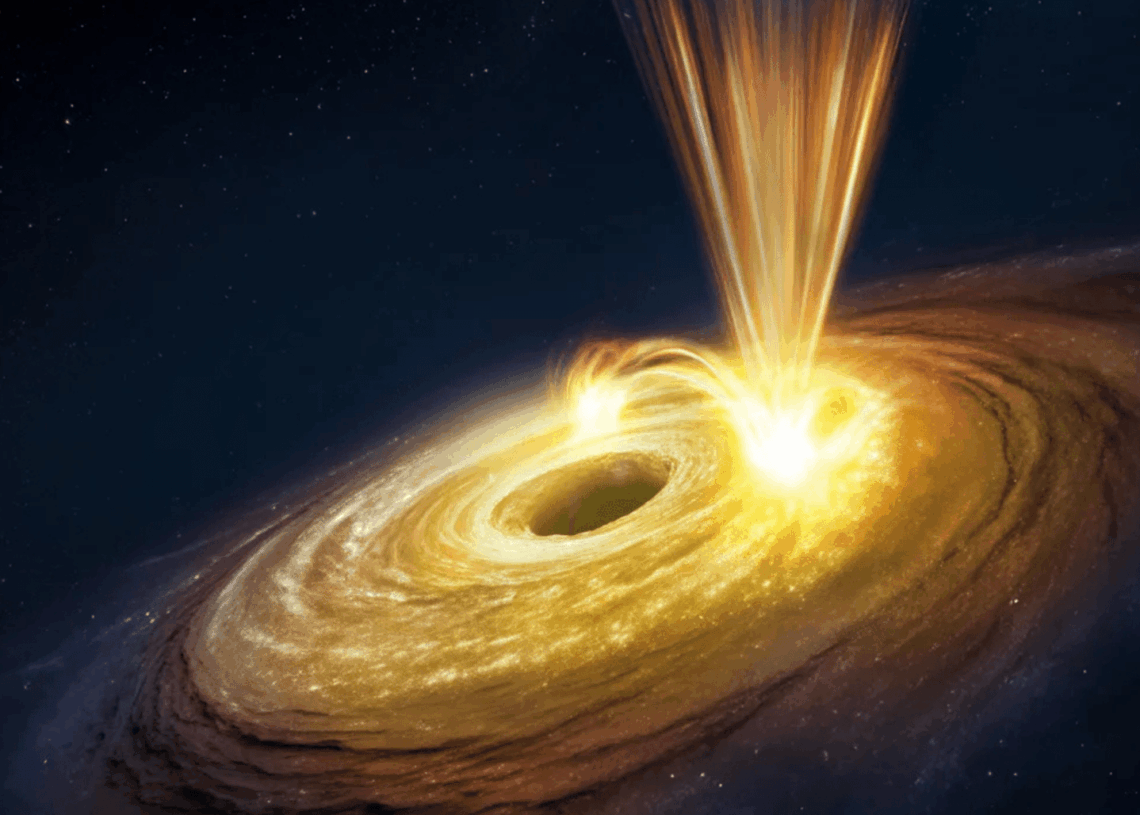
Astronomers just caught a black hole doing something so excessive it’s actually mind-boggling. Inside a spiral galaxy 135 million light-years away, a supermassive black hole lit up and hurled out winds traveling over 130 million miles per hour. Yeah, million. To put it into perspective, that’s about one-fifth of the speed of light.
The black hole sits in NGC 3783, a galaxy with what astronomers call an active galactic nucleus, which basically means the black hole is wide awake and feeding. Researchers noticed something unusual when the region lit up with an intense X-ray flare. When that flare calmed down, it left behind a torrent of charged particles racing outward at roughly 37,000 miles per second, according to findings reported by the European Space Agency.
“We’ve not watched a black hole create winds this speedily before,” said Liyi Gu, an astronomer at the Netherlands Institute for Space Research and lead author of the study, in an ESA statement.
This black hole weighs about 30 million times more than the sun, which helps explain why its outbursts feel freakishly insane. Scientists think the blast was driven by the black hole’s magnetic field, which can twist and tangle as matter spirals inward. When those magnetic lines suddenly snap and reorganize, they release huge amounts of energy, flinging radiation and matter into space.
The team compared the process to coronal mass ejections on our sun, when tangled magnetic fields hurl plasma outward. The analogy works until the scale kicks in. A strong solar ejection might travel at 1,500 kilometers per second. The winds from NGC 3783 move more than forty times faster.
“This is on a scale almost too big to imagine,” said Matteo Guainazzi, a European Space Agency astronomer and co-author of the study, in the same statement.
The discovery came from a coordinated effort between two space telescopes. ESA’s XMM-Newton spotted the initial flare, while the XRISM mission analyzed the winds that followed using its high-resolution Resolve instrument. Seeing both the outburst and its aftermath gave scientists a special look at how quickly a black hole can dump energy back into its galaxy.
The force involved is enough to interfere with star formation itself, heating surrounding matter and clearing out the gas galaxies rely on to keep growing over millions of years.
Black holes often get framed as silent, patient destroyers. This one was anything but; it announced itself loudly, violently, and at speeds that still feel hard to process, even by cosmic standards.
The post Supermassive Black Hole Found Churning With 130 Million MPH Winds appeared first on VICE.