
Skydance CEO David Ellison has amassed a dizzying collection of TV, film, news, sports and gaming assets following the closing of the Paramount-Warner Bros. Discovery merger, giving it increased scale to go toe-to-toe with Netflix, Disney and big tech players like Apple and Amazon. But that doesn’t mean the balance of power in Hollywood shifts overnight.
On Monday afternoon, Wall Street and Hollywood will get a first glimpse of the combined company’s financials and an update on its progress and priorities when it reports third-quarter earnings. Analysts are expecting $7 billion in revenue and a profit of 20 cents per share for the quarter, per Yahoo Finance. It will mark co-CEOs David Ellison and Ynon Kreiz’s first time talking to the wider investor community since the closing of the deal.
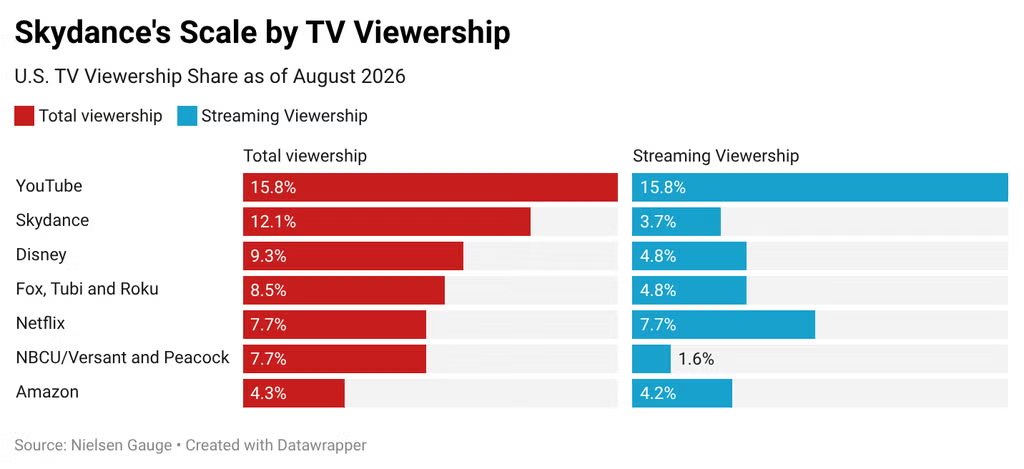
Skydance is now the second-largest U.S. media distributor by viewership, per Nielsen’s latest available data, trailing only behind YouTube. It owns a library of more than 15,000 films, has over 50 cable channels and three dozen premium sports rights and produces over 180 TV series. But while it’s a greater force to be reckoned with in competing for talent and content, experts told TheWrap that the combined company still has work to do before it can “punch up.”
Notably, it will still trail Netflix on the streaming subscriber front and YouTube, Netflix, Amazon, Disney and Fox’s Tubi and Roku on the streaming viewership front. While it will have increased leverage with advertisers, pay TV distributors and talent, its influence on the linear TV side may also be limited due to the structural decline of the business and a requirement to negotiate the distribution for Paramount and WBD’s cable networks separately under its settlement with 12 state AGs.
It will also be on the hook for at least 30 to 32 theatrical releases per year for the next five years, an output that many of Ellison’s critics are skeptical he’ll be able to maintain. By 2030, Skydance is looking to transition the majority of its revenue and profits from its linear TV business to its streaming and studios businesses.
The company will also have the difficult task of executing on a multi-year plan to bring all of these assets together under one roof, drive mid-single-digit revenue growth for the next three years, find at least $6 billion in cost savings as it looks to service nearly $80 billion in net debt, ramp up content spending to more than $30 billion annually and grow free cash flow to more than $10 billion.
“Skydance has a bigger seat at the table, but it’s going to be constrained by its large debt,” Court Stroud, founder of the media strategy consulting firm The Cledor Group and a New York University marketing and communications professor told TheWrap. “The balance sheet is where Skydance needs to do the most work to catch up.”
Ahead of its earnings, here’s a snapshot of how Skydance stands next to the rivals in its various businesses.
Streaming
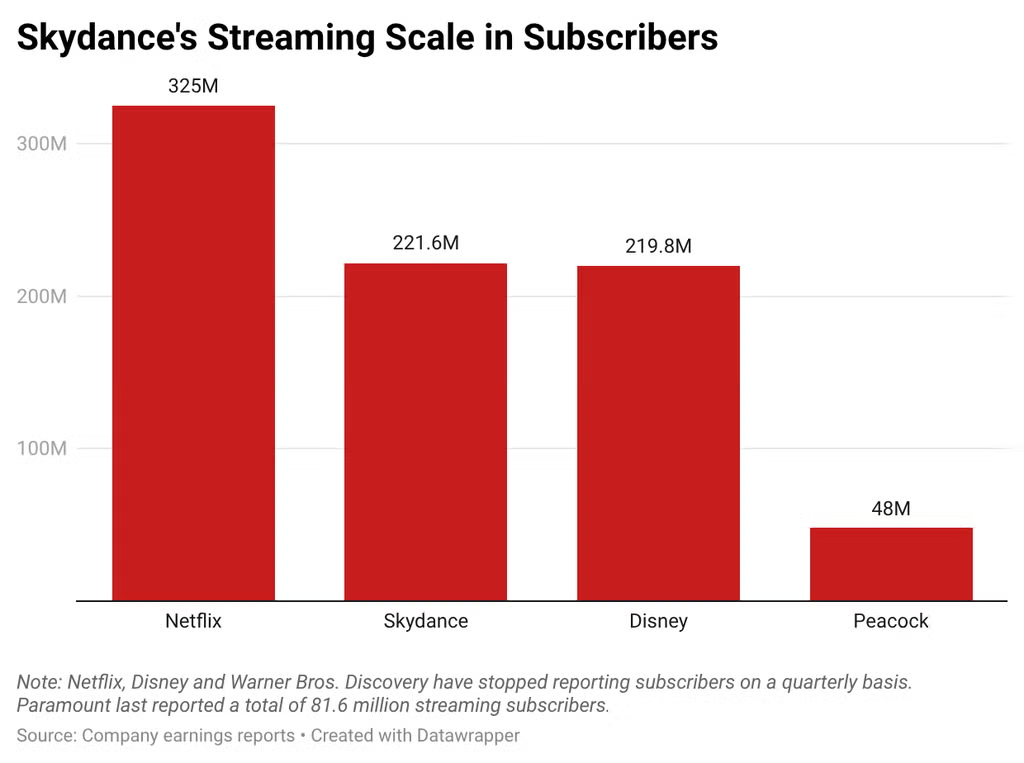
When looking at pure subscriber scale, Skydance will have a total of 221.6 million, based on the latest available disclosures from Paramount and Warner Bros. Discovery. While that’s well ahead of Peacock’s 48 million and slightly past Disney’s 219.8 million, it remains behind Netflix’s last disclosed base of 325 million.
But its subscriber footprint is only one metric of streaming success and doesn’t account for the competitive threat posed by YouTube. When looking at streaming viewership, Skydance only accounted for a 3.7% share in August, per Nielsen – making it the sixth-largest player when factoring Fox’s $22 billion acquisition of Roku.
“The challenge will be in maintaining or growing share versus well-capitalized rivals, especially with the debt load that Paramount is taking on to acquire WBD,” S&P Global streaming analyst Seth Shafer told TheWrap. “The time available to watch video content each day is finite and not growing, with free services, especially YouTube, capturing a growing share of that time for many consumers.”
“I still think you’re worried more about the TikToks and YouTubes of the world if you’re sitting there at Netflix,” Third Bridge senior analyst John Conca added. “I don’t see Paramount necessarily punching up and taking share from Netflix anytime soon.”
Shafer expects Skydance’s streaming business to become “solidly profitable” and the clear No. 3 behind Netflix and Disney by rolling all of the combined company’s services under Paramount+.
Ellison plans to eventually combine Paramount+ and HBO Max into a single platform, though a specific timeline for that remains unclear. In the meantime, the two services have a subscriber overlap of approximately 7.5 million subscribers, per Antenna, leaving substantial room for growth through bundling opportunities.
Linear TV
While Ellison will still be playing catch-up in streaming, Skydance will be the second-largest U.S. media distributor, trailing only behind YouTube, when factoring in its linear TV portfolio, which includes a suite of over 50 cable channels and broadcast network CBS.
The added scale is expected to give Skydance increased bargaining power in carriage negotiations with pay TV distributors, with an estimated 27% share of affiliate revenues controlled by Paramount and WBD, per S&P Global. However, the company’s state AG settlement could dampen the combined company’s influence in negotiations for the next five years.
Under the settlement terms, Skydance must negotiate distribution of WBD and Paramount’s portfolio of channels separately from one another unless they receive a written request otherwise. They’re also prohibited from using data from one to influence the other’s negotiations. Failure to comply with the requirement could result in a forced divestiture of BET, Comedy Central, VH1, Smithsonian channel, Destination America and Science Channel within a 120-day period.
“They can still deploy cost-cutting strategies, which should make margins look better for the cable network space. But the benefits are kind of muted. It’s not as important as it once was,” S&P’s cable analyst Scott Robson told TheWrap. “The strength that would be behind showing that type of data to pay TV operators is going to be irrelevant for the next few years.”
Content spending, sports and IP
Skydance also has big content spending plans, with Ellison promising an annual investment of more than $30 billion. To put that into perspective, Netflix and Disney are expected to spend $20 billion and $24 billion on content in 2026, respectively. But that will have to be balanced with at least $6 billion in cost savings over the next three years.
A major portion of Skydance’s content spend is its formidable portfolio of 36 premium sports rights. That includes the NFL, MLB, NHL, UFC, NCAA March Madness, the Olympics in Europe, Roland Garros, the UEFA Champions League, All Elite Wrestling, Zuffa Boxing, NASCAR, the PGA Tour, The Masters, the WNBA, the Big Ten and 12 Conferences, the Big East Conference, the SEC, the Mountain West Conference, the College Football Playoff, the National Women’s Soccer League and the United Soccer League, among others.
Experts previously told TheWrap there’s a “big bucket” of costs within Skydance’s content spending that it can look to cut to help service its $80 billion in debt. Those savings can range from using AI to lower production costs and being more efficient in where they choose to produce content to shelving projects or dropping sports rights that aren’t “must have.”
“We view the NFL, college football, MLB, UFC, March Madness, and UEFA as core properties,” JP Morgan analyst David Karnovsky said. “There is some potential to find cost savings across other properties, including PGA Tour, NHL, NASCAR and French Open, but these rights are less expensive and therefore less material to cost optimization.”
As for the entertainment side, its vast treasure trove of film and TV IP includes “Game of Thrones,” the DC Universe, “Harry Potter”, “Star Trek,” “Mission: Impossible,” “Top Gun,” “Transformers,” the Ocean’s franchise, “The Lord of the Rings,” “Dune,” “Minecraft,” Sonic the Hedgehog, Teenage Mutant Ninja Turtles, Monsterverse, Paranormal Activity, The Conjuring, It, A Quiet Place, Final Destination, The Matrix, Friends, The Big Bang Theory, The Daily Show, Yellowstone, South Park, SpongeBob SquarePants and Paw Patrol, among others.
“Skydance retains a sizable entertainment presence across its linear channels and has greater ambitions for streaming growth,” Karnovsky added. “Both require a consistent pipeline of original and licensed content to support engagement, subscriber retention and advertising demand.”
Theatrical
In addition to streaming, another key area where Skydance will be a greater threat is in theatrical, where it controls two of the major Hollywood movie studios.
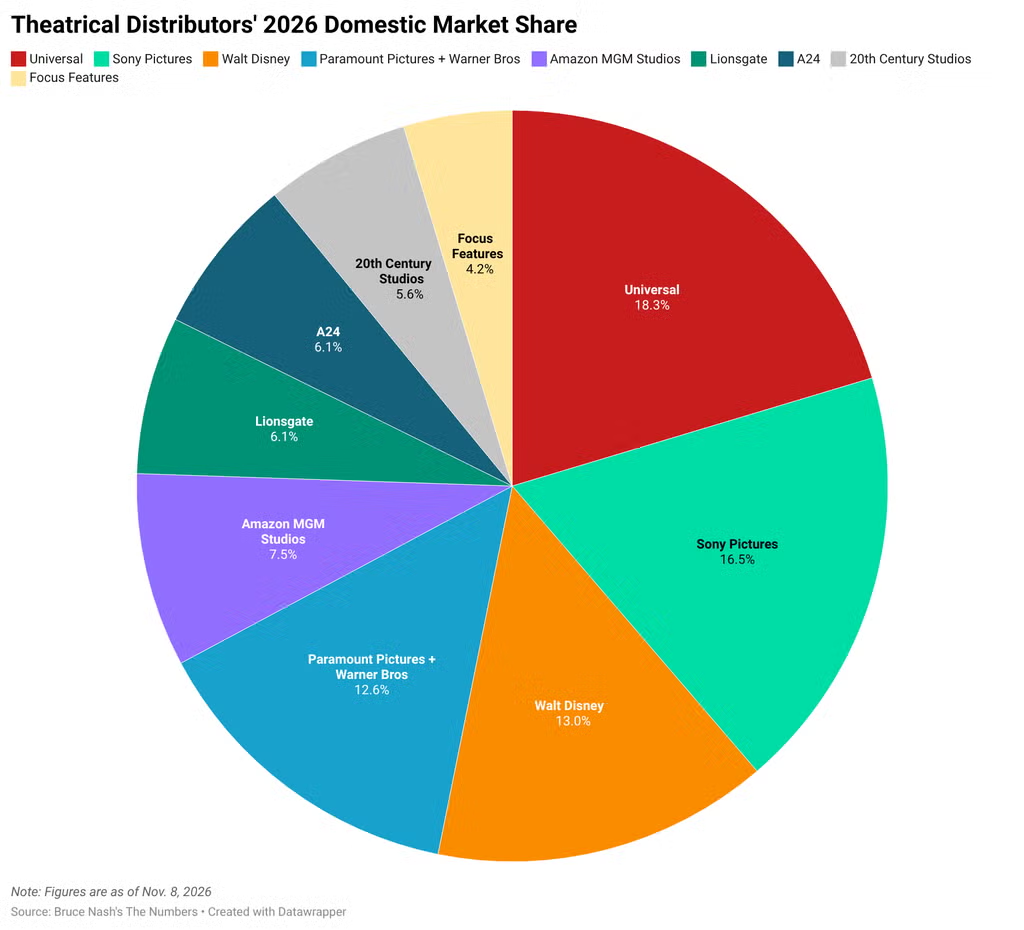
Per Bruce Nash’s The Numbers, Paramount Pictures and Warner Bros. had domestic box office market shares of 6.2% and 6.4%, respectively, or 12.6% combined as of Sunday. In comparison, Universal has a share of 18.3%, followed by Sony Pictures (16.5%), Walt Disney Studios (13%) and Amazon MGM Studios (7.5%) for 2026.
Karnovsky estimates there are more than 60 franchises across the two companies’ theatrical portfolios with roughly $90 billion of cumulative worldwide box office, including 26 franchises above $1 billion and four above $5 billion.
Notably, 2026 has been a lackluster year so far for Paramount and Warner Bros., with the latter having a particularly disappointing run.
Though Karnovksy believes Skydance’s 2027-28 slate looks promising — WB has sequels to “Superman” and “Minecraft” and Paramount has “Sonic” and “A Quiet Place” sequels — he warned the growth plan requires a wide-release output and cadence that only Universal has successfully executed since 2021.
He added that the the minimum theatrical release requirements will prevent Skydance from cutting volume if future returns disappoint. Failure to comply could result in a $30 million penalty per film that misses the release goal and a forced divestiture of the company’s Miramax stake within a 12-month period.
While the volume commitment is encouraging for theaters, Rentrak analyst Paul Dergarabedian told TheWrap that Skydance’s competitive position in 2027 and beyond ultimately depends on the quality of the movies themselves and the economics behind them.
“There are recognizable franchises, including Sonic, Godzilla and Kong, Superman, Minecraft, A Quiet Place and The Lord of the Rings, so there is considerable potential there [in 2027]. But we have to look beyond the quantity of films,” Dergarabedian said. “How good are the movies, what budget levels are they operating at, what will it cost to market them and what is their potential for profitability? Those are all key questions and the release calendar alone can’t answer them. The longer-term test will be how effectively they sustain that pipeline while delivering a mix of films that audiences want to see and that make economic sense for the company.”
The post Skydance by the Numbers: Sizing Up the Paramount-WBD Combo Ahead of Its First Earnings Report appeared first on TheWrap.