It’s easy to assume that we sit at the pinnacle of human knowledge and achievement. Zettabytes of information are just a click away; we jet halfway across the world in hours; we talk to anyone, anywhere, all while satellites circle the globe, DNA is sequenced and spliced and small packets of electrochemical energy hum with power at our disposal.
And yet archaeology consistently turns up hints of ancient accomplishments, buried for centuries. Just this year, researchers have discovered poisons used by early Homo sapiens, wooden tools carved by early hominins, well-engineered Maya plazas, terraces and other architectural feats and a centuries-old board game.
Discoveries like these provide clarity on how our ancestors lived, how their societies functioned and what we all have in common. But for every artifact that illuminates the past, there are several others that leave scholars with more questions than answers — or that prompt long quests to figure out exactly how they worked.
Many of these quests have been fruitful. We now know how Damascus steel was so strong and shatter resistant, what the Dead Sea Scrolls say, where a long-lost da Vinci mural was hidden and how to read a language of the pre-Maya Americas.
“There are just very long stages of tinkering and playing and experimenting,” Silvia Ferrara, a philologist at the University of Bologna in Italy, said of the process of discovering new things about the world of the past.
Below are a few of the lost-to-time innovations that researchers are still working to understand.
1. Greek fire
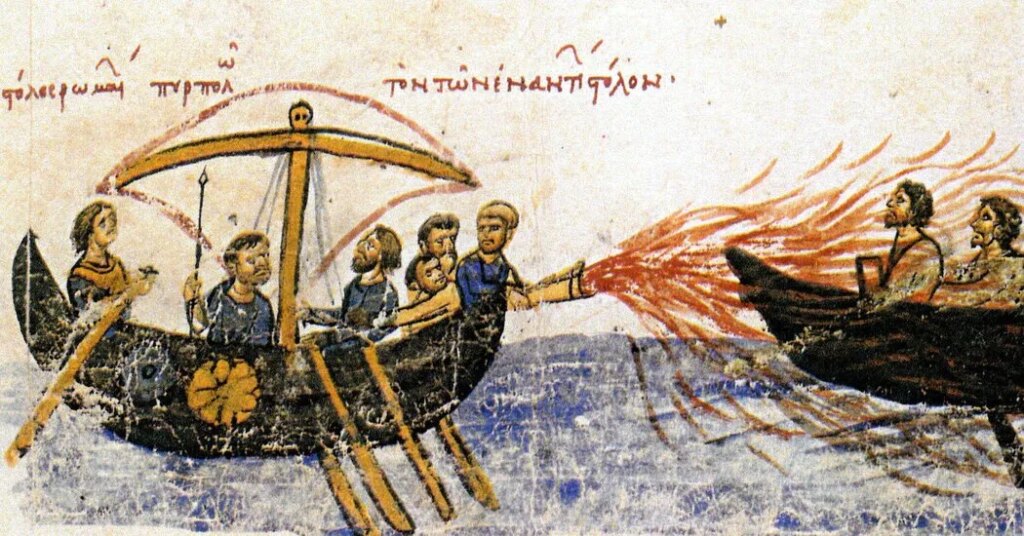
Greek fire was an incendiary weapon developed by the Byzantines in the seventh century. As legend has it, the fearsome naval weapon could stay aflame even on water, making it a powerful deterrent to ships threatening the shores of Constantinople and other ancient port cities. (A vaguely similar substance, with emerald-green flames, played a starring role in the HBO series “Game of Thrones.”)
Around the year 800, Theophanes the Confessor, a monk who recorded Byzantine history, chronicled the fate of enemy ships targeted by Greek fire: “Some of them were cast up burning by the sea walls, others sank to the bottom with their crews and others were swept down flaming as far as the islands Oxeia and Plateia.”
Used for more than 500 years, Greek fire is credited in historical documents with winning numerous battles for the Byzantine Empire, but it later fell out of use and its recipe was forgotten.
Based on comparisons with modern fire-starting agents and the region’s available natural resources, researchers assume that Greek fire was made by processing flammable materials like petroleum or coal, and that its effects and usage were similar to napalm today. The end product was most likely shot from a bronze nozzle, immediately engulfing in flames whatever it touched.
The exact composition is unknown — as is the reason it became obsolete. Some historians think that the Byzantines’ territory losses over time made it difficult to get the right ingredients; others suggest the recipe was told to so few people that it died along with them. Still others say the technology might have been developed into or been superseded by a new weapon that was more effective.
“But, at the end of the day, we are left with a fairly vague picture,” said Michael Fulton, a historian and archaeologist at Western University Canada, in Ontario.— K.R. Callaway
2. Antikythera Mechanism
The secrets of the Antikythera Mechanism came to light slowly, after divers exploring an ancient shipwreck off a Greek island in 1901 brought up an unremarkable lump of heavily encrusted wood and bronze. It took a half-century to discover that the mass hid a mechanical device of stunning complexity.
In time, a global consortium of researchers used X-rays and imaging tools to probe the corroded fragments, revealing the device’s true sophistication. Experts declared it the world’s oldest known computer.
Dated to the second century B.C., it had dozens of bronze gears and dials that produced a highly precise model of the solar system’s movements. The device, researchers came to argue, could predict not only the motions of the moon and the planets, but solar eclipses.
This latter capability pointed to the possibility that it helped initiate a societal paradigm shift: The ancient Greeks saw solar eclipses as very bad omens, so that even kings trembled. Modern researchers found that the device seemed to be able to predict such celestial events far in advance, putting the malevolent gods on notice that their days were numbered.
Humans eventually made astronomic devices of similar complexity as well as true analog computers. They took shape in the late 19th century, not long before the unremarkable lump came to light off the coast of Greece.
Today, the mechanism still holds many secrets and uncertainties, which continue to fuel scholarly debates. Just a third of the original device has survived to the present day, making it hard, if not impossible, to come up with airtight arguments and conclusions about its true capabilities.
Even so, Derek J. de Solla Price, a Yale historian who conducted early studies of the device, declared in 1959 that its discovery was “like opening a pyramid and finding an atomic bomb.” Realizing the surprising extent to which the ancient Greeks had progressed, he added, “is a bit frightening.” — William J. Broad
3. Quipus
Quipus — also spelled khipus — look like a mix between a macramé wall hanging and an abacus: Fibrous cords, dotted with carefully spaced knots, hang in a fringe from a primary strand.
In western South America well before phonetic writing systems emerged in the region, these textiles were systems for record-keeping and storytelling — used first by the Wari Empire between 600 and the end of the first millennium, and later by the Incas. In some communities, quipus are still employed today (their broader use faded after the Spanish conquest of the Inca Empire). But older examples of the system discovered at archaeological sites across the Andes haven’t been fully deciphered.
Early researchers of historical quipus assumed they were memory aids specific to the person who created them. But in 1923, Leslie Leland Locke, an American mathematician, published his findings that the knotted strands seemed to be simply encoding numbers, perhaps for statistical measures like crop yields or a population census. However, more recent research suggests they might have encoded more qualitative information about those measurements and the people who made them.
“From our current perspective, a lot of the answers researchers gave very confidently 100 years ago turned out to be remarkably or brilliantly false,” Manuel Medrano, a historian of Latin America at Harvard University, said of the conclusions of early quipu researchers like Dr. Locke.
Modern researchers like Sabine Hyland, an anthropologist at the University of St. Andrews in Scotland, are learning from the Indigenous communities who still use iterations of the quipu and believe these features might be the key to deciphering more complex meanings. — K.R. Callaway
4. Panjagan
In “The History of al-Tabari,” a historical tome that dates to the year 915, a Sasanian general is quoted as saying, “When I give you the order to shoot, let fly at them swiftly with a five-arrow volley.”
The text is one of only a few to describe an elusive technology known as the panjagan. Between the third and seventh centuries A.D., the panjagan was said to have been used by cavalry of the Sasanian Empire to shoot five arrows at once, a feat that historians say helped the empire dominate in siege warfare around what are now Iran and Iraq.
But how it worked remains a mystery. The Sasanians reigned between 1,800 and 1,375 years ago, and in the intervening centuries many documents have been lost or destroyed, and no artifacts remain.
To learn more about the panjagan, historians typically begin with the word itself. “Panjagan” comes from the Middle Persian word for five, panj. Ancient stories, such as that of an A.D. 684 battle in the city of Basra, wherein 400 Persian calvary members shot off 2,000 arrows in a single burst, clarify its role in warfare. Still, historians are split on whether the term might denote a way of using a bow or whether it was a weapon in its own right.
“It’s really a showdown between whether it’s a drawing method, which I think is highly unlikely, or some kind of arbalist or crossbow,” said Kaveh Farrokh, an independent historian who researches the Sasanian cavalry.
Dr. Farrokh admits that the mystery may never be solved, but he suggests that the panjagan might have been a weapon akin to a crossbow — a technology that had appeared in China by the sixth or seventh centuries B.C. — but with a cartridge-like device that could hold multiple arrows in place. — K.R. Callaway
5. Silphium
To the Greeks and Romans, silphium was not merely a plant; it was an empire’s indulgence. That is, before they seemed to have used it for food and medicine so liberally that it went extinct.
The heart of the obsession was a golden resin, which bled from the stalk and roots of this wild North African weed that fiercely resisted domestic farming (not to be confused with the sunflower-like plants found in North American tallgrass prairies).
Initially harvested in Northern Africa before weaker varieties were sourced in Syria, it grew strictly along a narrow, uncultivable strip of Cyrene, an ancient Greek city in modern-day eastern Libya. Because it could not be tamed, it remained a wild luxury so precious that it sold for its weight in silver. Julius Caesar even stored more than a thousand pounds of it alongside the state’s gold reserves in the Roman treasury. Its heart-shaped seed pods were also associated with its reputation as a birth control agent.
Elite gourmands paid fortunes to have silphium’s pungent juice ground into the exotic braises detailed in Apicius — a first-century collection that stands as our primary record of Roman haute cuisine — which describes using the spice to glaze whole parrot and flamingo in a rich date and vinegar reduction. Silphium’s flavor profile seemed to be similar to to garum, leeks and garlic; contemporary writers praised its unique, musky smell and the sharp savor it left on the palate.
Whether humanity truly over-harvested the weed remains a historical debate. Jens Jakobsson, an independent archaeological researcher, suggests that regional environmental shifts, overgrazing and border conflicts near Libya around the first century A.D. might have caused communities to abandon the crop. Yet the loss was unstoppable. As Erica Rowan, an archaeologist at the University of London, notes, Pliny the Elder observed its disappearance within his own lifetime — a stark demonstration of how human greed can collide with an environment’s natural limits.
While recent theories suggest it may still exist in a hidden form — pointing to a rediscovered Ferula species in Turkey — its legacy remains a cautionary tale of a civilization that loved it to death. — Franz Lidz
6. Ancient tablet weaving
During the Viking Age, a colorfully patterned or gold brocade trim sewn onto the edge of a tunic, or worn as a headband or as a belt could signify special status to others.
To create these intricately crafted bands, weavers relied on an art form largely lost now: tablet weaving. Weavers used thin tablets to separate and twist pieces of yarn into densely-woven finished products with precise patterning. Tablet weaving began during the Iron Age or earlier, and is still practiced around the world today.
But some early designs — found across the Eastern Hemisphere — are so intricate that researchers aren’t sure how they were made.
Lise Ræder Knudsen, a textile historian, has been (figuratively) unraveling these complex designs for decades, starting with a gold brocade band from the Viking Age that she and her colleagues wanted to replicate. “We found that no one knew how this was done,” she said.
Trying different ways to arrange each stitch, she eventually found a way to make a band with the same details as the original. “It is like when I was little and we didn’t have much television or anything like that, so we tried to find four-leaf clovers,” Dr. Ræder Knudsen said. “The more you do it, the better you get on seeing irregularities.”
But with so much time needed to understand each ancient design — she was working at least eight hours a day on it — there are still many designs that no one knows how to recreate. — K.R. Callaway
7. Rongorongo
The system known as true writing, which directly encodes the sounds of a spoken language into symbols, is thought to have been invented only a few times in human history — in the ancient civilizations of Mesopotamia, Egypt, China and Mesoamerica, for example. But some researchers believe that an undeciphered script found on wooden tablets dating between the 15th and 19th centuries might be proof that Easter Island was another hotbed of this type of invention.
The script, called Rongorongo, was used on Easter Island, a remote volcanic island off the coast of Chile, where the Rapa Nui people’s unique culture is reflected in the renowned stone heads that dot their coastlines. Rongorongo seems to predate the Rapa Nui’s contact with other civilizations who had been writing by up to two centuries. But, because none of the 27 surviving tablets have been deciphered, researchers aren’t yet sure whether the script is written language or some other type of information.
The philologist Dr. Ferrara and her research team have spent the last several years creating three-dimensional models of nearly every Rongorongo tablet in existence so that their more than 3,800 wavy, pictorial symbols can be accurately analyzed.
“If it is a proper script, then it will be deciphered within a short amount of time,” Dr. Ferrara said. “But it needs all of this work, you know, it takes a village.” — K.R. Callaway
The post How Did Greek Fire Work? And 6 Other Lost Inventions. appeared first on New York Times.