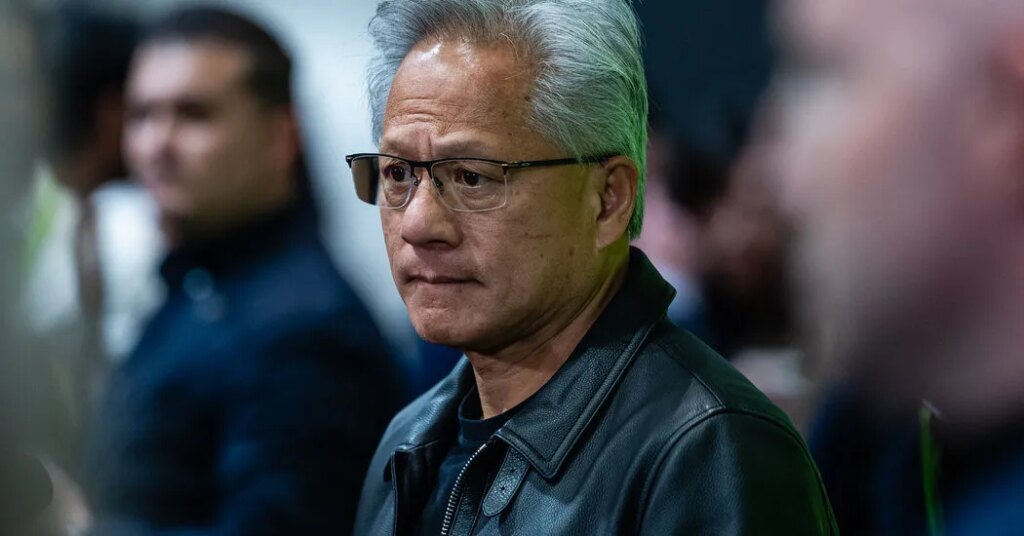
Jensen Huang, the chief executive of Nvidia and one of the most powerful figures in the artificial intelligence boom, acknowledged on Sunday that he’d had a romantic relationship with a Chinese businesswoman who U.S. intelligence agencies concluded was a spy for Beijing.
The admission followed a series of reports by The New York Times showing that the woman, who goes by Alice Huang, had been recruited by China’s main spy agency, and that President Trump and other top officials had been warned about the relationship. Here’s what to know.
What’s happening with Nvidia and its chief executive?
Nvidia said on Sunday that it was opening an investigation into Mr. Huang, a co-founder of the chip maker, after he told the board about his relationship with Ms. Huang. (Mr. Huang and Ms. Huang are not related.)
“I was unfaithful to my wife,” Mr. Huang said in a message to the company. “My actions hurt her and our children. There is no excuse for what I did. I am deeply sorry.”
Nvidia’s board said it had “no reason to believe that either national security or Nvidia secrets were compromised.” Mr. Huang will remain chief executive during the review. Last month, he told Bloomberg News that his dealings with Ms. Huang had been “completely normal.”
Why was Mr. Huang a target?
Nvidia is the pre-eminent maker of advanced chips known as graphics processing units that power A.I. The chips are so important to the development of the technology that Washington has restricted sales of the most powerful ones to China since 2022. Other nations that want to compete in A.I. are hungry for these chips.
U.S. agencies conducting electronic surveillance of Ms. Huang concluded that she had a close relationship with Mr. Huang and was passing information to Beijing, The Times reported last month. A memo that circulated among top U.S. officials this past spring cited intelligence that she was an asset of China’s Ministry of State Security. They concluded she had been recruited to gather information on Mr. Huang and potentially influence Nvidia to push for its most advanced chips to be made available to China. Secretary of State Marco Rubio oversaw the memo’s drafting.
Ms. Huang was a top executive at Megaspeed, a Singapore company that rents computing power from Nvidia chips to Alibaba and other Chinese firms. U.S. officials suspect the company has helped smuggle restricted chips into China. China’s embassy has called the allegations “smears.”
How influential is Mr. Huang?
Few executives have had as much sway over Mr. Trump’s approach to A.I. and China as Mr. Huang. Last year, Mr. Huang persuaded the president to roll back a ban on chip sales to China. The two later struck a deal letting Nvidia sell its second-most-powerful chip there, with the U.S. government taking a 25 percent cut. Nvidia has donated at least $20 million to Mr. Trump’s ballroom fund.
Mr. Trump was briefed on the intelligence about Mr. Huang and Ms. Huang roughly a year ago and took no action. Current and former officials said the men’s close relationship had impeded efforts to rein in Nvidia’s chip sales abroad, stalling some Commerce Department investigations and proposed trade sanctions involving China or Nvidia.
What does Nvidia’s code of conduct say?
Nvidia’s code of conduct, which opens with a letter from Mr. Huang, applies to every employee and board member. It lists “personal relationships” among the activities that may create a conflict of interest and says employees facing a conflict should remove themselves from related decisions and seek legal guidance.
In a section on bribery, the code also urges caution in dealing with people connected to a government. It asks staff to consider whether they could defend their conduct if it became public. Violations could lead to discipline, including termination, according to the code.
What’s next?
Nvidia’s board said a committee of independent directors, working with outside counsel, would oversee the inquiry. Besides Mr. Huang, the board has 10 members. They include Tench Coxe, a former venture capitalist who has been a director since 1993, the year Nvidia was founded; and Suzanne Nora Johnson, a former vice chairman of Goldman Sachs who joined in July.
The Republican leaders of three House committees have asked Mr. Huang to appear at a closed-door briefing this month. The Justice Department has taken over a federal investigation into Megaspeed.
The post What to Know About Nvidia’s Investigation of Its C.E.O. appeared first on New York Times.