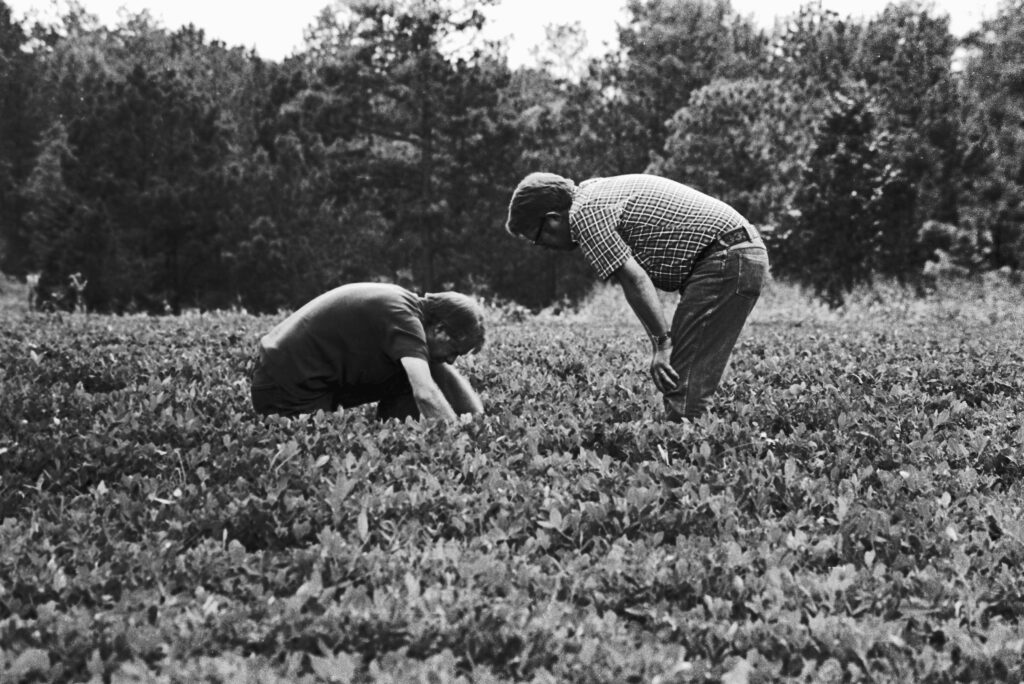
For the better part of a century, Jimmy Carter roamed the woods and fields of his family’s farmland outside of Plains, Georgia.
It is where he played as a boy and worked alongside his father, James Earl Carter Sr., growing peanuts, cotton and other crops. It was where he returned in 1953 after leaving the Navy to run the family business when his father died.
It was also where he often escaped the stress and spotlight of politics to walk among the pines with his wife, Rosalynn, or to hunt turkeys or fish in the pond. And it was where he returned in his later years to bird-watch, spend time with grandchildren and seek solitude.
Carter, the nation’s 39th president, traveled to every corner of the globe. But his youngest child and only daughter, Amy Carter, said, “I think his very favorite place was to be in the town and on the land where he grew up, and where he had those very deep roots.”
Now, the land that the Carter family farmed for generations has been sold to the nonprofit the Conservation Fund, which plans to eventually transfer the land to the state of Georgia.
“This is going to end up permanently protected in the way he would have wanted to see,” said Stacy Funderburke, the organization’s vice president for the central Southeast region. “But it’s also going to be open to others to have that same connection to the land.”
The $8.5 million purchase includes nearly 2,500 acres of sprawling fields and forests that provide longleaf pine habitat and a home to threatened gopher tortoises, birds and an array of other wildlife.
The long-term goal, Funderburke said, is to combine the land with the nearby state-managed Lanahassee Creek Wildlife Management Area — expanding its total size to about 7,000 acres — and to allow hunters, anglers and the broader public to access it.
The sale will not affect the nearby Jimmy Carter National Historical Park, which is run by the National Park Service. That encompasses several significant locations associated with Carter’s life, including his boyhood home and the site of his 1976 presidential campaign headquarters.
Blake Sullivan, who managed the former president’s farm and timberland for more than four decades, called the sale “a fitting tribute.”
In part, that’s because of Carter’s legacy as one of the most consequential conservationists to ever occupy the Oval Office. He signed into law a 1980 act that protected more than 100 million acres in Alaska.
He famously installed solar panels on the White House. He also helped to create Georgia’s Chattahoochee River National Recreation Area in 1978, supported the designation of new wilderness areas within national forests in the Western United States and backed a law that prohibited surface coal mining within the boundaries of any National Park Service unit.
Closer to home, Sullivan said, Carter took a very hands-on approach to managing his family’s land, making sure it was productive and well cared for year after year.
“He saw his job as being a good steward,” Sullivan said.
The Carters also cherished the farm and visited often. Every spring, Carter would hunt turkeys, Sullivan said. The couple loved to fish or simply roam. “They liked to go and walk the land,” Sullivan said. “That was their escape, to get out into the woods … For both of them, it was a place of rest and renewal.”
Amy Carter recalled how the Secret Service would often remain out of sight when her father visited the land to “allow him to feel alone.” The former president, who died in late 2024 at age 100, kept returning “until he was physically incapable of doing it,” she said, and even then he would at times find someone to drive him through the beloved landscape.
Amy Carter said she and her three brothers quickly decided that the sale to the Conservation Fund felt right. Having the place be protected and shared with others just made sense.
“This is the perfect thing for the land to have happen to it,” she said. “It’s not just passing it off to anyone. It feels like something that would fit into [my father’s] vision.”
Besides, she said, the Carter children will carry so many memories of the land long after they no longer hold the deed.
The family often went there to find a Christmas tree, letting Amy choose even when she picked “the little Charlie Brown” tree, she recalled. It was where her father would later take her children, and where he explained his family history as he strolled.
Amy Carter, who spent much of her youth living in the Georgia governor’s mansion and later in the White House, witnessed her father meet with dignitaries, hold state dinners and navigate the trappings of the nation’s highest office.
But when she pictures him now, she said, it is not in a tuxedo or on Air Force One. More often than not, he is in jeans and an old T-shirt, muddy and happy on the land he loved.
“That’s my main image of him when I think of him,” she said. “I can picture him on that land, walking.”
The post Jimmy Carter’s beloved family farm in Georgia sold to conservation group appeared first on Washington Post.