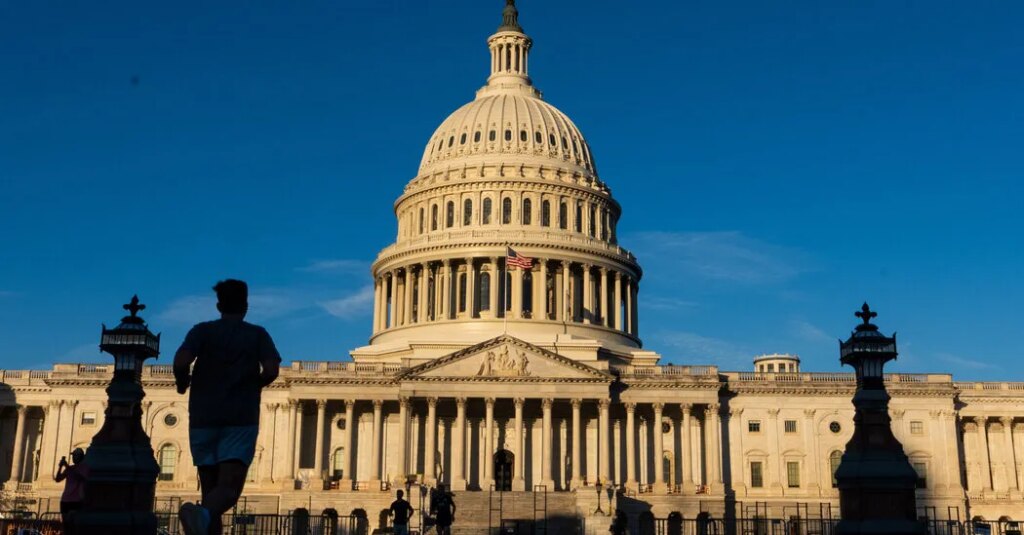
Last week, voters elected a historic new Congress, handing Democrats unified control after two years shut out of power.
On Monday, the old Congress returns to Washington with a full list of unfinished business, a large flock of lame-duck members who may or may not show up for key votes, and a transformed political landscape that will shape Republicans’ final weeks in the majority.
Hanging in the balance are a spending agreement that must be reached to keep the government funded beyond early December, a bill that would speed the approval of infrastructure projects throughout the country, major defense and agricultural legislation, as well as a slew of nominations that President Trump wants to push through while he still has the chance. Also on the agenda is an effort to impeach Pete Hegseth, the embattled defense secretary, whose leadership of the war with Iran has drawn bipartisan criticism.
Republicans now face tough decisions about what they can accomplish in their final weeks in power after a stinging rebuke from voters. And emboldened Democrats must decide how much to cooperate with the party they just defeated, knowing they are weeks away from controlling both chambers and setting the legislative agenda themselves.
Mr. Trump, for his part, has shown little indication that he intends to moderate his approach in response to the electoral drubbing. Instead, he appears to be doubling down, replacing his chief of staff, Susie Wiles, with Stephen Miller, one of the most hard-line figures in his administration and the architect of an immigration crackdown that alienated many voters.
Whether congressional Republicans will continue to unquestioningly follow his lead is an open question after they lost seven Senate seats so far and more than 40 in the House, including in places Mr. Trump won handily in 2024.
The most immediate fight will be over the fate of Mr. Hegseth, who faces impeachment charges by Representative Thomas Massie, Republican of Kentucky, that could come before the House as soon as Wednesday. Representative Hakeem Jeffries of New York, the minority leader, on Sunday said he was a “hard yes,” and Democrats are widely expected to follow suit, with some Republicans having signaled they would like to see the defense secretary gone.
In the Senate, the permitting measure is on track for a preliminary vote on Monday evening, and needs 60 votes — including those of several Democrats — to move ahead. Negotiations over the bill had lasted for months and yielded a bipartisan deal, but it was unclear whether that agreement would survive given how the election has scrambled the political incentives for both parties. Mr. Trump recently threw his support behind the effort in a social media post in which he urged ”all Senators” to vote for its passage saying the bill would lower energy costs and guarantee that data centers pay for their own electricity usage.
The dynamics of the post-election session will be tricky, and are unfolding as newly elected members of Congress are in Washington for orientation.
Incumbent Republicans who lost their re-election bids may feel less beholden to Mr. Trump and their leaders, while some others, demoralized by the crushing defeat, may not even return to Washington. With narrow margins in both chambers, even a handful of absences or defections could upend Republican leaders’ plans to move legislation and give Democrats a stronger hand to block measures they oppose.
Speaker Mike Johnson, who has struggled to keep his unruly conference united for years, may face the toughest challenge. He has announced he will not seek a leadership post after presiding over sweeping Republican losses. House and Senate Republicans both are scheduled to choose new leaders this week as they try to chart a new path for the party that will soon be relegated to the minority.
Beyond Mr. Massie’s impeachment effort against Mr. Hegseth, other challenges could emerge from rank-and-file lawmakers. Several discharge petitions, which allow a majority of House members to force votes on legislation over the objections of party leaders, are within one or a handful of signatures of the 218 needed to advance. Among them are a measure to provide legal status to certain undocumented immigrants brought into the country as children, and another to compel the Justice Department to release additional documents related to the investigation into Jeffrey Epstein.
Looming over both chambers is a Dec. 11 deadline to reach a spending agreement to keep the government funded through the beginning of the year and the start of the new Congress.
Senator Elizabeth Warren, Democrat of Massachusetts, declined on Sunday to rule out using government funding as leverage to pressure the administration to end the war with Iran.
“The wind is at our backs to end this war,” she said on CBS’s “Face the Nation,” adding, “We have got a lot of different tools on the table to get this done.”
The post Congress Returns to a Reordered Washington With a Hazy Agenda appeared first on New York Times.