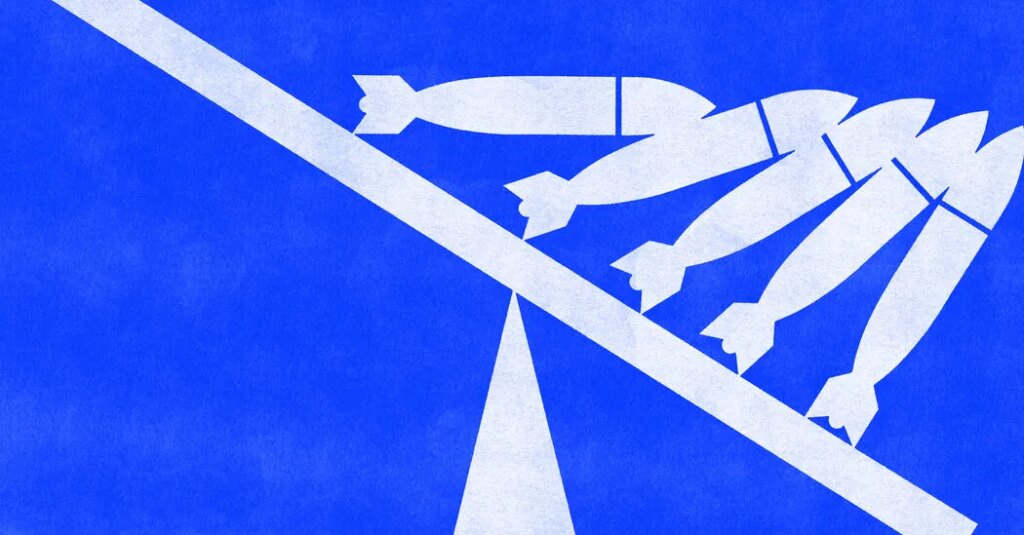
In the past month, I have been asked some version of the same anxious question by officials from Brussels, London, Paris and Warsaw: “What happens if we rearm and the far right takes over?”
After decades of outsourcing much of its defense to the United States, and following the twin shocks of Russia’s full-scale invasion of Ukraine and President Trump’s ambivalence about the United States’ role in NATO, Europe has been building up its military might on a new scale.
Last year, European allies pledged to spend 5 percent of their gross domestic product on defense and defense-related investments by 2035, up from the old 2 percent NATO benchmark. Poland is already spending more than 4 percent, and the Baltic states are spending between 3.4 percent and 4 percent. Britain is aiming for 3 percent by 2030, while France, currently around 2 percent, has made strengthening its nuclear deterrent central to its plans. In a speech in March, President Emmanuel Macron proposed more cooperation with France’s neighbors to deter attacks — a sort of backstop to the United States-led NATO nuclear umbrella — a strategy he described as “forward deterrence.”
Germany, Europe’s largest economy, currently spends between 2 percent and 3 percent. The country is already Europe’s biggest spender on defense, but by 2029 it plans to spend as much as France and Britain spend now combined, by far Europe’s largest defense spender
These commitments are the burden-sharing that Washington has long demanded, and in some ways they are a good-news story at a time when America’s willingness to defend Europe is uncertain and Russia continues its war in Ukraine and escalates its shadow war in Europe.
But as Europe’s buildup is gathering pace, far-right parties, particularly in Germany and France, are breaking through in elections and polling. There is a potential scenario in the near future in which European countries are governed by Euroskeptic, in some cases explicitly pro-Russian, parties, which will be able to derail or misuse their countries’ rearmament with nothing obliging them to use it for the original purpose.
France is the immediate concern. Presidential elections are scheduled for April, and recent polls project that Marine Le Pen, the candidate for the far-right National Rally, would lead the first round with between 35 percent and 37 percent of the vote. Ms. Le Pen is deeply Euroskeptic and has said she would wind down financial aid to Ukraine. She wants to withdraw France from NATO’s integrated military command (when the war in Ukraine is over) and has criticized “forward deterrence” as a “political public relations exercise.” In a crisis with Russia — if, for example, Russia tested NATO with an aggressive action against the Baltic states — it is hard to picture a France governed by National Rally as a leader on European defense.
The deeper, longer-term worry, however, is Germany. The far-right Alternative for Germany, or AfD, is broadly Euro- and NATO-skeptic, has argued that sanctions on Russia hurt Germany more than their intended target and wants a return to Russian gas for energy. Last month, the party leader Alice Weidel told a news conference that Germany needs “a sustainable, reliable and cheap energy resource that has been guaranteed by Russia for the last four decades,” and that sanctions have “destroyed” her country’s “business model.”
There is no imminent scenario in which the AfD ascends to power nationally, but such a development is no longer unthinkable. The party is polling nationally at around 28 percent, well ahead of Chancellor Friedrich Merz’s Christian Democrats. In September it won in a landslide in regional elections in the eastern state of Saxony-Anhalt. Germany’s “firewall” agreement between mainstream political parties, to refuse to work with parties they deem extreme, is holding, but it is under strain.
Even if Germany’s firewall against the AfD holds as anticipated in the next elections, expected in 2029, Germany’s neighbors are already worrying about what comes after. The AfD’s popularity could peak in the mid-2030s, when Germany’s rearmament is projected to be near complete. It is not far-fetched that an AfD-led and rearmed Germany could bully its neighbors and break down decades of European integration and cooperation.
It is not possible to populist-proof Europe’s rearmament. If a far-right party in Paris or Berlin were determined to burn bridges with its neighbors, it could. But Europeans can take steps to buy time and make it costlier to withdraw from Europe’s common defense.
European countries need to entangle their military might and their defense industries so deeply with one another’s that the cost for any party of reversing or abandoning Europe’s defense rises. This means more joint financing of defense, which creates incentives to cooperate — the existing SAFE program with E.U.-backed loans for joint procurement is a good start. Integration of European forces and long-term production contracts with shared supply chains would encourage Europeans to rely on one another. If this sounds familiar, it is because it was also the logic behind the European Coal and Steel Community, the seed of what later became the European Union.
The United States should support such efforts. It wants Europe to defend itself, but burden-shifting will work only if Europeans cooperate instead of mistrusting one another. The Trump administration welcomes the rise of “patriotic European parties” as though they would naturally form a friendly bloc that Washington could work with. But these parties often define their national interests against those of their neighbors, leading to competition and fragmentation in Europe — the opposite of what burden-shifting aims to achieve.
For decades, Europe’s security has rested on three pillars: the U.S. security guarantee through NATO, which kept the Soviet Union and later Russia out; the French-German friendship at the heart of the European Union, which kept Europeans at peace with one another; and Germany’s integration into NATO and the European Union, which allayed fears about German dominance. U.S. security guarantees have already been undermined. If Ms. Le Pen and the AfD were to put the other two pillars in doubt, the result would not be a Europe that can defend itself. It would be a Europe rearmed and adrift.
Liana Fix is a senior fellow for Europe at the Council on Foreign Relations and the author, most recently, of “Germany Rearmed: The Return of War and the End of Illusions.”
The Times is committed to publishing a diversity of letters to the editor. We’d like to hear what you think about this or any of our articles. Here are some tips. And here’s our email: [email protected].
Follow the New York Times Opinion section on Facebook, Instagram, TikTok, Bluesky, WhatsApp and Threads.
The post What if Europe Rearms at Exactly the Wrong Time? appeared first on New York Times.