SECRETS: A Reporter’s Memoir, by Bob Woodward
“Would you interview Hitler if you had the chance?”
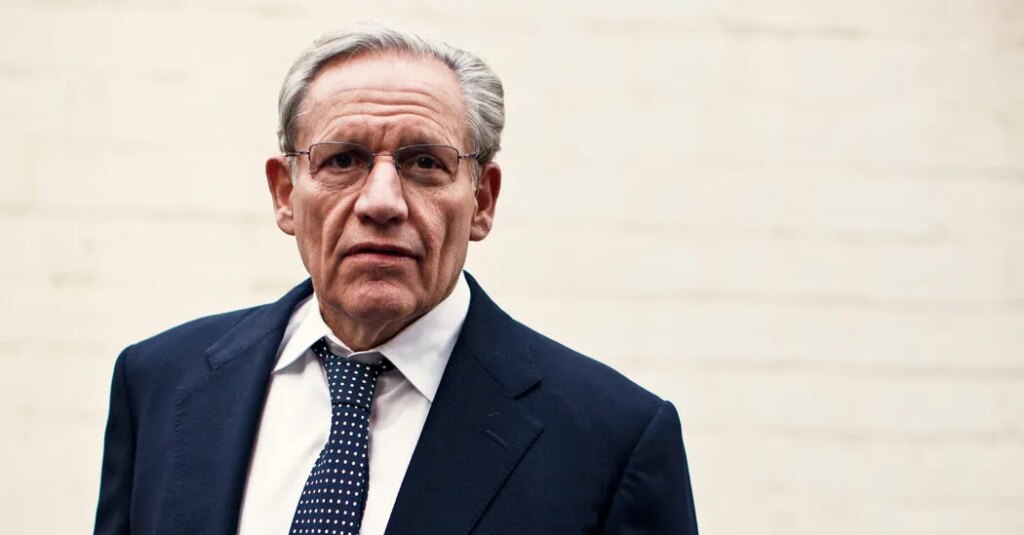
This, Bob Woodward wants readers to know, is how he felt about the prospect of interviewing Robert S. McNamara, who served as secretary of defense in the 1960s and ramped up American involvement in Southeast Asia. Even after Woodward first started talking to him, in 1988, he was frustrated at McNamara’s insistence on blaming others for the Vietnam War. “I viewed McNamara as someone responsible for evil actions,” Woodward writes in his new memoir, “Secrets,” “and in my own mind quietly grappled with the question of whether he was himself evil.”
Woodward, now 83, admits that the challenge felt “personal.” After graduating from Yale in 1965, he served in the Navy for five years, managing to talk his way out of getting sent to the Mekong Delta. He already understood Vietnam as a “death sentence” and later learned that the man who was sent in his place was killed. For a journalist who prides himself on dutifully recording the facts — “I let readers judge” — his willingness to wonder aloud whether the former defense secretary was “evil” jumps out.
But the eruption of moral language is only a blip. At the end of the chapter comparing McNamara to Hitler, Woodward has reverted to a more typical Woodwardian character assessment: “By our last interview I had come to view McNamara not as evil, but as a deeply flawed, misguided and ambitious man who was ill-equipped to be secretary of defense.” It’s become a mainstay of Woodward’s best-selling books that even the most powerful men in the world, no matter how much havoc they wreak, are only human after all.
Reading this memoir, you may notice two seemingly incongruent Bob Woodwards. There is the dogged investigative reporter who, along with Carl Bernstein, brought the Watergate scandal to the front pages of The Washington Post and helped bring down President Richard Nixon. That Woodward is hypervigilant, a self-described “catastrophic thinker” who is always scanning the horizon for the next threat.
By comparison, the other Woodward is what Christopher Hitchens called “a stenographer to the rich and powerful”: the “access” journalist who grew up in a moderate Republican household in Wheaton, Ill., and came to the job with “a drilled-in respect for authority.” Instead of confrontation, this Woodward seeks cooperation, getting insiders to talk to him on “deep background” so that he can “focus on human behavior and decisions,” recreating what the leadership class did and said (or what it says it did and said). He says he wants “to be so far inside a source’s circle of trust that when something important happens, I am on their mind.”
Woodward doesn’t try to reconcile the two sides of himself in “Secrets.” In a prefatory note, he thanks his co-author, Claire McMullen, who pushed him to go beyond his habit of “keeping as much of myself out of my reporting as possible,” and to recognize that for the book to be a memoir he needed “to be in it.” It has a bravura opening: On the first page alone, we read about his mother’s nervous breakdowns and the afternoon, at age 11, he came home and caught her kissing his father’s best friend.
When Woodward tried to talk to his parents about what was happening, they were cagey. “I learned to trust what I saw.” It was a formative lesson in how people could try to keep hidden something of enormous consequence: “You have to snoop.” After his parents divorced, he continued to be fearful. Every night before bed, he would bundle his toys and clothes into a blanket in case his house went up in flames and he needed to make a quick getaway. To this day, his home is equipped with “a great number” of fire extinguishers.
“Whether it is my house burning down, a terrorist attack on the United States, a dangerous president or the detonation of a nuclear weapon,” Woodward muses, “I am always calculating risk” and “trying to figure out what might make things safer.”
So it’s notable that despite his incessant risk calculations — despite his experience of Watergate — Woodward admits to being blindsided by extremely consequential events. He says he was wrong when he “believed and reported” on the Bush administration’s assertions that Iraq possessed weapons of mass destruction. He says he was wrong when he treated Hillary Clinton’s “email server issue” in 2016 as seriously as he did “the Trump unknowns.” He admits to living in a “bubble.” That fateful year, what he calls “Washington’s blind spot” was also apparently his: a failure to grasp the extent of anti-establishment rage.
A Woodward book titled “Secrets” is bound to reveal secrets, several of which have already leaked. These include his method for securing a famous deathbed confession regarding the Iran-contra affair from the C.I.A. director William J. Casey, as well as his disappointment with Jeff Bezos, the billionaire owner of The Washington Post. (He also provides oblique corroboration for some Beltway gossip about The Post’s publisher Katharine Graham and McNamara: Once, when Woodward was visiting Graham’s home, he happened to pass by her bedroom and noticed a picture of McNamara on her dresser.)
The more personal stuff is riveting and genuinely moving, but it takes up precious little space in this nearly 600-page book, chunks of which are given to extended quotations from Woodward’s previous books — including multiple paragraphs from “The Final Days” — and extended re-creations of the many, many interviews he has conducted over the years. (Between 2009 and 2025, he interviewed the late Republican senator Lindsey Graham “at least 74 times”; mercifully, we are spared a highlight reel.)
But then, hewing closely to his notes and tapes has long been Woodward’s safe place. “As always, I report incrementally,” he writes. “I do not speculate.” So when he decides that “there are alarming parallels between Nixon and Trump,” you can practically feel the rising panic that presumably forced him to step out of his comfort zone.
Jan. 6 was a decisive shock. Woodward notes that only two presidents in his lifetime have tried “to subvert a free and fair democratic election to ensure his own political survival.” Woodward’s career began with the secretive one, and it is coming to a close with the shameless one.
“I wish I could be more hopeful but it is not who I am,” Woodward declares. “Those are the facts.”
SECRETS: A Reporter’s Memoir | By Bob Woodward | Simon & Schuster | 579 pp. | $35
The post Bob Woodward, Chronicler of Government Secrets, Spills Some of His Own appeared first on New York Times.