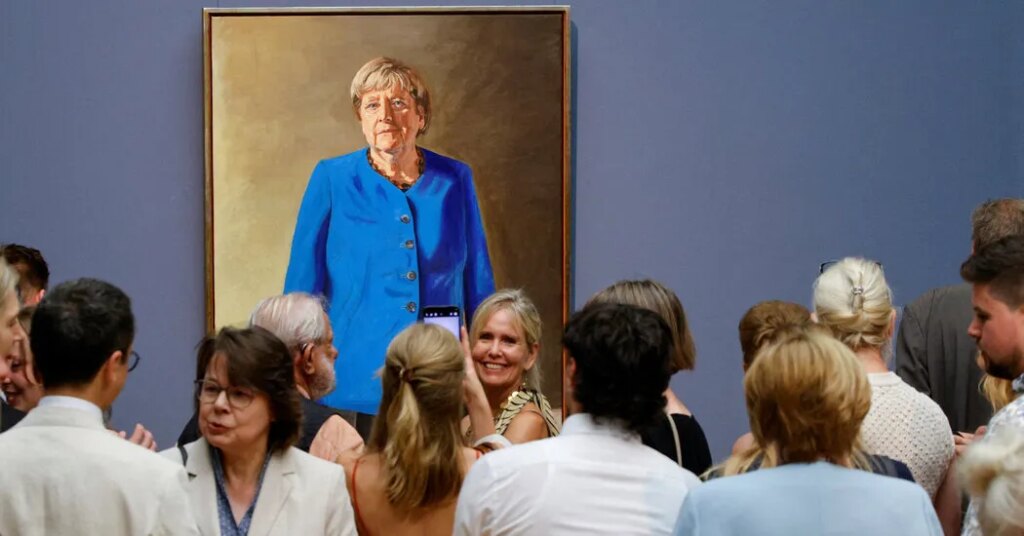
The painting’s subject looks out of place on the museum wall, standing in a bright blue blazer, posing stiffly, her fingers perched tent-like on a table and her lined face unsmiling.
“I think she’s fantastic,” said a museum visitor, Heidi Brandt, gazing up at the painting of Angela Merkel.
Germans are experiencing a strange sort of nostalgia for Ms. Merkel, their former chancellor. At a time of political upheaval, polls show voters would rather see Ms. Merkel steering the country than the current chancellor, Friedrich Merz. Both are from the center-right Christian Democratic party.
After 16 years in power, Ms. Merkel left office in 2021 and her official portrait went on display in late summer at the Bode Museum in Berlin. Daily visits to the museum, which is usually not a top tourist draw, have risen by 80 percent since the exhibit opened. The rush was large enough to cause museum officials to extend the portrait’s stay by several months, through the end of the year.
Mr. Merz’s approval rating stands at 11 percent, said Peter Matuschek, who leads the German polling firm Forsa. Ms. Merkel left office with a rating near 75 percent, crossing party lines.
“People have an overall impression of her as a chancellor who seemed to hold the country together,” Mr. Matuschek said.
The affection persists even though Ms. Merkel’s policy legacy remains deeply unpopular — and widely blamed for many of Germany’s problems today.
As chancellor, Ms. Merkel made an ill-fated push to buy imported gas from Russia, while shuttering nuclear power plants. She welcomed more than one million refugees, mostly from Syria, Afghanistan and Iraq. Both moves eventually fueled public anger.
Commentators say the backlash over immigration has fed the rapid rise of the far-right Alternative for Germany party, or AfD. The AfD is poised to govern an eastern German state, after defeating Mr. Merz’s and Ms. Merkel’s Christian Democrats in fall elections. Mr. Merz is fighting daily rumors that his government could collapse.
And yet, amid that turmoil, museum-goers have flocked to see the gravity that Ms. Merkel brought to the chancellery.
Her fans, young and old, say they see in her portrait a reflection of better times, when the political center held and Germany lived up to its reputation of reliability and moderation.
“I think she is increasingly becoming a sort of myth, a symbol of stability,” said Fanny Widmann, a 17-year-old from Stuttgart, as she waited to see the portrait at the Bode last month.
When a German chancellor leaves office, the Federal Chancellery typically commissions an official likeness. Ms. Merkel, however, has always preferred to control her own narrative.
She selected a relatively unknown French-German-Canadian painter, Jérémie Queyras, now 28. She chose to display his work in one of the least-flashy institutions on Berlin’s Museum Island, one of the capital’s main cultural hubs, close to the apartment where she lived as a teenager in East Berlin.
The work is striking for its spareness. The only objects visible in the painting are two file folders and a rendition of the silver cube that Ms. Merkel kept on her desk throughout her years as chancellor. It bears the phrase, “In serenity lies strength.”
Despite the public interest, reviews have been mixed. Fans called it “a monumental work with a compelling presence” and “a success” in which “nothing has been prettified.” Harsher critics called it “almost devoid of style” and “as daring as an administrative regulation.”
The art magazine Monopol wrote that it “expresses, in every square millimeter of canvas, what philosopher Matthias Warkus once dubbed ‘Merkelcore’: a celebration of low-conflict German mediocrity.”
It’s exactly the sort of split reaction Ms. Merkel tended to avoid as chancellor.
“Her approach was one of moderated consensus,” said Karl-Rudolf Korte, director emeritus of the NRW School of Governance at the University of Duisburg-Essen. “She was incapable of being a polarizing figure. Many people find that refreshing now.”
Ms. Merkel has done little to shape the public response. She arranged to visit the Bode for three talks with school groups in front of the portrait, but she didn’t allow members of the public or journalists to join. The museum’s director, Antje Scherner, who attended two sessions, declined to publicly disclose anything she said out of respect for Ms. Merkel’s insistence on privacy.
During one of those talks, museum-goers who had come for the sole purpose of seeing the portrait — including Ms. Brandt, 63, who dressed to match Ms. Merkel, and a couple who had traveled nearly 300 miles to see the painting — were surprised to find themselves locked out of the room by the former chancellor herself.
Upon finishing that session, Ms. Merkel walked determinedly past the small crowd waiting to greet her in the museum’s rotunda.
A reporter asked if he could pose a question.
“Nein,” she said.
The post Germans Miss Merkel, Their Old Chancellor, Though They Dislike Her Policies appeared first on New York Times.