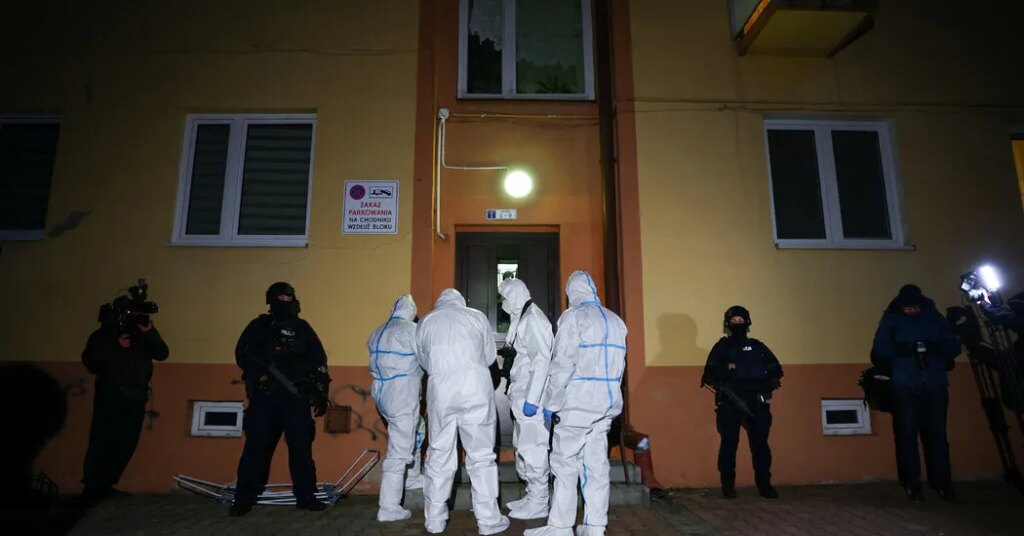
He lived with his parents on the top floor of a three-story apartment building painted a sunny yellow, but he nearly always dressed in black. He attended sedate family events like christenings but was fascinated by guns and the history of World War II.
A day after the authorities said a 24-year-old man had killed his sister and parents at their home and then shot dead six people in the central square of Krakow, neighbors and relatives in the gritty former steel town where the family lived were struggling to piece together what had happened. What, they asked, might have pushed an often sullen but seemingly unaggressive young man with no criminal record to mass murder?
“My legs are still shaking from shock,” said Ryszard Piasecki, who is related by marriage to the suspect’s slain mother, Renata. “He was a loner and didn’t have a girlfriend or any friends at all. He always wore black — but lots of young people do that.”
The suspect, Michal Oksinski, was a lathe operator. His parents and sister, Magdalena, a third-year student at the Fine Arts Academy in Krakow, were found late Saturday in their apartment in Ostrowiec Swietokrzyski, a Communist-era industrial center now fallen on hard times.
Magdalena, 21, was visiting for the weekend when her brother killed her on Saturday morning, according to investigators.
One Ostrowiec Swietokrzyski resident, Marta Piwowarczyk, said her brother-in-law lived in the same apartment building as the Oksinskis and called her on Saturday to say the police had sealed off the area and that “something terrible seems to have happened.”
After killing his family, the authorities say, Mr. Oksinski drove his father’s Subaru around 130 miles to the Old Town in Krakow. Entering its medieval central market square about 3 p.m., the height of a weekend rush in one of Poland’s most popular tourist destinations, the authorities say he began firing from the car at crowds of people strolling and shopping. Among the six people shot dead was a visitor from Britain.
Police officers, fearing that the door of the family’s home in Ostrowiec Swietokrzyski might be booby-trapped, entered the apartment late Saturday evening through a window next to a small balcony overlooking the street. On Sunday, a smashed window pane and a steady flow in and out of the building of police investigators, counterterrorism experts and forensic technicians pointed to the horrors committed there 24 hours earlier.
Americans may have grown accustomed to senseless mass murder committed by lone gunmen, but in peacetime Poland it has been met with incomprehension. “My mind can’t compute what happened. No normal person can understand what got into his empty head,” said Mr. Piasecki, the relative.
After public appeals on the day of the shooting for blood donations, the Krakow police department asked people to stop volunteering because blood banks were full. “The scale of the public response exceeded our wildest expectations,” it said Sunday.
Two police officers, among the 16 people wounded in Krakow during the rampage, were still hospitalized on Sunday. One was listed in serious condition but had emerged from the coma he was in when admitted. The Polish authorities declared two days of national mourning on Sunday and Monday.
Mr. Oksinski was shot by police officers responding to the attack. He was reported to be in critical condition.
The Oksinski family lived in a tidy working- and middle-class district near a small park carpeted on an autumn weekend with leaves. Mr. Oksinski’s father, Janusz, an electrician, had his own small business, and his mother worked as a cashier in a nearby food store.
After the collapse of Communism in 1989, the town’s biggest employer, a state-owned steel mill with 17,000 workers, was privatized and began slashing staff to the bone. One sign of the pain that followed endures in old graffiti daubed near the entrance to the Oksinski family’s stairwell: “Nothing is eternal.”
On Sunday, the Krakow branch of Poland’s National Prosecutor’s Office opened an investigation and described the mass shooting as an “act constituting a terrorist offense,” though it gave no hint of a possible motive.
Poland’s interior minister, Marcin Kierwinski, said it appeared to be political. “Everything points to the perpetrator holding very, very radical views,” he said. Without going into detail, he said the suspect “was fascinated by far-right ideologies.”
Local residents were not buying that.
“He wore a black hoodie and painted his nails black, but does that mean anything?” asked a retired steel mill worker, who said he used to see Mr. Oksinski in the neighborhood. He would give only his first name, Boguslaw, citing neighborhood tensions following the deaths. “Claims of a political attack is just empty talk,” he said.
His wife, Barbara, who retired from a sports club once funded by the now-moribund steel mill, said that before now she had never heard of gun violence in Ostrowiec Swietokrzyski. “When people here want to kill themselves, they jump out of windows but never use guns,” she said.
Guns, however, seem to have been a big part of Mr. Oksinski’s life.
A spokesman for the district prosecutor’s office said on Sunday that seven firearms and a large quantity of ammunition had been seized from his family’s apartment. The father, he said, had permits for nine guns, while his son had two permits. Neither had criminal records, which would have precluded the permits. Two guns were found on the son after the attack in Krakow.
Forensic experts were still working “to determine exactly which weapon was used to fire the shots in the Ostrowiec apartment,” the spokesman said.
Mr. Piasecki, the relative, said the father and son had bonded over guns, often going together on weekends to a shooting range in a nearby town. He said his wife, whose sister is related to the suspect’s mother, had shown him a picture posted weeks ago on Facebook by the young man. It portrayed him waving a gun with the inscription: “Dad, thanks for buying me this.”
The gun club where they practiced firing their weapons released a statement on Sunday distancing itself from the mass shooting. It insisted that the suspect had never received “dynamic, tactical or combat shooting training at the club.” And the management, it said, “is cooperating with the authorities conducting the investigation.”
Anatol Magdziarz contributed reporting.
The post Reeling From Rare Mass Shooting, Poles Ask What Set Off Young Suspect appeared first on New York Times.