The first volunteers gathered in the back house of Nithya Raman’s Silver Lake home with little besides a whiteboard counting down the number of days until the June 2 primary election.
Raman had jumped into the Los Angeles mayor’s race the day before, right at the Feb. 7 filing deadline. Her campaign didn’t have an office, a bank account, a campaign treasurer, or even a proper website.
It lacked, put simply, “the most basic things,” said Ian Manheimer, Raman’s campaign manager, who joined the team after a 10 p.m. call from Raman the night before the filing deadline. There would be a meeting the next day in Raman’s backyard accessory dwelling unit to get things rolling.
“For anyone who suspected Nithya had designs on this for a long time, you could just come to the ADU and that would dispel those notions,” Manheimer said.
Those unassuming beginnings in Raman’s backyard, with her parents and her husband’s parents taking turns cooking vegetarian Indian lunches for the small staff, evolved into a disciplined campaign that overcame initial struggles to unseat incumbent Mayor Karen Bass, a veteran politician who had racked up endorsements from most of L.A.’s traditional power brokers.
Raman did it on a hyper-abbreviated timeline by turning out and expanding her base of younger renters, pitching herself successfully to Latino voters, securing late but key endorsements from groups and officials that gave massive support to her campaign’s ground game and by running on a hopeful message about restoring city services against a deeply unpopular mayor.
From the moment she got into the race, there was an evident, yet narrow lane for the progressive, second-term council member to rise to the city’s highest office, but it was far from clear that she would be able to make it through.
For much of the primary, Raman and her campaign were all alone. She had few endorsements, and almost none from elected officials.
Because of her late entry into the race and some past disagreements, she failed to secure the backing of the Los Angeles chapter of the Democratic Socialists of America for the June 2 primary, even though the left-wing organization endorsed her in both of her council campaigns. Raman got almost no supportive outside spending in the primary, while millions of dollars were spent opposing her.
But Raman had made a name for herself on the City Council as an advocate for tenant rights, and her campaign focused on turning out L.A.’s legions of renters to secure enough of the vote to make the runoff.
She was still a largely unknown entity early on in the race, with 51% of likely voters in a March poll saying they didn’t know enough about Raman to form an opinion of her.
On top of that, Raman was quickly upstaged by Spencer Pratt, the Republican former reality television personality, whose slash-and-burn campaign on social media attacking L.A.’s liberal political establishment dominated news coverage.
While Raman’s camp hadn’t initially worried too much about Pratt, thinking he and entrepreneur Adam Miller would split the more conservative vote in the city, it became clear as the primary went on that Pratt could emerge over Raman as the second candidate in the runoff.
To dent Pratt’s appeal, the Raman campaign worked to brand him as the MAGA Republican in the nonpartisan race, knowing it would hurt his chances in a deep-blue city like Los Angeles. They chose to try out the line at the only televised mayoral debate.
Raman didn’t miss her chance.
“This is a MAGA Republican’s idea of what Los Angeles looks like,” she said during the NBC4 debate on May 6, referring to Pratt’s sometimes dystopian depiction of L.A. “This is really not the city that I love so much.”
Though Raman’s debate performance was widely panned — and Pratt’s was praised — her team felt she had gotten the point across to Angelenos: With the unpopular Bass almost certain not to win the primary outright, the runoff could either be a contest between two progressive Democrats, or Bass versus a candidate whose views echoed those of President Trump.
That debate was a learning moment for Raman and her campaign.
“She’s up against an extremely seasoned politician and a television star. She’s just a normal person who hasn’t been on stage like that,” Manheimer said.
But defining Pratt as MAGA, the campaign believed, would pull some voters to Raman from lower-performing candidates on the left and in the middle with the hopes of keeping Pratt out of the runoff.
Raman was able to eke out a win against Pratt in the primary, getting 29% of the vote compared to his 26%, with Bass taking first place at 34%.
The sole goal of the primary for Raman’s campaign was, self-evidently, to make it out of the primary.
If her team could move on to the runoff, it would be able to reset — fundraising would restart, it could build a bigger team and it would have a longer runway to increase Raman’s name recognition and build out her base.
While Bass dominated labor and elected official endorsements throughout the race, Raman began to pick up key supporters in the runoff.
In August, the Western States Regional Council of Carpenters endorsed her, sponsoring an independent expenditure group for her called Estamos con Nithya for Mayor 2026.
That was followed by the endorsement from the union Unite Here Local 11, a major player in city politics, which represents hospitality workers at airports and in hotels.
Raman also got major endorsements in the runoff from City Controller Kenneth Mejia and L.A. County Supervisor Lindsey Horvath.
Mejia especially became a pit bull for Raman at events and on social media.
“Kenneth would call every day and say, ‘Let me know what myths I can bust today,’ ” said Tessa Wick, the communications director for Raman’s campaign.
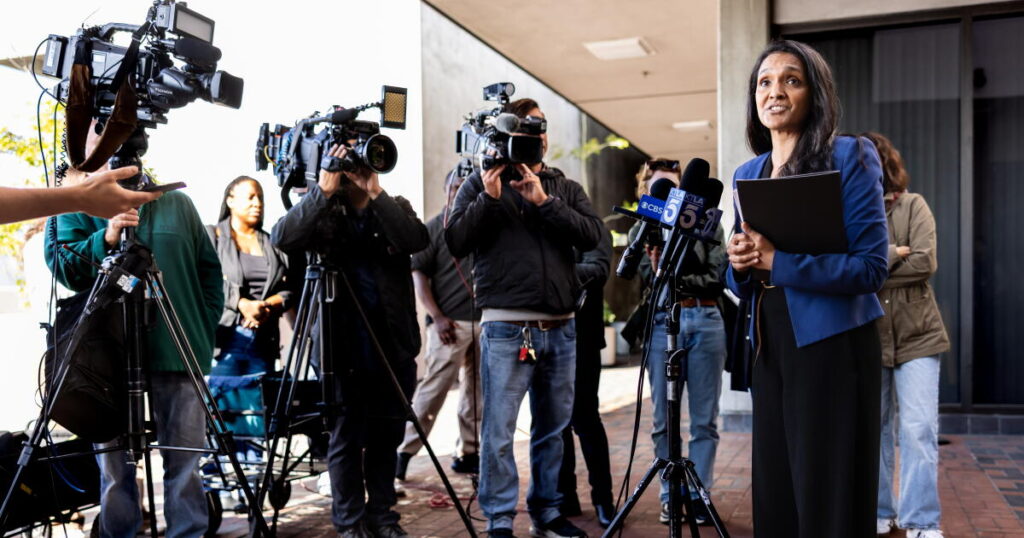
“We didn’t have time to feel particularly lonely in the primary, but once we saw what it felt like to have all these groups and people behind us, each press conference we would do was injecting more force into this movement we were building,” Wick said.
Raman’s bid also got a serious infusion of cash from Aaron Sosnick, a hedge fund manager and bike lane advocate who poured $8 million into two independent expenditure groups to support Raman, making him the single biggest spender in the mayoral campaign.
“He is a cyclist. He just wants to not die riding the streets in L.A.,” said Michael Schneider, who runs Streets for All, a transportation advocacy group that ran one of the independent expenditure groups that Sosnick funded.
Raman also capitalized on a difficult summer for Bass, during which the mayor faced turnover on both her campaign and administration teams, unsheltered homelessness rose citywide (but crucially, went down sharply in Raman’s city council district) and a massive fire burned at a cold-storage food warehouse in Boyle Heights, sending noxious fumes into the heavily Latino, working-class neighborhood.
“Many Latinos saw themselves in the Boyle Heights residents,” said Lauren Perez-Rangel, senior director of Latino outreach for the Raman campaign.
Bass had prevailed in more Latino neighborhoods than any other candidate in the primary. The Raman campaign worked to change that in the runoff, Perez-Rangel said, focusing especially on Latino voters. Raman brushed up on her Spanish and used it frequently at events.
The campaign also teamed up with Latino and Spanish-language content creators to spread Raman’s message of affordability, building more housing and solving the homeless crisis. The result: Raman led Bass among Latino likely voters throughout the runoff campaign, according to polls by UC Berkeley IGS and the L.A. Times.
Despite that growing support, Bass and her allies’ negative portrayal of Raman in attack ads had an effect, as Raman’s unfavorable ratings rose month by month. They framed the council member as too far left, allowing homeless encampments in front of schools and failing to show up for thousands of City Council votes.
“It was a race to define Nithya,” said Jeff Millman, an advisor and spokesperson for Raman’s campaign. “Their strategy was to tear down Nithya. Our job was to make sure that people knew Nithya’s strengths and record of success as a council member.”
As the campaign drew to a climax, Raman improved as a candidate and came off as more confident during the two runoff debates. Her team said she spent many hours improving her debate skills.
“There was no secret weapon, just a person really committed to practicing,” said Wick.
Still, she opened herself up to attacks from Bass’ side during the final debate Oct. 13, after she said the city used to be the “gold standard” of noncooperation with immigration authorities under controversial former LAPD Chief Daryl Gates. Bass hammered Raman over the remark, accusing the council member of romanticizing Gates’ tenure.
Despite that and other missteps during the closing days of the campaign, her team said it was Raman’s insistence on running a largely positive campaign about an optimistic vision of L.A.’s future that pushed her over the finish line.
“She was really dogged that it was a campaign that was hopeful, not nasty and cynical. She wanted the campaign to be a love letter to L.A.,” said Wick.
In her election night speech, still trailing Bass by a few percentage points that she would quickly make up, Raman spoke to that vision.
She called it a vision where the people who made L.A. extraordinary could afford to live in the city and where government is responsive and takes responsibility.
“We believed that Angelenos were hungry for that city,” she said. “And it turns out that we were right.”
The post Inside Nithya Raman’s improbable campaign for L.A. mayor appeared first on Los Angeles Times.