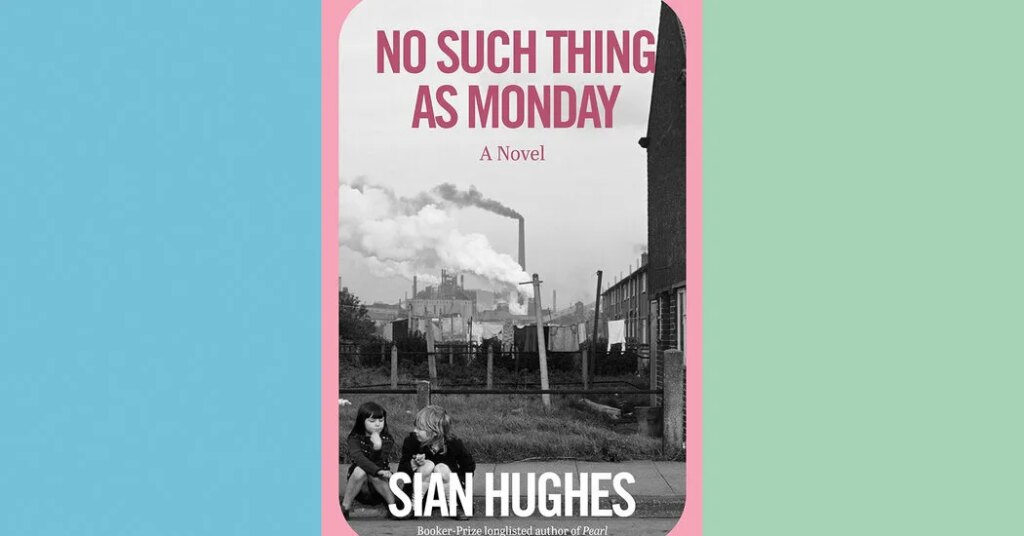
NO SUCH THING AS MONDAY, by Siân Hughes
Some stories come in quietly, on little cat feet. Siân Hughes’s fractious and darkly funny second novel, “No Such Thing as Monday,” kicks off with a snarling, snuffling dog tied to an armchair in which slumps a dead body, somewhere in the grubby West Midlands of England.
The cold lump in the chair is a charismatic bully and generally terrible man named Stan, and the unlucky witness to this tableau is his second-born daughter and also the book’s narrator, Steffie. Most likely in shock, Steffie sets down the meal she’s brought him (“Never mind, Dad,” she says, “you’re not missing much. It was that tinned potato salad you don’t like”), wonders idly how much it will cost to put down the dog, then rolls herself a cigarette.
Even in her mid-50s she’s still the girl her father molded her to be, somewhere between a human cactus and a honey badger. When she was growing up, Stan favored Steffie to an almost pathological degree while withholding love, kindness and even basic sustenance from his careworn wife and their older daughter, Caroline. For reasons no one ever really said, he’d butter both sides of Steffie’s bread rather than allow either of the other two a crumb.
By the time Stan’s heart stops, though, the family unit is long dissolved: his wife lost to an easily curable chest infection and Caroline into the mist, having left home as a teenager as soon as she could. And like one of the hard-luck animals he used to train for dog- or cockfights, Steffie has become an inveterate scrapper, conditioned to see the world through an angry red haze. When her boss at the dry cleaners where she works catches her filching a customer’s trouser suit to wear to Stan’s funeral, she impulsively slaps him across the face.
So there goes the job and soon, her tenancy in a shabby but cozy apartment — actually the disused storeroom above a hairdresser’s shop — too. Ill equipped to process grief, among other base-line emotions, Steffie’s mind returns to muddled childhood memories, many of them about her sister: Caroline sweetly coaxing her to sleep in their shared little-girl bedroom or glimpsed through a doorway, curling into herself while Stan stands over her kicking; Caroline there one day and gone the next, her one thin school coat no longer on the hook in the hallway.
Then there are flashbacks to Steffie’s own lost years, a wayward youth of zonked-out delinquency and dope-running for local hoodlums that ended in a jail sentence, and eventually, some career direction via a stint in the prison laundry. With the slap, though, whatever stability she’s built for herself since her parole goes down to zero again.
Against almost every indication I’ve given you so far, this ouroboros of ongoing traumas somehow manages not to be head-smashingly bleak. Steffie is one of those fictional creations you probably would and should run screaming from in real life, but on the page, she’s a pretty great hang: spiky, sharp-witted, blazingly self-aware. At a remedial waitressing job, she’s taken for a sad divorcée by much younger co-workers, and she sees their point. “I thought maybe I was at the arse end of a bad divorce from my own life.”
There are more than a few familiar beats of hardship and redemption here; “No Such Thing as Monday” fits comfortably in the milieu of working-class British realism that will chime with anyone who’s read Thomas Hardy or seen a Ken Loach movie. But Hughes, a poet whose 2023 fiction debut, “Pearl,” was longlisted for the Booker Prize, has a canny, lyrical ear for her misfits and underdogs, and a touch tender enough to nudge their fate toward better things.
NO SUCH THING AS MONDAY | By Siân Hughes | Holt | 216 pp. | $26.99
The post In This Scruffy Black Comedy, Misery Makes Good Company appeared first on New York Times.