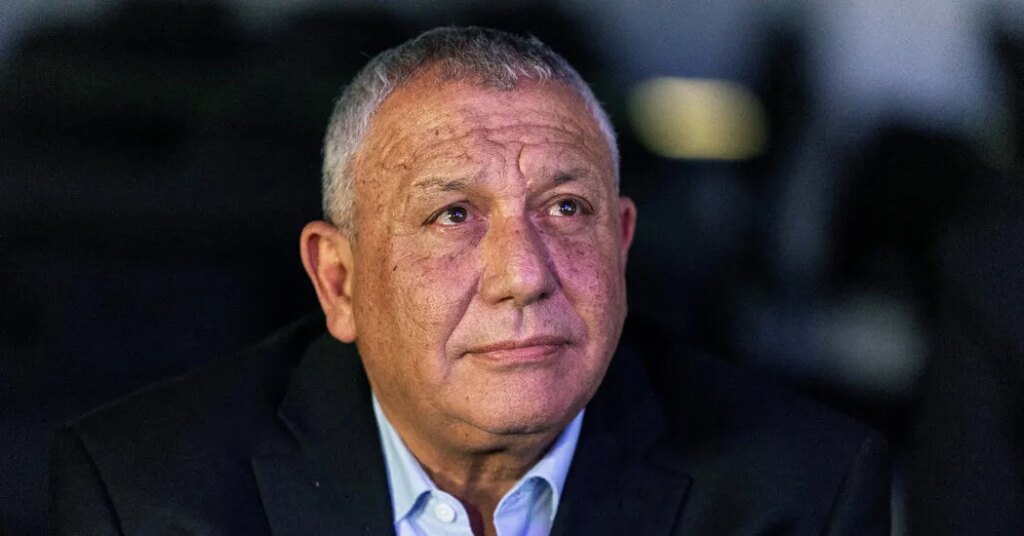
The clock starts ticking on Sunday for Gadi Eisenkot, the leading rival of Prime Minister Benjamin Netanyahu of Israel, to form a new government.
Mr. Eisenkot is set to be given the official mandate to form a government at an afternoon ceremony presided over by Israel’s president, Isaac Herzog. After days of consultations, Mr. Herzog said late Saturday that he would give the opposition leader first dibs at trying to forge a coalition after the country’s inconclusive national election last month.
A soft-spoken former general, Mr. Eisenkot leads Yashar, a center-right party that campaigned on a promise of keeping Israel secure while pivoting away from policies that prompted international anger and led to Israel’s isolation on the world stage.
Mr. Eisenkot, 66, has up to six weeks to build a coalition before the president passes the opportunity to another candidate, most likely Mr. Netanyahu. Here’s what to know about the career general-turned-politician.
What is his background?
Mr. Eisenkot, a married father of five, was born in Tiberias, in the north, to Moroccan immigrants and was raised in Eilat, a working-class city in southern Israel.
He is relatively new to politics, having spent his career in the military, and has served only part of a single term as a lawmaker and eight months as a minister.
Mr. Eisenkot started out in the infantry and rose through the ranks to take command of Israel’s military operations in the West Bank in 2003, at the height of the Second Intifada. By 2015, he was serving as the country’s top general — the military’s chief of staff — and held that role until early 2019, under Mr. Netanyahu.
He entered politics in 2022, and, after the Hamas-led Oct. 7, 2023, attack on Israel, served in Mr. Netanyahu’s war cabinet for part of the Gaza war. He lasted eight months, resigning in June 2024 over Mr. Netanyahu’s push for a “total victory” instead of a deal with Hamas to release the hostages.
Last year, Mr. Eisenkot formed a new party — Yashar, meaning “straight” or “honest” in Hebrew — which aimed to attract centrists and center-right voters worried about where Mr. Netanyahu’s coalition was leading Israel.
Mr. Eisenkot’s personal story also spoke to voters. One of his sons and two of his nephews were killed in the war in Gaza. He has said he hoped to be “worthy of the enormous price paid” by his son, “so that there could be a better reality here for our children.”
What would his policies look like?
Mr. Eisenkot has rejected the prospect of Palestinian statehood in the near term. He has also voiced support for a more restrained expansion of Israeli settlements in the West Bank while promising to curb settler violence.
His platform in the election zeroed in on Mr. Netanyahu’s vulnerabilities, including by endorsing calls to investigate the security and intelligence failures preceding the Oct. 7 attack.
Still, his approaches to the threats of Hezbollah in Lebanon and Iran place his foreign policy not too far off those of his former boss. It was Mr. Eisenkot who in 2008 articulated the “Dahiya doctrine,” which called for creating deterrence by responding to Hezbollah attacks with devastation.
What happens now?
Israel’s pivotal election on Oct. 27 left all sides short of an outright 61-seat majority in Parliament. Mr. Netanyahu’s coalition won 53 seats; Mr. Eisenkot and his Zionist allies secured 48; and two Arab parties took a record 19.
Now, Mr. Eisenkot and his allies have no easy path to power.
They could join forces with the two Arab-led parties, but some of the right-wing Jewish parties in his bloc have said they would not enter a government that relied on their support. Mr. Eisenkot has also stipulated conditions that the Arab parties have yet to meet, such as publicly labeling Hamas as a terrorist organization.
Or, he could look to partner with members of the Mr. Netanyahu’s coalition to form a unity government. One possibility would be to woo the ultra-Orthodox parties.
Either option would be tricky because some of his allies campaigned against the ultra-Orthodox factions, while others promised never to join a coalition backed by Arab parties.
Last week, Mr. Eisenkot said he would work to establish a “national emergency government” to eject Mr. Netanyahu as soon as possible. That would probably mean a minority government that would rely on the Arab parties’ support to prevent a no-confidence vote against it.
The post Who Is Gadi Eisenkot, the Israeli Tasked With Forming a Government? appeared first on New York Times.