It feels fitting right now to think about the power of anger in the face of injustice.
I think most men would be amazed by the amount of low-lying rage that simmers in the background of many women’s lives. I’m talking about the anger at avoiding street harassment, trying to comply with irrational beauty standards, the disproportionate burdens of family life, the loss of reproductive freedom, the struggle for equitable pay and, of course, the ever-present threat of attack. From childhood, girls are taught to wonder: Am I safe? But in the zeal to protect us from harm, we are rarely taught how to express the anger we might feel at having to be so damned careful all the time.
In the weeks leading up to the midterms, Netflix offered us Zoe Kazan’s “East of Eden,” a seven-part meditation on an extreme, unchecked expression of — specifically female — anger. It was bracing and, in a way, perhaps prescient.
“East of Eden,” based on John Steinbeck’s classic 1952 novel, prompts us to consider a still-shocking proposition: What if a woman sought revenge for her own oppression? What if she resorted to violence, with no concern for morality or law or consequences? How would we view her fury?
The show lands like a cultural gut punch. The pain it depicts (and induces) has purpose. It explores misogyny, sexual predation, child abuse, racism and a vengeful, manipulative narcissist so damaged in childhood that she loses all empathy. In other words, though set in the American West at the turn of the 20th century, “East of Eden” explores a litany of horrors that are all too recognizable in the era of Donald Trump, Jeffrey Epstein, ICE and Dobbs.
Steinbeck’s novel is mostly about men. A retelling of the story of Cain and Abel, it traces one family’s fathers and sons across generations. For Ms. Kazan, this adaptation is also intergenerational, a response in part to her grandfather Elia Kazan’s 1955 film version of the book, starring James Dean. The elder Kazan also concentrated on the men in his version of the story. Granddaughter Zoe takes another tack, delving into the novel’s main female character, Cathy (later Kate) — an antiheroine with a dark soul.
Ms. Kazan’s modern interpretation includes something Steinbeck did not address directly: an explanation for Cathy’s anger. Deviating from the book slightly, Ms. Kazan inserts a clear childhood trauma: Cathy’s sexual molestation, in early childhood, by a teenage boy. This backstory allows us to see Cathy’s violence as revenge. A violation of this magnitude, Ms. Kazan suggests, could fuel a lifetime of fury. As a woman living under an administration unwilling to pursue justice for, or even listen to, the victims of Mr. Epstein’s massive sexual trafficking enterprise, I can fathom that kind of fury.
Steinbeck described Cathy as a “monster,” but wrote her character with a degree of nuanced psychology. Ms. Kazan goes further. Hers, she says, is a feminist take on Cathy. She recasts “East of Eden” as a kind of revenge fantasy about burning down the patriarchy, with Cathy holding the match (sometimes literally).
What could a woman’s rage look like if unleashed? The answer might be a sort of marauding colossus overturning anything in its way. A female Godzilla, disguised as a lovely young woman. It’s a pop culture fantasy that’s surfaced in multiple ways in recent years, visible in shows such as “Furious,” about a revenge-driven female serial killer, and “Big Little Lies,” and in the film “Promising Young Woman,” about a female vigilante avenging crimes against women.
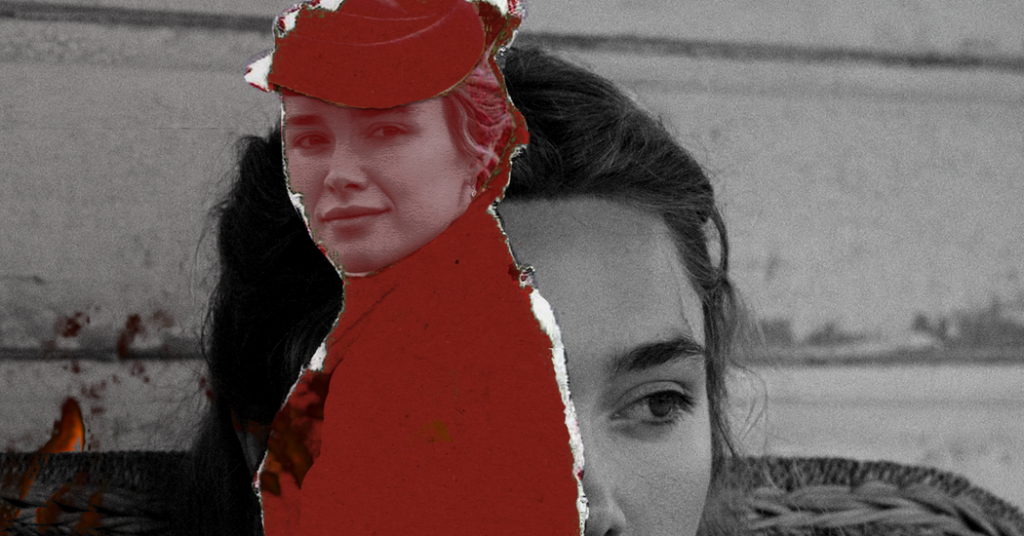
“East of Eden” might figure among these, although it begins more conventionally. Its first scene presents us with Cathy (Florence Pugh) as a victim: She lies half dead on the ground, grotesquely battered, her face distorted and covered in blood. We may recoil, but not out of surprise — mangled (often dead) young female bodies are, alas, standard opening fare on television. Often, the bloodied female victim then recedes in importance as the narrative turns to finding and prosecuting her assailant. Even if the victim survives, her rage is rarely central to the plot.
But “East of Eden” inverts those expectations. The series is concerned more with crimes committed by Cathy than with those committed against her. It follows her ruthless, even depraved, quest for power, money and independence — everything she feels she has been denied.
Cathy is a stone-cold killer, devoid of compassion, kindness, romantic love or maternal feeling. After her father beats her and locks her in her room, she sets fire to her parents’ home, killing them both. Deprived of an education or career, she studies with prostitutes to master their trade and support herself. Feeling trapped by a pregnancy she never wanted, she attempts a self-abortion — in a grisly scene involving a heated knitting needle. When that fails, she abandons her twin infants upon birth without a second glance, impassively shooting her husband when he tries to stop her.
Why did I find these scenes almost unbearable? Harder to watch somehow than the usual violence on television? In part, because we almost never see a woman reject every presumed obligation of her sex. Forced to look at violence committed by a young woman, we feel the ire that motivates her more acutely. And we share some of it.
I do not know a single woman who has not encountered abuse or harassment. And while I consider myself comparatively lucky, I have been aggressed, stalked, dragged into park bushes on a sunny afternoon (I escaped), mugged at gunpoint; I’ve had my head bashed in a taxi door by a panhandler to whom I’d refused money on the street (“The bitch deserved it,” he told the police), and I’ve been deeply frightened countless other times. For me, this started at age 11, when a man partially disrobed and committed a lewd act in front of me and a school friend, in an otherwise empty subway car. We covered our eyes. We cried. Were we angry? No, we were frozen in fear. Anger builds slowly. Given how discouraged women are from expressing it, it tends to disappear into silence.
But that silence is, as they say, a feature, not a bug. It’s a constituent part of the greater social system, especially in politics. The entire political world seems to rest on the shoulders of women and girls, like so many invisible, gender-reversed Atlases. Just beneath the gleaming marble corridors of the highest government institutions — the Supreme Court, Congress, the White House — there lurks a constant, ever-renewing stream of scandals and painful stories involving women who’ve been abused, exploited, cheated, mistreated and often overlooked.
Sometimes popular culture holds a kind of fun-house mirror up to our political psyche. Ms. Kazan’s “East of Eden” was an id-like eruption of female anger arriving just weeks before a historic midterm election in which women voters and candidates were critical in turning the country blue.
There’s still plenty to feel angry about. Millions are denied their reproductive rights, and the menace symbolized by that knitting needle is back again, more than a century after the era depicted in “East of Eden.” That fact alone seems rage-inducing enough to summon a murderous revenge fantasy. Cathy is a monster, yes, but it might be useful here to recall that word’s roots: It comes from the Latin “monstrum,” meaning divine warning or portent.
Rhonda Garelick is the founding director of the Institute for Public Humanities and Arts at Hofstra University, where she is also a distinguished professor of literature. She is the author of “Mademoiselle: Coco Chanel and the Pulse of History,” the forthcoming “Why Fashion Matters” and other books.
The Times is committed to publishing a diversity of letters to the editor. We’d like to hear what you think about this or any of our articles. Here are some tips. And here’s our email: [email protected].
Follow the New York Times Opinion section on Facebook, Instagram, TikTok, Bluesky, WhatsApp and Threads.
The post ‘East of Eden’ Came Just in Time appeared first on New York Times.