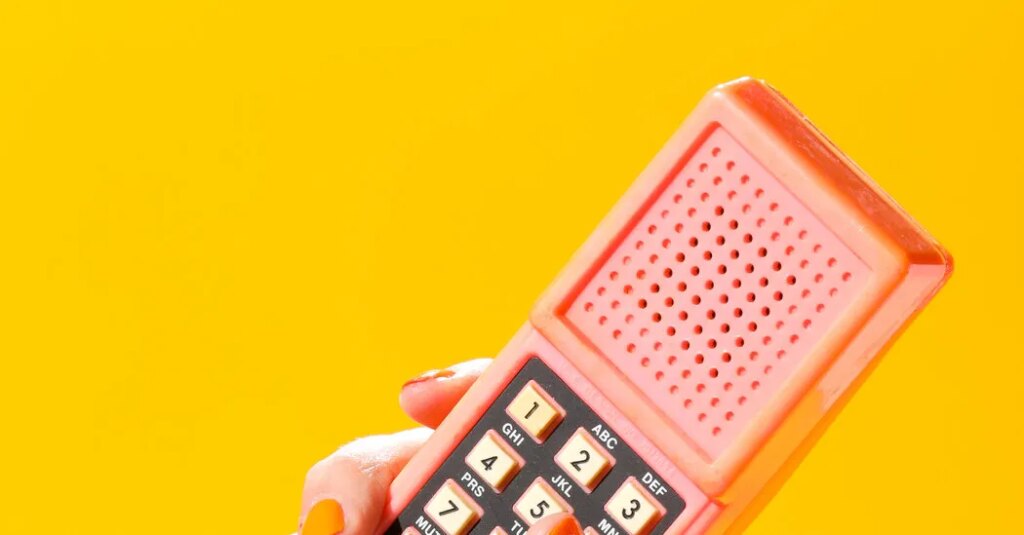
THE TELEPHONE: A New History, by James Gleick
What was the telephone? Certainly not the thing we now call a “phone”: this mesmerizing toy Turing machine that we have to silence as if it were an impertinent child and yet cannot use with any reliability for sustained conversation with another human.
“I’m losing you” — as we say when the connection falters — was not a phrase people used to utter casually.
Appropriately solid, though nothing approaching the heft of the annual white or Yellow Pages that once landed with a plunk on doorsteps and got borrowed for booster seats, James Gleick’s latest book, “The Telephone,” restores the old instrument to its rightful place in history. And, furthermore, it burnishes a once mundane tool with dignity and mystique. “Was it a connector, a unifier?” he wonders. “Or a disrupter of precious solitude?”
The traditional telephone was a portal to adulthood — not a sinkhole, like the new phone — its “extensions” situated in the household’s most intriguing nooks (the television was at the center; the telegram was a rare special visitor, though notably still the name of some newspapers). Wired to desks and often guarded by professional assistants — we called them secretaries, kids, because they kept secrets — telephones along with typewriters gave a pleasing contour to office life. Nestled in metal booths, they offered pockets of privacy on the open streets.
And everywhere, they heightened drama, romantic and otherwise, without the degraded language of text messaging. One theater critic thought every play should include a telephone scene.
Gleick is a respected science writer who likes to get out of the lab onto those streets and beyond, with a touch of Doc and his DeLorean from “Back to the Future.” His eyes light up at concepts like chaos theory or time travel, the subject of his last book. “The Telephone” begins by zooming to 1975, when a 16-hour, five-alarm fire disrupted service for over 170,000 customers in downtown Manhattan. This was a major inconvenience for the go-go metropolis. “If I can’t use the telephone, I’m dead,” a funeral parlor director told a reporter.
But the company that had monopolized this technology for almost a century, American Telephone & Telegraph, a.k.a. AT&T — so dominant then that it was referred to as Ma Bell — had already begun its decline. A walloping antitrust suit had been filed by MCI Communications a year earlier, and Motorola, having produced a beeper evocatively named Pageboy in 1964, was now working furiously on mobile phones, no strings attached. (Freedom? Ha, as if.)
That “Bell” echoed the old ring so perfectly is probably part of why one man, Alexander Graham Bell, got so much credit for an invention arrived at, as Gleick outlines carefully, by many. This was an era of frenzied innovation that included Thomas Edison’s phonograph and lightbulb, and involved a lot of collaboration and competition. You’ve heard of getting in the weeds; this author might wonk out a little overmuch, for the layperson, on wires. But more than most gadgets the telephone foregrounded personality above all.
Bell, known as Aleck, was the surviving middle son of three in a Scottish family who came to North America after a terrible bout of tuberculosis. His father, an elocution professor, was part inspiration for George Bernard Shaw’s Henry Higgins in “Pygmalion”; his mother was hard of hearing, and Aleck taught at the School for Deaf Mutes in Boston, eventually marrying Mabel Hubbard, a teenage tutee. One letter to her suggests he was a most appalling white male supremacist. “The wisdom of the world has decided that they are inferior beings doomed to exist within the narrow space called ‘Women’s Sphere,’” he wrote of the female sex.
Funnily enough, his special project would expand the spheres of women, ushering them into the work force en masse, first as operators of the switchboard — “Mary has a thingamajig clapped on her ears,” as the poet Carl Sandburg wrote — then as the aforementioned secretaries. Moreover, the telephone alleviated their domestic isolation and arguably increased their social power. “It let women speak with men on a more equal basis, at times of their choosing, and — no small matter — at a safe distance,” Gleick writes. “It gave them confidence.” It also enabled a new, marginally safer category of sex work: the so-called call girl.
A whole red leatherette-covered encyclopedia, that other 20th-century relic, could be devoted to the telephone’s seismic impact on narrative (music included), and to the void its removal leaves. Gleick gives us a chapter, bounding from Proust to Freud to Woolf and Dalí’s lush surreal visions. “Telephone frappé, mint-colored telephone, aphrodisiac telephone, lobster-telephone, telephone sheathed in sable for the boudoirs of sirens with fingernails protected with ermine, Edgar Allan Poe telephones with a dead rat concealed within …,” the artist rhapsodized in his autobiography.
Muriel Spark, Haruki Murakami, “Dial M for Murder.” This elegant survey should be required reading for digital natives, but anyone from Generation X or earlier will be bleating other examples. How about, for example, Nicholson Baker’s “Vox,” for which the headline of one review in The Times was “Reach Out and Don’t Touch Someone” — a play on a famous AT&T slogan mysteriously missing from the very thorough “Telephone.” Maybe it paid to be unlisted.
THE TELEPHONE: A New History | By James Gleick | Farrar, Straus & Giroux | 528 pp. | $35
The post A History of the Telephone That Wonks Out on the Wonder of Those Wires appeared first on New York Times.