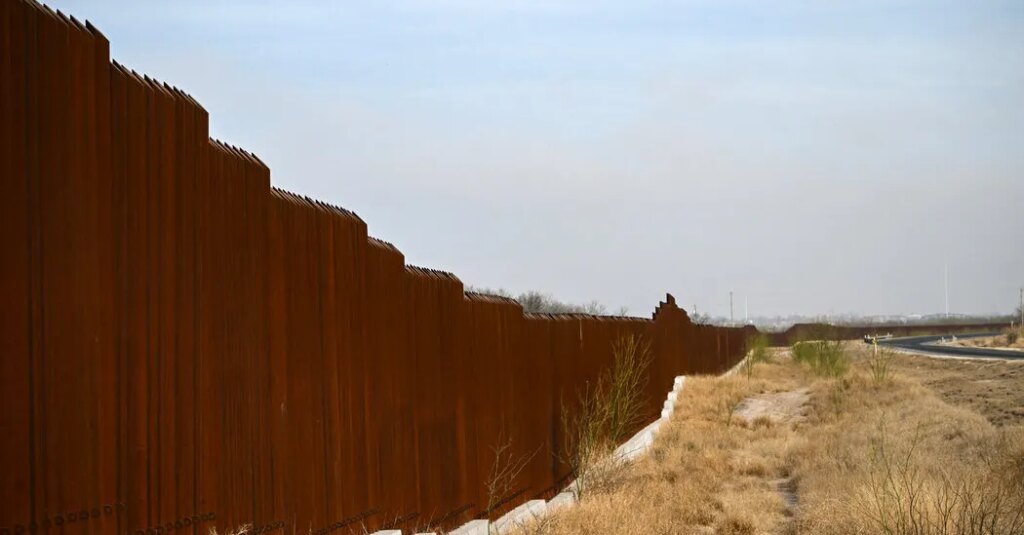
Texas spent years as the nation’s fiercest proving ground for hard-line immigration enforcement.
Gov. Greg Abbott and Republican leaders became indispensable White House allies in President Trump’s mass deportation campaign, aggressively pushing the bounds of state power to counter what they defined as an “invasion” at the southern border.
The state supplied detention beds, floating river barriers and miles of concertina wire. Officials empowered local police to arrest migrants and drafted the legal playbook to advance stringent policies, unwind deportation protections and target pro-immigration advocacy groups.
Last week’s surprise Democratic sweep is expected to throw that approach into reverse. It is a shift likely to reverberate far beyond Austin, as newly minted lawmakers in Texas, Washington and across the country prepare to reshape the national battleground over the Trump administration’s mass deportation campaign.
Already, in Houston and Austin, mayors John Whitmire and Kirk Watson have directed city police officers to limit their cooperation with Immigration and Customs Enforcement during traffic stops, bucking a policy imposed on Texas’ cities by Mr. Abbott.
Still, Democrats looking to usher in a new era of accountability will find the institutional and legal challenges remain formidable.
The incoming cohort of new leaders is by no means united on how to overhaul a national immigration system that has not been updated in more than three decades. Holding federal agents accountable under state law is exceedingly rare — and prosecuting them is substantially harder. And cities and states that have passed sweeping measures restricting the tactics of federal agents, whether barring them from wearing masks or requiring them to identify themselves, have been locked in drawn-out court battles over the policies with the administration.
Markwayne Mullin, the homeland security secretary, signaled no retreat, posting online last week, “Deportations will continue.” On Friday, President Trump announced that Stephen Miller, the domestic policy adviser and architect of his administration’s immigration agenda, would become his White House chief of staff.
Even with election results still rolling in showing deep Republican losses, Mr. Miller indicated that he would not back down from the aggressive actions that many voters rejected, The New York Times reported Saturday. He continued to push ramping up deportations and was girding for a fight with Democrats over congressional subpoenas and investigations.
Yet the electoral victories have galvanized the Democratic Party’s base around at least one shared priority: the independent scrutiny of ICE tactics, including violent traffic stops and fatal shootings by federal agents.
Local prosecutors could receive backup from state attorneys general as they pursue criminal investigations into the conduct of federal immigration agents. Police, sheriff and highway patrol partnerships with federal agencies could be curtailed or scrapped. County leaders and landowners fighting the expansion of Mr. Trump’s border wall could find they have more leverage with the support of top state officials.
In Congress, Democrats say they will lean on two primary levers.
The first is to use congressional control over funding. Spending bills could be written to withhold or claw back money from federal immigration agencies that have already received more than $100 billion. They could also be used to attach guardrails and limits on ICE in exchange for funding.
The second is to mount robust oversight of ICE abuses on the streets and in detention centers.
Of course, Mr. Trump holds veto power over any bill, and for Democrats to override such a veto, they would require votes from Republicans.
But Representative Joaquin Castro of Texas, who has drawn attention to the cases of detainees, said he aimed to push for details on the frenzied spate of ICE hirings, including vetting procedures and the people who were hired.
Congressional committees will also have the power to subpoena witnesses and could potentially hold hearings in select cities to bring to light new accounts, records and body-camera footage, Mr. Castro and other lawmakers said.
“What I hope is that it will be a new era where we are always going to have border security and immigration enforcement,” Mr. Castro said. “But what we have seen in the last two years is a reckless, soulless cruelty against people — and that has to stop.”
Texas is poised to serve as a central battleground, led by Governor-elect Gina Hinojosa, who on Tuesday unseated Mr. Abbott, and by Nathan Johnson, a Democratic state lawmaker elected to succeed Attorney General Ken Paxton.
Before Mr. Trump’s election in 2016, Texas Republicans and Democrats had tended to carve a pragmatic middle lane on immigration, striking a balance between border security and support for immigrants in a state shaped by the realities of sharing the longest stretch of border with Mexico. But Mr. Abbott and Mr. Paxton broke with that tradition.
Under the Biden administration, Mr. Abbott signed state legislation making it a crime to illegally enter the state; bused migrants to liberal-leaning cities; poured billions into the deployment of National Guard troops to the border; and built a state-funded border wall. He synchronized those efforts with the Trump administration and expanded on them. Over the summer, he refused to sign a rendition warrant to extradite a federal ICE agent to Minnesota, where the agent faced assault charges.
Mr. Paxton leveraged state resources to investigate immigrant shelters and advocacy nonprofits and to promote Mr. Trump’s baseless allegations of widespread noncitizen voting. He and Mr. Abbott also together filed at least a dozen lawsuits against the Obama and Biden administrations over executive actions relating to the border and immigration, including ones that sought to rescind Trump-era border policies and protect some immigrants from deportation.
Both Ms. Hinojosa and Mr. Johnson have acknowledged that immigration policy falls primarily under federal purview. But they have also pledged to ensure that federal law enforcement complies with basic public safety standards and to act as a check against the administration.
In an exclusive interview with The Times, Ms. Hinojosa said she would review the effectiveness of Mr. Abbott’s multibillion-dollar border enforcement program, known as Operation Lone Star, and the financial incentives for private prison companies holding immigrant mothers and children. “Locking up little kids like that, even with their parents, that is child abuse,” she said. “It doesn’t happen anywhere else. It should not happen here.”
Mr. Johnson told The Times that he planned to assess the state’s participation in an ICE program that deputizes local and state officers to carry out immigration duties, and that he would consider withdrawing from it if he found it strained resources for other investigations and impeded state oversight.
He envisioned his office as a line of defense for landowners resisting private border wall contractors from encroaching on their properties and parklands. In courtrooms, he promised the state’s forensic muscle and legal expertise to county prosecutors trying to build cases against federal agents accused of misconduct.
“If ICE is in here terrorizing communities and impeding the ability of local law enforcement to get information from, for example, Hispanic communities, their illegal actions are affecting the ability of law enforcement to keep people safe in my state,” he said. “I will have grounds to proceed on that basis.”
Still, pursuing criminal investigations against ICE agents is difficult. The Constitution’s supremacy clause prohibits local authorities from interfering with federal operations and grants federal officers broader immunity in carrying out their duties. In an emailed statement, ICE said that only the federal government has the authority to investigate its officers, maintaining that local entities have no such jurisdiction.
Nationwide, local authorities have started their own investigations into at least a dozen high-profile deadly shootings and other incidents involving federal immigration agents over the past two years. Prosecutors have so far secured criminal charges against only four officers in Colorado, Minnesota and Texas.
In Travis County, which encompasses Austin, the local police and county prosecutors said the federal government has failed to respond to numerous requests to interview witnesses, obtain video footage and records in the September shooting of a Venezuelan man, who was critically injured by an immigration agent during a traffic stop.
After Tuesday’s electoral wins, José Garza, who heads the district attorney’s office, said he welcomed the reinforcements from state leadership but remained cleareyed that federal prosecutors and officials across the Department of Homeland Security and the Department of Justice all remained under the sway of Mr. Miller. “I am feeling hopeful but cautiously so,” he said.
Sean Teare, the district attorney in Harris County, which includes Houston, has faced similar obstacles after months spent investigating the fatal shooting in July of Lorenzo Salgado Araujo, an undocumented Mexican construction worker trailed by unmarked ICE vehicles.
But Mr. Teare’s office was able to move far more swiftly in a separate case against Mario A. Morales, 33, an ICE agent accused of ramming his vehicle into another undocumented Mexican construction worker. Mr. Morales, the first federal immigration officer in the state to face local criminal charges, turned himself in on Monday on a charge of aggravated assault with a deadly weapon.
The indictment drew a blistering rebuke from the Justice Department. Aaron Reitz, the U.S. attorney for the Southern District of Texas, claimed his office saw “no basis for federal charges” and accused Mr. Teare of pursuing a political vendetta.
“The Harris County district attorney now appears determined to put a different federal agent’s scalp on the wall,” Mr. Reitz said, accusing Mr. Teare of taking out his frustration over the investigation into the killing of Mr. Salgado Araujo.
In an interview with The Times, Mr. Teare, who spent six years leading his office’s vehicular crimes division, said he drew on that experience in prosecuting Mr. Morales and presenting the charges before the grand jury.
“There is not a lot of precedent for state prosecutors to charge federal agents, and that is in large part because historically we have trusted the federal government to investigate and prosecute their own,” Mr. Teare said.
Jacey Fortin, Edgar Sandoval and Michael Gold contributed reporting.
The post Texas Led on Hard-Line Immigration Policies. Democrats Plan a Reversal. appeared first on New York Times.