On Tuesday morning, Angela Lewis got off her overnight shift as a psychiatric nurse, drove to her polling place in Meridian, Miss., and then sat in the parking lot and prayed.
That morning, she asked that God’s will be done; the day before, she said a prayer of thanks to her father, James Chaney, one of the three civil rights organizers murdered by Mississippi Klansmen in June 1964, days after she was born. It is because of people like her father that she could vote at all.
The man she had come to vote for on Tuesday was Scott Colom, who now appears to be edging toward becoming the first Black senator from Mississippi since Reconstruction.
“I called all my kids,” Ms. Lewis said, “and I told them that if they love me and if they ever want to talk to me again, they better get out of that bed in the morning and they better go vote.”
They did, as did hundreds of thousands of Black voters, white voters, enthusiastic college students, angry suburbanites and discontented small-town conservatives, an unparalleled coalition that has put Mississippi on the cusp of history. If he wins, Mr. Colom will take the seat once held by Hiram Revels, the nation’s first Black senator, who was elected in 1870, the middle of the Reconstruction era.
The last Black senator from Mississippi, Blanche K. Bruce, served from 1875 to 1881, as Reconstruction was in its final days, raising alarms about the violence faced by Black voters but expressing his confidence “in the endurance, capacity and destiny of my people.”
On Saturday morning, more than 145 years after Mr. Bruce left office, Mr. Colom, 43, a gregarious district attorney from Columbus, Miss., was ahead by more than 2,500 votes, a margin that many believed would hold or even grow given the areas where uncounted votes still remain. His Republican opponent, Senator Cindy Hyde-Smith, 67, has insisted that she will prevail, and armies of lawyers have flown into Mississippi to monitor the vote count. The deadline for certification to the state is Friday.
“We are not backing down,” Ms. Hyde-Smith said last week on her campaign social media accounts. “This election is not over.”
The circumstances behind Mr. Colom’s electoral performance may be a combination of hard work and luck, a skilled candidate running a sharp campaign at just the right time. But history hangs heavy in Mississippi, and the significance is profound. The huge Black turnout this year was in part a reaction to efforts in Mississippi and elsewhere in the South to redraw district lines that would cut up majority-Black seats in Congress and in state legislatures.
Among Mr. Colom’s supporters, the prevailing sentiment is that a Black Democrat’s victory was simply a matter of time. What seems so astounding to outsiders is seen by many here as a math problem that has finally been solved.
“It was coming,” said N’spire Walker, 39, a middle school science teacher in Meridian, Miss. She was not sure if this was going to be the year until the evening before the election, she said, when she went to a rally for Mr. Colom and couldn’t tell if there were more white people or Black people.
“That’s when I knew,” she said.
Mississippi’s political math is not complicated. The state’s Black population, which overwhelmingly votes Democratic, is around 37 percent, the largest proportion of any state, so a Democratic candidate running statewide has a high floor. But with a white population that is overwhelmingly Republican, the ceiling for a Democrat is not far from that floor. In 2008, Barack Obama’s first campaign saw a record turnout of Black voters, and he drew 43 percent of the vote.
A successful Democratic candidacy in Mississippi thus needs to spur a high turnout among Black voters while winning roughly a quarter of the white vote. After 1982, when John Stennis became the last Democrat to win a U.S. Senate seat in Mississippi, Democrats began to lose races up and down the ballot.
But after the Obama years, when statewide Democrats were all but wiped out, some candidates started sowing the seeds of a comeback: Mike Espy, a former Democratic House member and the first Black man to serve as agriculture secretary, came about seven points short of Ms. Hyde-Smith in a special election for the Senate seat in 2018.
Mr. Colom, in an interview in Jackson on Friday, seemed still irked that the national fixation that year was on Beto O’Rourke, the Democratic Senate candidate in Texas, forcing Mr. Espy to spend most of his time hunting for money and attention.
“The electorate was there,” Mr. Colom said. “He just didn’t get to campaign enough.”
Five years later, Brandon Presley, a white populist Democrat and second cousin of Elvis Presley, cut Mr. Espy’s margin in half when he lost by a little more than four percentage points in the 2023 governor’s race. Even before that race, Mr. Presley said, he, Mr. Colom and other Mississippi Democrats would meet for lunch in Columbus or Tupelo to pore over the data.
“The numbers were there,” he said. “But there was no money, no infrastructure, and people had just kind of given up. “
Mr. Colom, the son of a female judge and prominent lawyer who served on Ronald Reagan’s transition team, entered politics through the courthouse, becoming the district attorney in the Golden Triangle region in eastern Mississippi. When he announced his candidacy for the Senate in 2025, he was already a disciplined fund-raiser and campaigner, having defeated a white district attorney who had held the post for nearly 30 years.
“I knew how to build an argument,” he said last month after knocking doors in Jackson. “I knew how to prosecute the case.”
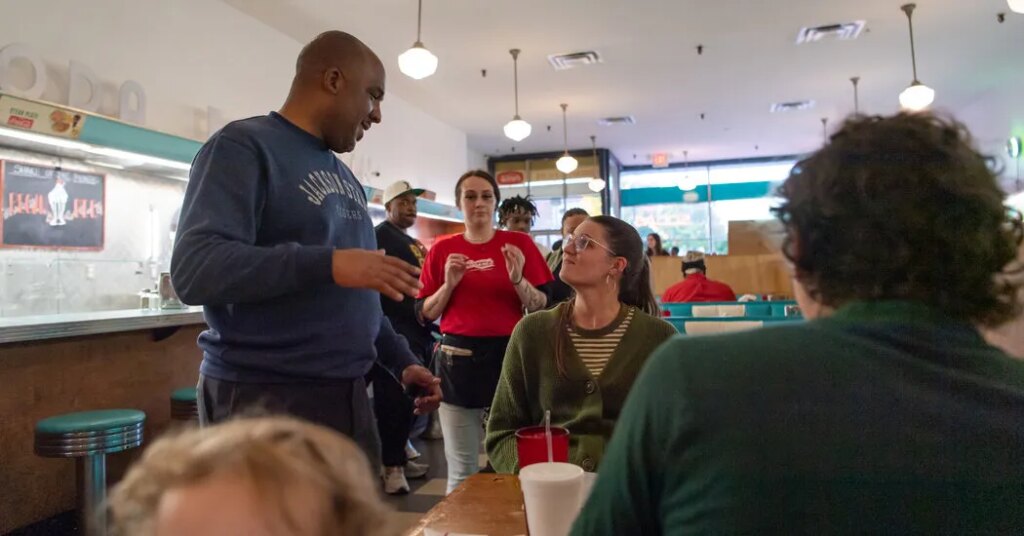
He pilloried Ms. Hyde-Smith about her low profile in the state with a series of “Where’s Cindy?” town halls. He set up a food truck outside small-town city halls and walked the line of attendees at a Trump rally in the final days of the campaign.
As in much of the country, President Trump’s record had led to frustrations even in conservative corners of the state: farmers were straining under costs from the Iran war and tariffs, working-class people were furious about cuts to health insurance subsidies they received through the Affordable Care Act, and suburbanites were in revolt over data center development.
Chris Cook, 60, a financial adviser in DeSoto County, where the Mississippi Delta merges into the Memphis suburbs, met Mr. Colom with a friend over a lunch of chicken, mashed potatoes and vegetables. Mr. Cook had backed Mr. Trump, but, he said, “there’s got to be some checks and balances” for a president he saw as “punch-drunk on power.”
He left the lunch fairly convinced he would support Mr. Colom. His friend, Mark Vines of Walls, Miss., also voted for Mr. Trump but had grown irked by Ms. Hyde-Smith’s opposition to releasing the Epstein files and her refusal to take questions.
“At that point, you look past your jersey,” said Mr. Vines, who even filmed a campaign ad for Mr. Colom.
On Tuesday, Mr. Colom flipped DeSoto County, which shifted 30 percentage points to the left of its vote in 2024. Just outside the capital of Jackson, he also flipped Madison County and its suburbs, once known for the white flight that began with the desegregation of Jackson’s schools. And in the state’s southeastern Pine Belt, he flipped Forrest County, named after a confederate general and Ku Klux Klan leader, and still largely conservative.
“Colom turned out the core Democratic vote and even increased it a little bit,” said Jere Nash, a veteran Democratic strategist in Mississippi, adding that Mr. Colom also won over Republicans who voted for G.O.P. incumbents lower on the ballot.
That, Mr. Nash said, “is unheard of.”
Aside from its name, Forrest County is also known for the University of Southern Mississippi, which supplied a previously untapped resource for the Colom campaign, college students.
Mr. Colom said early in his campaign that he knew he had “to get young people to care about this election.”
Young people were unlikely to see political ads on television, so he started making videos for social media. Late posts drew national attention, such as his “Pick another protein” gibe and his spin on the Mississippi-based movie “Sinners.” But long before those, he said, he knew his gambits were working “because I was going places and younger people would notice it.”
For some students, the election was a chance to reshape the image of Mississippi.
“Mississippi just needs to change,” said Aznii Welchlin, 21, a senior at Tougaloo College, a historically Black college in Jackson.
With the final call still days away, the change Ms. Welchlin wants is still on hold.
Unlike the students and her father long before them, Ms. Lewis said she was not political, though she cherished Mr. Chaney’s “vision of justice.” She did know how her father would have responded to this moment.
“Even if Scott Colom wins,” Ms. Lewis said, “I think the day after the voting, my dad would have gotten up the next morning and said: OK. Let’s get back to work.”
The post How Mississippi Reached the Verge of Electing a Black Senator appeared first on New York Times.