Few things unite South Africans like a dry faucet.
That’s what thousands of residents of Africa’s richest city, Johannesburg, woke up to on Wednesday before voting in local government elections. From the impoverished mostly Black township of Diepsloot to the racially mixed upper-middle-class Midrand to exclusive Hyde Park, which the president calls home, many voters expressed the same frustration as they left the polls.
“Now, we don’t have water,” said Luleka Ngqangqashe, 35 and unemployed. “Imagine.”
Some chalked up the Election Day outages to divine timing, others to political sabotage and still others to, well, life in Johannesburg. In any case, they were a reminder of the government failures that led the overwhelming majority of voters in this city of nearly five million people to vote against the nation’s once-dominant political, social and moral force: the African National Congress.
With most of the votes tallied by Sunday, the A.N.C. was projected to win around 20 percent of the vote in Johannesburg, down from 33 percent in the last local election five years ago. Its biggest rival, the Democratic Alliance, led by its combative mayoral candidate, Helen Zille, was far ahead at about 35 percent.
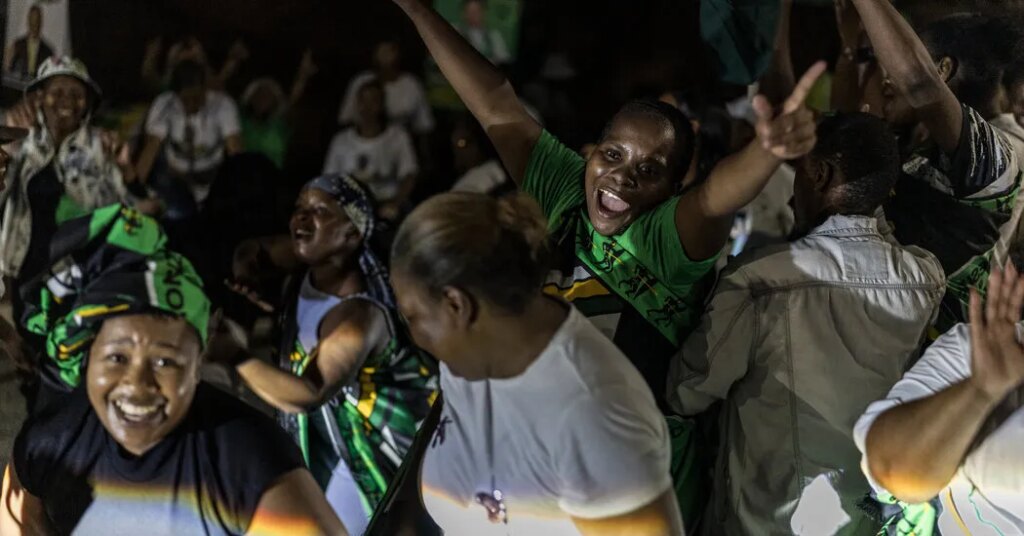
The results in Johannesburg, the country’s most populous city and economic engine, were indicative of the beating the A.N.C. took in mayoral and City Council races across the nation. The party, which for years rode a wave of good will for having led the country out of the racial oppression of apartheid, produced its worst electoral showing since South Africa became a democracy 32 years ago.
Less than a third of South Africans nationally cast ballots for the A.N.C., a decline of roughly 15 percentage points from five years ago. The party was projected to finish first in just two of South Africa’s eight major cities, compared with six in the previous election.
Although the party received more votes nationally than the hundreds of other parties that ran, few doubt that this result represents a decisive political shift.
“This is sort of now the end of the post-liberation era,” said William Gumede, a political scholar at the University of the Witwatersrand who has written extensively about the A.N.C.
The A.N.C. “now will just be the equivalent of any other party” that will “have to fight for the vote or die over time,” he added.
Over the past decade, the A.N.C. has plummeted in almost every major election. In 2016, it fell below 50 percent of the vote in Johannesburg and lost the mayor’s seat for the first time since democracy. In 2021, it slipped below 50 percent across the nation in local elections for the first time. In the 2024 national elections, the A.N.C. lost its absolute majority in Parliament, also a first.
If Republicans in the United States were overwhelmed by a Democratic blue wave in the U.S. midterm elections, then the A.N.C. was hit by a tsunami from all sides in South Africa’s multiparty system, said Wayne Sussman, an election analyst.
The Democratic Alliance, long the country’s second-largest party, received the most votes in five major metro areas. The A.N.C. also ceded ground in its historical strongholds to many other parties in an election that featured more than 500 of them. Its grip on South Africa’s Black majority also loosened.
The Democratic Alliance, long derided as a “white party,” estimated that it had won at least a million votes from Black South Africans, leading its leader, Geordin Hill-Lewis, the mayor of Cape Town, to declare, “We are now a mainstream party in every community in the country.”
Because South Africa uses proportional representation, parties will have to form coalitions to choose a mayor and govern in all of the major cities except Cape Town, which the Democratic Alliance won outright. The A.N.C. may still enter a coalition with the Democratic Alliance — which it partners with in the national government — to help govern Johannesburg and other metros. But for the first time, there is a real possibility that the A.N.C. could be locked out of government in most major cities.
“They’re not central to that conversation anymore,” Mr. Sussman said of the A.N.C. “That is just a stunning, stunning thing to say.”
What the A.N.C.’s free fall means for South Africans is unclear. The parties that so vigorously campaigned against it will now have to show that they can fix the frequent water outages, electricity cuts, crime, housing shortages, bad roads and other everyday municipal issues that turned so many South Africans against their former liberation party. Some analysts say that the shellacking in local elections could force the A.N.C. to compromise on its governing agenda not only in cities but also on national issues like foreign policy and affirmative action.
“The A.N.C. no longer can sort of relax into the belief that they are dictating the agenda within the metros,” said Caleigh Plaatjes, a consultant at Africa Practice, a strategic advisory firm.
A.N.C. officials concede that the party needs serious self-reflection. It is set to pick a new leader next year, and there has been little excitement around potential successors to President Cyril Ramaphosa, who also leads the country and can’t run again because of term limits. National elections that will decide the presidency are scheduled for 2029.
“If we do nothing about this situation, or if we continue the way in which we’ve been doing things, we are going to be an insignificant party that nobody will want to talk to in 2029,” said Mdumiseni Ntuli, the A.N.C.’s head of elections.
Zimasa Matiwane contributed reporting.
The post South Africa’s Politics May Never Be the Same Again appeared first on New York Times.