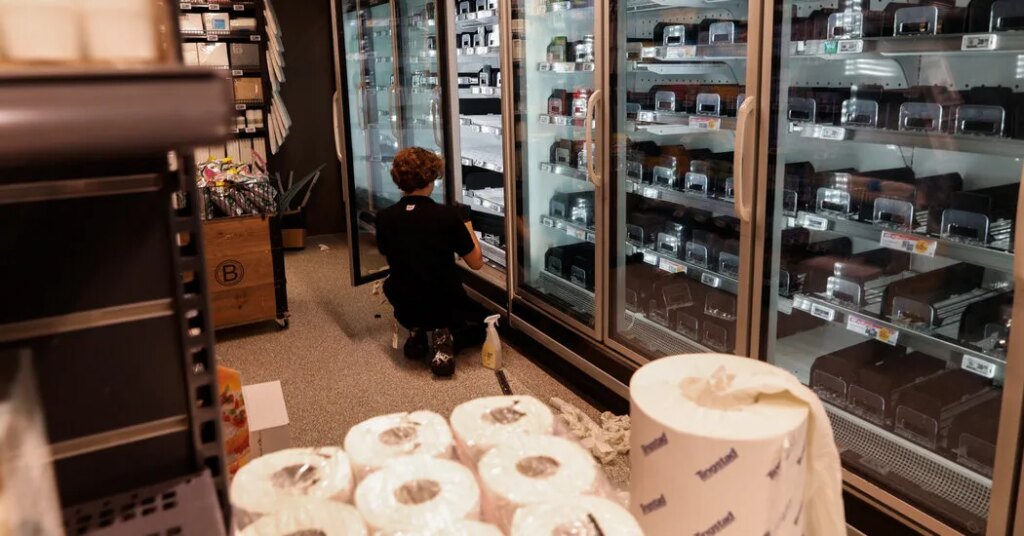
Supermarket refrigerators across Europe were hacked. Blood banks, too. Bomb threats grounded dozens of flights on the continent and emptied a handful of its newsrooms. European governments urgently warned of a vulnerability in ubiquitous software.
And the British government unveiled a slightly ominous campaign that urged citizens, “Be Ready.”
The mix of disarray and upheaval in recent days and weeks has left European officials rushing to identify culprits and residents inconvenienced, confused or fearful. Countries are struggling to fend off adversaries looking to steal data and disrupt life, sometimes in ways that once seemed distant but now touch daily routines such as grocery shopping.
Whether nuisances or true threats, the events collectively highlighted Europe’s vulnerability in a digitally connected era. Costs included spoiled food, time lost to flight delays and diversions and the expense of sending military jets to escort some of the planes to safe landings. The developments left unsettled the question of how, and when, the turmoil might ease.
“Psychological destabilization has been achieved,” Ciaran Martin, a former top British cyber official, said. “At a time Western Europeans have enough things to worry about, now they are getting news that they might go into the supermarket for a convenient meal on a busy day and find that it has melted. It does feed into that insecurity.”
Who is behind the intrusions remains unclear. They came amid an intensifying wave of sabotage operations that Western officials have blamed on Russia, which is trying to undermine European support for Ukraine. Asked about the refrigerator attacks, a Kremlin spokesman denied involvement.
The authorities in European countries raised suspicions that the attacks were related, if not through a single actor, then through a shared motivation to “create panic,” as Italy’s defense minister, Guido Crosetto, told reporters this past week. He also mentioned a spate of drone sightings over European military installations and airports in recent months.
“It’s all connected: the refrigerators, the blood in France, the drones, the planes, the threats,” he said.
And after newsrooms in Ireland were evacuated in response to emailed bomb threats on Friday, the Irish government said, “It seems likely that this is a coordinated campaign of disruption,” noting the threats to planes, as well.
Although the bomb threats turned out to be hoaxes, the grounding of so many flights showed how an unknown group can wield immense power, said John May, 45, who was traveling from Dublin to Rome to celebrate his 20th wedding anniversary on a flight that was diverted to Évreux-Fauville Air Base in France.
“This is happening to show the powers of Europe how easy it is to cause mass panic and disruption,” he said in a direct message on social media. “Europe needs to step up its security.”
Other Europeans said the events highlighted a sense of an uncertain future.
“What kind of world are we heading toward?” said Frederic Bombaerts, 58, while eating a hamburger for lunch in a bar in Brussels on Friday. “In recent years, it’s become a bit more worrisome, that’s for sure.”
The week opened with a broadening of the grocery cyberattacks that began last month in France. On Monday, supermarkets in Belgium, Estonia, Finland, Ireland, Luxembourg, the Netherlands and Sweden reported issues with cooling systems that started rising uncontrollably. Hackers exploited software that controlled the cooling systems, the authorities said. Then attacks hit French blood banks.
“The repeated occurrence of these cyberattacks is deeply concerning,” Christophe Hansen, the European Union’s agriculture and food commissioner, said in a statement. “They are a deliberate attempt to disrupt our food supply chain and undermine consumers’ confidence in it — a warning that we must take seriously.”
There were no demands for ransom. Mr. Martin called the hacking spree “baffling” because no one had claimed responsibility, nor had the authorities identified any suspects. By comparison, after an enormous $6.3 billion cyberattack last month on Binance, the world’s largest cryptocurrency exchange, the F.B.I. quickly determined that a North Korean hacking unit had carried it out.
No adversary government has been implicated in any of the attacks. The Kremlin’s spokesman, Dmitry S. Peskov, waved off accusations that pro-Russian groups were behind the supermarket attacks, calling such allegations “absurd.” Cyber experts are also treating claims by Russian groups about the bomb threats with skepticism.
The bomb threats and cyberattacks had the hallmarks of so-called hybrid operations that typically originate in Russia, said Peter Neumann, a professor of security studies at King’s College London. The targets were diffuse, and the goal seemed to be disruption.
“The aim of a hybrid campaign is to create chaos, uncertainty, and a sense of threat,” he said. Other hybrid attacks — aggressive actions that fall short of direct military conflict — blamed on Russia in recent years include arson, drone incursions and attacks on infrastructure.
Russia is also trying to exploit fault lines in European countries like Germany where divisions have grown over support for Ukraine, he said.
European leaders are set to meet next week in Ireland, whose public service broadcaster received a bomb threat on Friday, prompting the evacuation of its headquarters in Dublin. Other Irish media outlets received threatening messages, too, as did the British broadcaster Sky News.
“European leaders must establish control,” Barry Andrews, an Irish member of the European Parliament, said on social media. “This cannot continue.”
Some officials have taken the approach of enlisting the public in shoring up defenses against a variety of attacks or intrusions. At an event last month, Wes Streeting, the British defense secretary, said the public should be prepared to deal with a host of very serious threats.
He mentioned a vulnerability in PHP, an open-source programming language that helps run website and internet applications. Mr. Streeting said people should be “alert but not alarmed.”
Security agencies, including the U.S. National Security Agency, issued advisories about the PHP flaw, triggering fears in Europe and the rest of the world about disruptions for consumers and businesses.
British officials have also urged people to prepare to endure three days of interruptions to critical supplies such as water or electricity, whether because of severe weather, cyberattacks or other causes. They recommended stockpiling water, food, batteries and cash, among other items.
“We look for cues all the time that it is another country’s problem,” said Lucy Easthope, a specialist in emergency planning and a professor at the University of Bath in England. “But it’s not another country’s problem. It is our problem.”
She advised people not to be scared, but more prepared.
Mr. Bombaerts, in Brussels, said he and his wife began stocking up on supplies about six months ago, including bottles of water, flashlights and foods like quinoa and cereal, bracing for the unknown.
“We’re realizing that we’re at the end of an era, an era in which the balance of power is shifting and the center of gravity is shifting,” he said. “The geopolitical balance is shifting.”
Reporting was contributed by Jeanna Smialek and Koba Ryckewaert from Brussels, Amelia Nierenberg from London, Josephine de La Bruyère from Rome and Dustin Volz from Washington.
The post Bomb Threats and Cyberattacks in Europe Inject Unease Into Everyday Life appeared first on New York Times.