When the new Senate convenes in January, it will welcome some (relatively) young new legislators. A few are even millennials, including James Talarico of Texas, 37, and Abdul El-Sayed of Michigan, 42, two Democrats who may have energized young voters to turn out.
But their effect on the average age of the Senate — which has crept up over the last few decades — will be small. The senators of the 120th Congress will be less than a year younger, on average, than the Senate’s current members were at the start of the 119th Congress two years ago. That’s because so many sitting senators are old, and getting older.
These numbers assume that Mary Peltola and Scott Colom will win their races in Alaska and Mississippi; they were both ahead in the vote count late Friday. (If both lose, the Senate’s average age will land at 63.6.)
Voter complaints about an aging Congress were part of the discussion as the midterm primaries played out. Polls show a majority of Americans support age limits for elected officials, but voters have continued to choose older politicians. In congressional primary races where an incumbent 65 or older faced a challenger, often a younger candidate, the incumbent almost always won, according to a New York Times analysis.
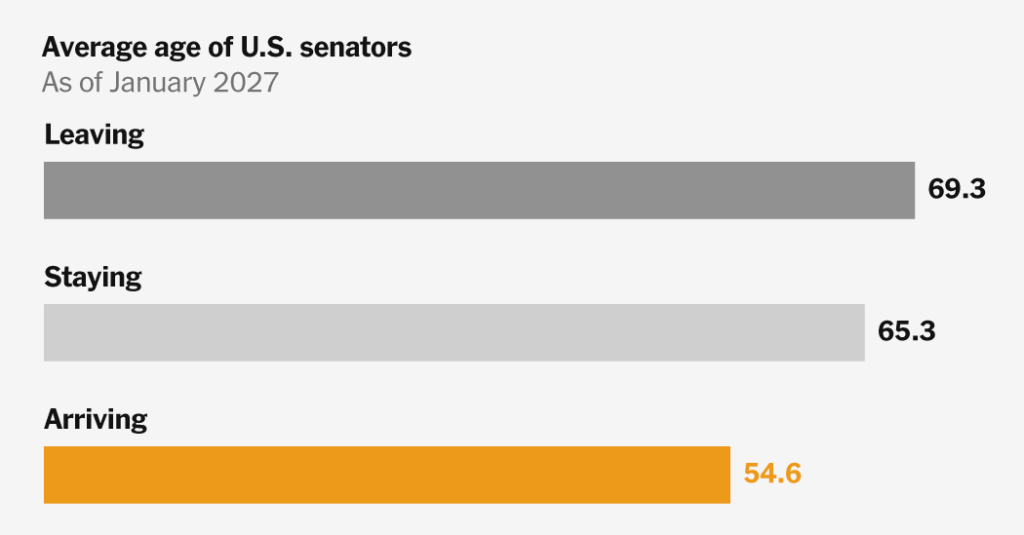
Still, some older members of the Senate are headed out the door, and the new senators-elect are, on average, much younger. The age difference between incoming and departing senators is nearly 15 years.
But new members make up only about a fifth of the next Senate, in part because only about a third of the members are up for re-election every two years.
And the aging of returning senators over the past two years has erased most of the effect brought by incoming younger senators. If all current Senate members had remained, the average age would have risen above 66.
Democrats, in particular, will contribute to the age decline. Of the incoming senators, the average age for Democrats is 53; for Republicans, it’s 58.
Mr. Talarico, the youngest incoming senator, will be part of the small percentage of senators under the age of 40 sworn in since 1900 — including Joe Biden, who took the oath of office soon after he turned 30. (Barack Obama was 43 when he was sworn in.)
The oldest incoming senator — who is also a former senator — is Sherrod Brown of Ohio, who will turn 74 on Monday.
About the data
Senators’ ages were calculated based on the day that Congress first convened (or, for the 120th Congress, will convene).
For the Senate of the 119th Congress, we used only the members who were serving as of early November, excluding those who left — such as JD Vance (to become vice president), Marco Rubio (to become secretary of state) and Lindsey Graham (who died in July). Their replacements were included to get an accurate picture of the differences between incoming and departing members. For earlier years, for simplicity, we used the members who started each term.
Additional reporting by Karen Yourish, Elena Shao, Ashley Wu and Matt Zdun.
The post With So Much New Blood in the Senate, the Average Age Is Falling. To 63. appeared first on New York Times.