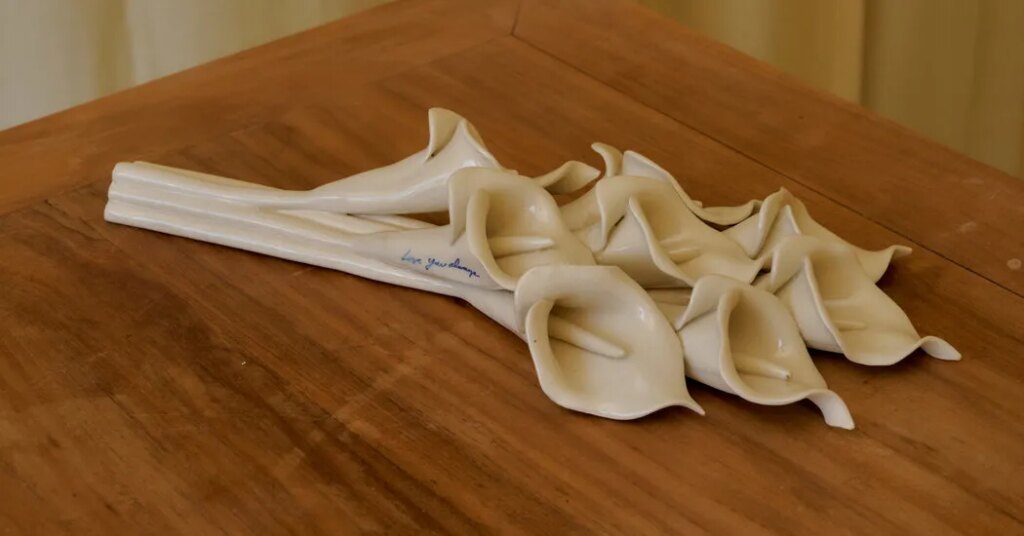
A month before her June wedding on the Amalfi Coast in Italy, Clare Dumont worked with the ceramist Karina Black to make her bouquet from scratch.
Dumont, a Brooklyn-based bride who works in tech, built her calla lily bouquet at Black’s four-week course at Dusty & Co, a studio in NoMad, Manhattan. The flowers, handmade to look strikingly similar to the real thing, are Black’s design. Dumont, 30, sculpted her own under Black’s guidance, with the artist designing and assembling the final bouquet.
On the day of her wedding to Matthew Turk, 31, Dumont said she felt like she was holding something with “weight and intention.” Weighing about a couple of pounds, similar to a traditional bouquet, the clay flowers are now displayed in the newlyweds’ living room.
Black, a Los Angeles-based artist and the founder of Cosa Ceramica, has become the face of the niche ceramic flower bouquet category and a driver of its demand, even though she didn’t set out to make wedding flowers. “People want fewer things that disappear overnight and more things that become part of their lives afterward,” she said. (If the flowers break or chip in transit, Black and her team will remake the bouquet. If it chips in the owner’s possession, Black recommends using super glue to repair the ceramic flowers.)
Before working as a ceramist, Black was in digital marketing, using clay as a creative outlet when she needed something “grounding and more tactile.” She initially focused on creating pieces that focused on memory preservation with a line of ceramics that involved stenciling real handwriting — letters, recipes and wedding vows — into clay.
The flowers were a happy accident that came to life during a studio session in October 2025, when she found herself sculpting forms that resembled calla lilies and decided to turn the shape into a series, the Calla collection, which she introduced on Instagram in March 2026.
When she shared a video of the ceramic flowers on Instagram, people responded positively in comments. She officially introduced the concept of the clay wedding bouquets in May, and “things really took off,” she said.
Cosa had about 62,000 Instagram followers at the time, and has since gained more than 40,000. Black has been thrilled. Her Calla videos have brought in nearly 8.3 million views.
While clay bouquets are increasing in popularity, ceramic flowers date as far back as the 18th century, with European porcelain houses creating them as décor. Katy Schimert, a ceramics professor at the Rhode Island School of Design, said “people want things that are handcrafted and last,” attributing an increased interest in clay to a desire to “balance out the digital.”
Black deliberately keeps her commissions limited, in part because a single piece can take several weeks to complete. But she has no interest in scaling into mass production or outsourcing the manufacturing. “I love that the people who connect with my work get to work with me personally,” she said.
Since starting her Calla collection in March, she has made custom pieces for nearly 30 brides, taking on three to five commissions a month. In addition to the bouquets she’s currently working on, she is fully booked through the end of the year.
Shira Berg, a New York-based ceramist and founder of Shira Berg Studio, is also fielding bridal requests. This summer, Berg, whose work focuses on florals, received two bouquet requests for 2027 weddings — one is a ceramic bouquet of white roses, and the other is a hybrid of real flowers and ceramics, featuring daisies and wildflowers.
And while a traditional flower-centric bouquet can cost up to $500 for elaborate arrangements, according to the wedding website Zola, the ceramic bouquet is more of an investment. A single stem starts at $250, similar to the cost of a simple standard fresh bouquet. But brides are opting for more than one ceramic flower.
Cosa’s website also sells two ready-made bouquets: A three-stem cascading bouquet costs $1,800, and an eight-stem bouquet costs $3,000. Because the forms are delicate and layered, the sculpture increases in difficulty with each stem. Berg charges $200 for each long-stem flower. She recommends three to five stems for a hybrid bouquet and seven to 10 stems for a full ceramic bouquet, calling the flowers “an investment.”
Paige Cleary, 28, a data platform manager from Knoxville, Tenn., who is getting married at a Scottish castle in December 2027, said seeing the calla lilies on Instagram for the first time felt like “being struck by lightning.” She’s known Mod Becher, Cosa’s production ceramist who helps run the Los Angeles studio, since seventh grade, and reached out to him on Instagram before the wedding bouquets were announced.
A bouquet that lives beyond the wedding day instantly becomes a family heirloom, taking away the headache that comes with logistics around pressing and drying traditional flowers. Dumont imagines her future daughter will carry her clay bouquet down the aisle decades from now.
Ceramics, as Black pointed out, can outlive even the person who made it.
The post Would You Carry a Bouquet Made from Clay? appeared first on New York Times.