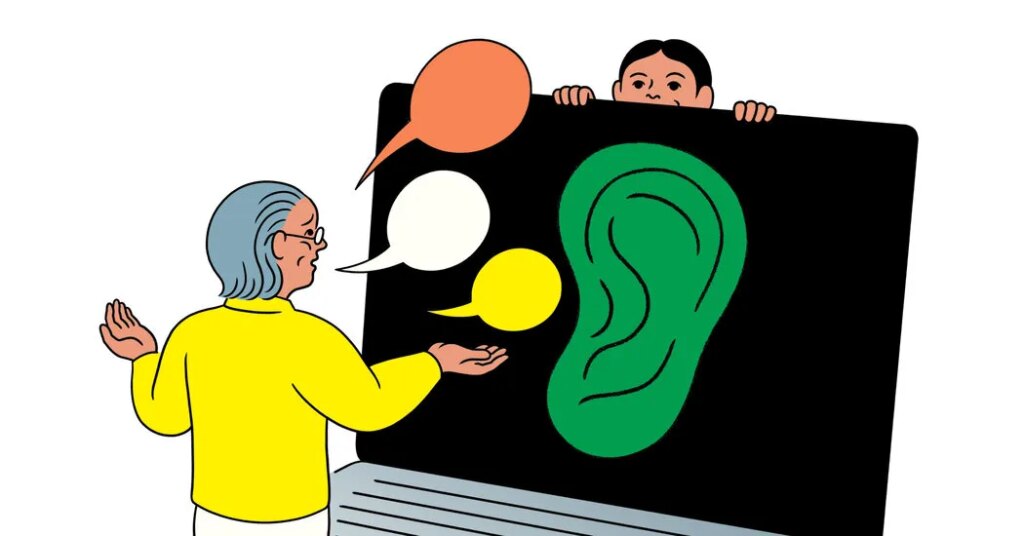
My mother has been deeply negative and prone to catastrophizing for as long as I can remember, increasingly so as she has aged. Last year, when her health problems became too much for my father to manage, they moved into an independent-living facility. My mother now claims she never agreed to the move, though she did at the time.
Her physical health has since improved remarkably. She takes medication prescribed by a psychiatrist and attends regular counseling, but her outlook remains unchanged. She finds fault with the facility’s extensive services while demanding more than anyone can realistically provide. She seems to suffer from “perfectionist paralysis”: Even small decisions overwhelm her, yet she refuses to admit she needs help, blaming others for not providing enough information.
As my father’s memory, health and independence have deteriorated, the burden of her negativity and helplessness has fallen increasingly on my brother and me. I speak with her nearly every day from several states away; my brother, who lives closer, bears a much heavier burden. She dismisses suggestions that require her to do anything, and trying to end calls with her becomes an exhausting process of having to listen to another grievance or request.
My brother and I want to support her, but the toll is unsustainable. As regular users of artificial intelligence, we’ve wondered whether we could offer her a clearly identified chatbot to serve as a 24/7, infinitely patient sounding board and source of practical help. We recognize the risks of “hallucinated” advice that is not actually sound and of the loss of genuine human connection, but we hope that talking with a chatbot might help my mother reframe her anxieties and assist her in ways my brother and I can no longer manage without resentment.
What do adult children owe aging parents when their emotional demands exceed what we can reasonably provide? Would using a chatbot as an emotional buffer be compassionate, or would we be failing in our filial duty by substituting an algorithm for a child’s attention? — Name Withheld
From the Ethicist:
The interactions people have with a chatbot aren’t equivalent to a relationship with an actual person. Part of the value of a human relationship lies in the presence of someone real and independent on the other side of it, someone with distinct concerns and values, someone who matters the way you matter. Love, Iris Murdoch once wrote, is “the extremely difficult realization that something other than oneself is real.” A simulated persona, by contrast, can give us the illusion of another person’s company without confronting us with another person’s independent will.
But let’s not dodge the “Compared with what?” question. The fact that a chatbot is no substitute for human companionship doesn’t mean it can’t play a useful role when other people aren’t available. You owe your mother attention and companionship, but not in unlimited quantities. It’s relevant that you and your brother are feeling exhausted by emotional demands that exceed what you can reasonably supply. If your mother would feel better having an A.I. chat partner, that counts as a reason to provide one.
There are risks, of course. A chatbot that’s endlessly complacent might reinforce your mother’s catastrophizing, affirming her grievances rather than, as you hope, helping her gain perspective. But in an aboveboard way, you can tailor the chatbot, through custom instructions, so as to discourage reflexive agreement and encourage more thoughtful responses. Another challenge is how you’d present this resource to your mother without making her feel that you’re beating a retreat. You could suggest that she turn to the chatbot when she wants help thinking through a problem. If she could work through some of her worries with the bot, your own conversations just might become more rewarding.
Whatever comfort she draws from a chatbot, it isn’t going to replace the value of being loved by people with lives of their own, people with whom she shares a history. Still, recognizing people as real means recognizing that their time and patience have limits. On some level, she has to be able to understand that her children can love her and still need to get off the phone.
Readers Respond
The previous question was from a reader who was seeking guidance about a memoir she was writing about her life. She wrote:
I have written a memoir that includes the story of a crime my mentally ill brother was convicted of more than 40 years ago. I have always had a very close relationship with my brother and am now overseeing his care in assisted living. The memoir, while delving into the circumstances surrounding the crime, is mostly about our relationship and its evolution through the years. I worked very hard on the book and have received very positive comments from mentors in the publishing world. It would mean a lot to me to get it published. … Do I ask my brother for permission to publish it? My parents and others who might have been hurt by the publication of the story are now gone. My brother is developing dementia and will most likely never be aware of the book’s publication if I do not tell him about it. He and I never talk about the crime … and I am afraid such a conversation might destabilize him. I have changed the names in the book. What obligation do I have here? — Name Withheld
In his response, the Ethicist noted:
We generally owe those we love fair warning when our choices may expose aspects of their private lives. … This doesn’t give the person a moral veto over publication. But we should consider their wishes, even if we ultimately don’t comply with them. … Your brother’s condition doesn’t necessarily prevent him from expressing a meaningful preference. You might consult someone familiar with his care about whether discussing the book with him would pose the risks you fear. Even if it would, you should consider whether he would have consented when his ability to deliberate was less impaired. Having known him all your life, you may have a good sense of what he would have wanted. The question is whether your reasons for publishing justify revealing things he would have preferred to keep private. … It would be wise to discuss these questions with someone who can consider his interests without sharing your hopes for the book. That your brother may never learn of its publication is a good reason not to upset him unnecessarily; it’s not a reason to disregard what he would have wanted.
(Reread the full question and answer here.)
⬥
I am an editor at a nonfiction publisher, and I acquire and publish many memoirs per year. If your brother is still living and if he is at all identifiable to a savvy sleuth (e.g., he shares a last name with you), the publisher I work for would require his permission in writing to move forward with the memoir. It’s likely other publishers would, as well. It would be wise to start the conversation now so you’re positioned to obtain his permission in writing if your publisher requires it. — Sophia
⬥
I am a memoirist and publisher with 75 books under my belt. My hard and fast rule that I present to clients when deciding how much to say is: “Would you say this out loud to the face of the person you’re writing about?” If yes, then say it to the world. If no, keep it to yourself or hide it behind indistinguishable details. Considering the brother’s mental state, there’s no reason to bother him with such a question. It sounds like the crime is just part of a bigger story about the relationship between you. I see no reason not to say what the author wants to say. If she were my client, I would give her the green light. — Marlayna
⬥
If the letter writer really thought her brother would approve the memoir about her brother’s crime, she would have asked him. Since she really wants to publish the book, she has made up a plausible reason to not tell her brother, and she is asking the Ethicist to justify this unethical course of action. She absolutely should not publish this memoir without at least telling her brother. — Aileen
⬥
If all memoirists followed your advice, there would be no memoirs. Anne Lamott: “If people wanted you to write warmly about them, they should’ve behaved better.” Mary Karr urges writers to write both lovingly and truthfully, and it sounds like this writer is doing just that, changing the names and neither avoiding nor focusing on the crime. — Kat
⬥
You say the writer should tell her brother but has no obligation to comply with his wishes. I wonder which is worse: a) Not telling the brother, or b) Telling him, having him say he doesn’t want it published, and then publishing it anyway. It seems to me that telling the person contains at least an implicit request for permission, unless it’s made clear that the revelation is purely informational and that the person’s wishes will be regarded as irrelevant, which is an unlikely conversation with a sibling or a friend. Though the negative implications are about equal, were I the person being written about, I think I’d feel marginally worse if I had denied permission and the material was published anyway. — Steve
The post Can I Have an A.I. Chatbot Field My Mother’s Endless Complaints? appeared first on New York Times.