More than a half century after it triumphed over the Soviet Union in humanity’s first space race, the United States is again vying with a communist rival to reach the moon.
But in the decades since Neil Armstrong and Buzz Aldrin left a stirring memorial plaque in the desert of another world — We came in peace for all mankind — much has changed. Once a symbol of superlative government competence, the nation’s weakened federal space agency has largely outsourced its extraterrestrial ambitions to the private sector.
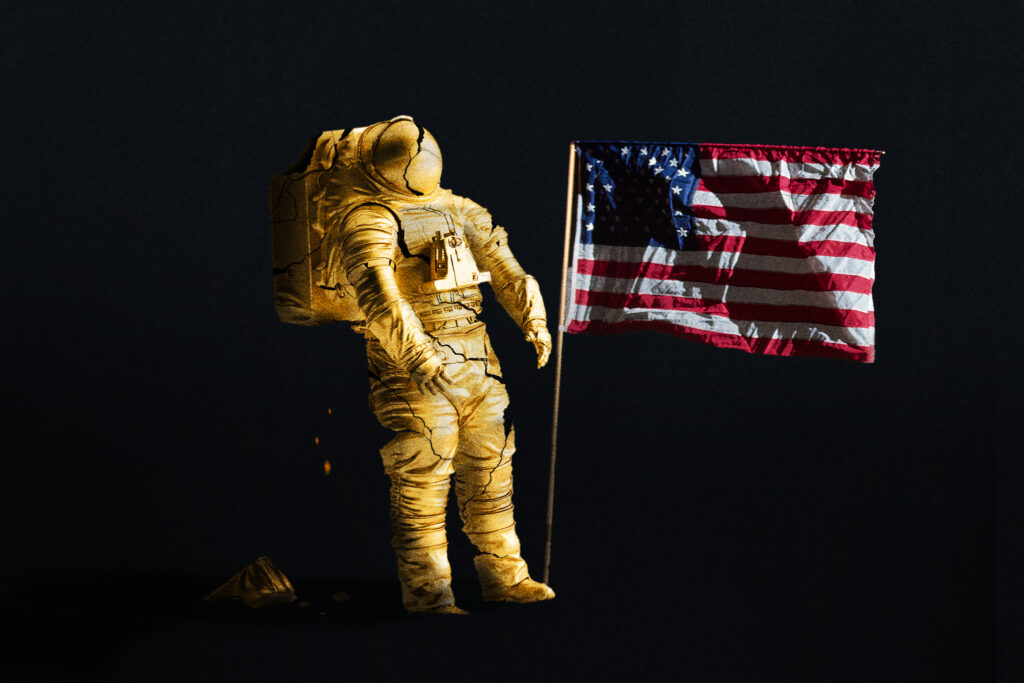
As a result of that shift, a pressing question now confronts the U.S. space program: When American astronauts return to the lunar surface, will they have anything to wear?
The answer depends on Axiom Space, a little-known vendor responsible for redesigning spacesuits that have not had a wholesale update since the 1970s. Founded in 2016 by a longtime federal contractor and a former NASA engineer, Axiom embodies the flashy ethos and uncertain prospects of what is still a largely speculative space economy.
Originally focused on the still-distant goal of building a for-profit space station, Axiom has branched out into other out-of-this-world business ventures. Among them was the idea, promptly vetoed by NASA, to hold World Wrestling Entertainment matches in orbit, according to a former executive at the company. For the new spacesuits, it is teaming up with Prada, the Italian fashion house known for its luxury dresses and $3,000 leather purses.
It is a fitting partnership for Axiom, whose business model has so far consisted in substantial part of outfitting the ultrawealthy for excursions into orbit — and which has drawn hundreds of millions in investment from venture capitalists bullish on commercial possibilities beyond Earth’s atmosphere. Among Axiom’s financial backers is 1789 Capital, the investment firm in which the president’s son, Donald Trump Jr., is a partner, and which has drawn congressional scrutiny for its relationships to defense-tech firms with federal contracts.
Yet cracks are showing through Axiom’s glitzy veneer. Interviews with former employees, current and former NASA officials and space industry experts portray an ambitious company that has charmed investors but struggled to find financial and organizational stability or to turn its dreams — from an orbital studio intended for Tom Cruise to the Prada spacesuits expected by U.S. astronauts — into realities. In recent years, Axiom has struggled with inconsistent cash flows, churned through top executives and grown reliant on NASA personnel to help develop the spacesuit the agency is paying the company to create.
In April, NASA’s inspector general issued a report warning that Axiom was at risk of not having the next-generation spacesuits ready in time for the Artemis program’s much-anticipated lunar landing in 2028, Americans’ first trip back to the moon’s surface since 1972. The potential delay, which would compound other missed deadlines in the Artemis program, could mean that China will become the first nation to land astronauts on the moon in the 21st century.
Fearful of falling behind, NASA officials recently decided to scale back the features on the spacesuit Axiom is creating for the first Artemis moon landing — simplifying the work in hope of staying on schedule. The result will be a suit whose basic capabilities resemble those of astronauts’ gear on the Apollo missions in the 1960s and 1970s, according to NASA officials.
One analyst described it as a “bargain basement version” of the extensive upgrade for which NASA was initially willing to pay more than $3 billion. The agency has already obligated at least $594 million of that sum to Axiom, federal contracting records show. NASA officials say the more advanced, full-featured spacesuit will continue to be developed.
Axiom declined repeated requests for comment and did not respond to a list of detailed questions for this report. Spokespeople for Prada and for 1789 Capital declined to comment.
In an interview with The Washington Post, NASA Administrator Jared Isaacman acknowledged that Axiom, before his agency’s recent intervention, had not been on track to deliver the spacesuit originally envisioned for the Artemis moon landing. However, Isaacman suggested that blame lay not just with Axiom but with his own agency, which he said had unrealistic expectations for the kind of advanced space suit the private sector could deliver.
“It’s not fair for NASA to shift our responsibility of achieving the near-impossible,” Isaacman said. “When it comes to the suits, I’m sure there is some responsibility Axiom has in the process. There’s also a lot on NASA.”
The changes to Axiom’s mandate are part of a broader reassessment of the U.S. space program, Isaacman said. When he took his job 10 months ago, the NASA administrator — an ally of SpaceX founder and CEO Elon Musk and the first former private astronaut to lead the agency — was widely expected to double down on a decades-long privatization trend. Instead, he has surprised some of his erstwhile critics by musing publicly that the storied U.S. space program has grown too dependent on commercial actors.
“It became this kind of ‘easy’ button, if you will,” Isaacman told The Post.
The story of Axiom, and of the generational changes at NASA and in the American economy that gave a relatively untested firm such a pivotal role in America’s next mission to the moon, is bigger than a single company, contract or presidential administration. It is, rather, a case study in the consequences of the U.S. government’s gradual relinquishing of the final frontier to eccentric billionaires, delay-prone contractors and hype-soaked tech start-ups.
The first moon landing was the work of an energetic federal agency that was barely 10 years old but wielded more than 4 percent of the U.S. government’s total budget. Today, NASA is in torpid and comparatively impoverished middle age — allotted less than half of one percent of the federal budget — and has let private firms take the lead on human spaceflight.
This approach has benefits. SpaceX, the company owned by Musk, has almost single-handedly revived core pieces of the U.S. space program, creating reusable rockets and restoring the transportation of American astronauts and cargo to the International Space Station aboard its Dragon vessel. Spurred by SpaceX’s trillion-dollar public offering this summer and the Trump administration’s plans to expand the U.S. Space Force — the extraterrestrial branch of the military — private investors poured $23 billion into space-oriented companies during the first half of this year, more than double the previous year’s tally, according to Seraphim, a British investment firm that tracks funding of the space industry.
But most companies are not SpaceX. (Just ask Musk’s less accomplished competitors, which have struggled to rival his company’s scale and launch cadence. They include Blue Origin, the rocket venture created by Amazon founder Jeff Bezos, who also owns The Washington Post.) And NASA’s reliance on profit-driven entrepreneurs has introduced differences of culture and style to the U.S. space program that are a far cry from the sober optimism of the agency’s “for all mankind” era.
‘Our secret sauce’
Amid the marvels of physics and engineering that enable humans to venture beyond their home planet’s atmosphere, the humble spacesuit is easy to overlook.
But suits are much more than just a protective layer around an astronaut. They are, in essence, a one-person space vessel — not only shielding their wearers but sustaining telecommunications and life support, regulating the body’s temperature and pressure and absorbing urine and feces in the highest-of-high-tech diapers.
To reliably provide these functions inside a flexible, durable garment isn’t easy. NASA achieved it for the Apollo missions in the 1960s in partnership with private contractors including Hamilton Standard, an aircraft company that brought to bear its expertise in creating pressurized cabin environments.
But since the 1970s, faced with tight budgets and changing mission directives, the agency has repeatedly failed to overhaul its spacesuits. These efforts began in 2007 and persisted in various forms through 2022, when NASA went looking for private vendors to do the job.
The project was urgent. Astronauts were clambering around the ISS in refurbished suits whose design was decades old. In 2013, Italian astronaut Luca Parmitano almost drowned during a spacewalk when his old-line NASA suit malfunctioned and leaked water into his helmet. NASA’s Aerospace Safety Advisory Panel repeatedly expressed concern about the age of the suits worn by American astronauts, calling their use “a clear and present safety risk” in a 2022 report.
“It is an undeniable fact that the 40-year-old [spacesuits] used in ISS operations are reaching the end of their useful life,” the panel stated. “The problem does not lie simply in the fact that the suits are old; but the fact that manufacturers of several critical suit components, including the very fabric of the suits, have now gone out of business.”
In 2022, NASA selected two contractors for a multibillion-dollar redesign, intended to ultimately produce a versatile suit whose main components could be used both for floating in space and roaming the surface of the moon. One company was Collins Aerospace, a longtime agency vendor created through a merger that absorbed Hamilton, the original designer of NASA’s spacesuits.
The other was a 6-year-old startup based in Texas.
Axiom was founded in 2016 by Kamal Ghaffarian, an engineer who had come to the United States from Iran for his college studies. Ghaffarian had made a fortune working at and eventually running companies that focused on a primary customer: the U.S. government. In 2018 he sold one of these firms, Stinger Ghaffarian Technologies — which provided IT and other support services for NASA — for $355 million.
Ghaffarian was not shy about sharing the key to his success. “This ability to bid on contracts and succeed is our secret sauce,” he told a Forbes reporter in 2023.
With Axiom — co-founded with Michael Suffredini, a veteran NASA employee and former program manager of the International Space Station — Ghaffarian’s plan was to create the first fully privatized space station. The idea was to build smaller modules, initially attached to the ISS, that could be separated and expanded into an independent station before the ISS’s scheduled decommissioning in 2030.
By the end of 2022, the firm had raised $320 million from private investors and was valued at close to $2 billion, according to an investor who met with company officials in the first quarter of 2023. Axiom was then attempting to raise an additional $400 million, said the investor, who spoke on the condition of anonymity in order to share financial information that Axiom conveyed privately.
“They did not feel like bulls—,” said the investor, who ultimately chose not to put money into Ghaffarian’s project. “We thought they were very smart in assessing an opportunity. We were not sure they could pull it off.”
By that time, Axiom had already won the NASA spacesuit contract but did not talk about it in their pitch, the investor said. This was not a coincidence, according to a former Axiom employee, who spoke on the condition of anonymity to discuss internal company operations.
The suits, the former employee said, were essentially an afterthought. Although Axiom officials worked hard to prepare their bid, the firm’s leaders were still primarily interested in building a space station, and considered the spacesuit contract a fortuitous stream of revenue that could support that goal. NASA’s inspector general later observed that Axiom had “no appreciable spacesuit development experience” at the time it won the contract.
“It was one of these things that the company won the award and went, ‘Oh,’” said another former employee, a departed Axiom executive who spoke on the condition of anonymity to candidly discuss financial and organizational problems inside the company.
‘It was madness’
By the time it won the spacesuits contract in 2022, Axiom’s plans for a commercial space station were off track. The company had originally aimed to have its first module ready to attach to the ISS by 2020, but two years later was not close to being ready. In the meantime, it had turned to another line of business: facilitating trips to low earth orbit by rich hobbyists, as well as astronauts from smaller countries, aboard SpaceX vessels.
Axiom charged as much as $55 million per person for these adventures. Nevertheless, the company lost money on the trips, the former executive said, it margins eroded in part by the need to provide months of training, quarantine, transportation and lodging for its customers. “We had to train the commercial astronauts and they were treated like royalty,” the former executive said. “The amount of money we were spending on hotels and cars and training was insane.”
In September 2022, a Texas school district and the city of Houston sued Axiom for more than $17,000 in unpaid property taxes. (The case was dropped two months later, according to court records.) By 2023, according to reporting by Forbes, Axiom was struggling to make payroll. The 2026 NASA inspector general’s report noted that the agency agreed in 2023 to “partial milestone payments” to Axiom—essentially providing advance infusions of money for the incomplete spacesuit—in a move that the IG interpreted as “signifying cash flow issues” at the company.
Over about 15 months in 2024 and 2025, Axiom had four different CEOs.
“It was madness,” the former Axiom executive said. “It just became kind of this spiral. The minute we had an investment come in it was right back out the door. It was a company that should have been in a more mature state, and it was still acting like a startup.”
At one point, Axiom leaders privately considered holding professional wrestling matches in space, according to the former executive. The idea did not sit well with federal officials who still had some sense of Apollo-era propriety. “When NASA heard that was something that was being kicked around, they completely lost their minds,” the former executive said.
While the WWE idea did not pan out, Axiom had a knack for forming attention-grabbing corporate partnerships. In 2022, a UK-based entertainment company announced that it had contracted Axiom to build a studio in space for a Tom Cruise movie. Four years later, shooting has yet to start, because the studio does not exist.
Officials at the UK company, Space Entertainment Enterprise, did not respond to a request for comment. A representative for Cruise did not respond to a request for comment.
When it set out to redesign NASA’s spacesuits, Axiom teamed up with marquee brands including Prada and Oakley, the high-end sunglasses company. (Spokespeople for Oakley did not respond to a request for comment.) In 2024, Axiom revealed some sleek-looking prototypes of the suit at a conference in Milan. In June of this year, at Prada’s store in Manhattan’s SoHo neighborhood, the company unveiled an elegant gray bodysuit—what a Prada executive called “super nice pajamas”—that will serve as the underlayer of the new moon garments.
“Prada leads the world in development of luxury items,” Axiom CEO Jonathan Cirtain said, according to the New York Times. “Why would you choose to do it on your own when you could work with the best?”
Earlier this year, Axiom announced that it had raised $350 million in an investment round led by Qatar’s sovereign wealth fund and Type One Ventures, a venture capital firm specializing in space companies. Another investor in that round was Donald Trump Jr.’s firm, 1789 Capital.
The president’s son has had no direct involvement with Axiom and was not part of the decision to invest in it, according to three people who are familiar with 1789 Capital’s relationship with Axiom, and who spoke on the condition of anonymity to describe private conversations. The venture-capital firm is led by investors Omeed Malik and Chris Buskirk, a prominent ally of Vice President JD Vance.
1789 made a small investment in Axiom after an introduction from a Mar-a-Lago member involved with Type One Ventures, two of the people said. The 1789 investors wanted to establish a stake in Axiom in case the company becomes a prominent player in the space economy. Among the firm’s other investments is a large stake in SpaceX.
Isaacman told The Post that no representatives of 1789 have ever spoken to him about Axiom’s spacesuit contract and that the White House has never pressured him to treat the company favorably. He noted that the company won the spacesuit contract during the Biden administration, four years before 1789 invested.
For all mankind, in rented clothes
By tapping multiple vendors for the suit redevelopment project, NASA intended to reduce the risk of relying on just one contractor. The combined maximum value of the contracts was more than $3 billion, according to federal records: a ceiling for the total amount that could be split among the chosen firms.
But the daunting specs for the sort of spacesuit the agency wanted — capable not only of floating around outside a space station but of repeated exposure to the sharp rocks and highly abrasive dust (more like powdered glass) on the moon’s surface — had, from the start, scared off most firms.
“If everybody could build a spacesuit, we’d have a ton of vendors, just like we do with space vehicles,” said a former NASA official, who spoke on the condition of anonymity because he was not authorized to publicly discuss the agency.
In 2024, facing complaints from NASA about its work, Collins gave upon the suits in order to prioritize other contracts. That left NASA reliant on a single vendor, Axiom, which had now become a linchpin in America’s quest to return to the moon.
That quest was already beset by other challenges.
The first Trump administration announced the Artemis missions in 2019, laying out an aggressive jump-starting of human space exploration. American astronauts planned not only to return to the moon, but to build a permanent base at the lunar south pole. This, in turn, could be a stepping stone for humans’ first crewed mission to Mars.
NASA had originally hoped to get an American astronaut back on the moon in 2024. It is now aiming for a lunar landing by the end of Trump’s second term, in 2028.
Even that delayed timeline is questionable. SpaceX is behind schedule on its Starship vessel, intended to land humans on the lunar surface. The NASA inspector general’s office, in its April report, estimated that Axiom, if it experienced the sorts of delays typical of other agency projects, might not have the next-generation spacesuits ready until 2031.
Wary of this risk, NASA has now tasked Axiom with designing a pared-back “sortie suit” for the 2028 moon landing. Isaacman told The Post that the simplified suit will be capable of excursions of about two-and-a-half hours — similar to the suits worn on the Apollo missions. Axiom’s contract had originally called for a spacesuit that could be used for six hours at a time, he said.
“It’s certainly going to be modern, and it will be inherently more safe, because we’re building in more redundancy and fault tolerance,” Isaacman said of the sortie suit. “But the requirements are going to be more in line with a ‘step one.’”
The NASA administrator said that the more advanced suit will still be created, although he could not say when.
“Everything now is being done in a much more logical, iterative approach,” Isaacman said. “If everything was right to the dream state, if everything had to [be] Apollo 11 on steroids, it’s not going to be done on time or on budget.”
America’s next spacesuit may well be appropriate for lunar recreation such as Alan Shepard’s golf swing or Eugene Cernan’s bunny hop. But it probably won’t be ready for the Ultimate Warrior’s Gorilla Press Slam, to say nothing of Sabu’s Triple Jump Moonsault.
Charlie Precourt, a former astronaut and member of the Aerospace Safety Advisory Panel, said at a panel meeting in August that NASA has also taken a much more hands-on role in developing the new spacesuits — dispatching its technical experts to work with Axiom employees, offering the company the use of government facilities and performing “increased day-to-day insight through embedded personnel,” according to minutes of the meeting.
Don Platt, director of the Spaceport Education Center at the Florida Institute of Technology, said that, even with NASA’s direct involvement and the decision to settle for what he called a “bargain basement version” of its new spacesuit, it’s an open question whether the Artemis missions can stick to their latest timeline.
“I see very little chance, honestly, that NASA will have humans on the moon by the end of 2028,” Platt said.
The mission’s timing will be closely watched, and measured, against the nation’s chief geopolitical rival. China’s ambitious space program, after successful lunar excursions using robots, is now attempting to land its own astronauts on the moon by 2030. (China’s Tiangong space station, in orbit since 2021, is already on track to become humans’ only permanent extraterrestrial abode after the ISS shuts down.)
The competition’s outcome could be interpreted as a verdict on two very different paradigms of 21st century space exploration. China, a country whose industrial and technological progress is closely superintended by its authoritarian government, is — somewhat ironically — taking an approach to its moon missions that resembles the American government’s top-down efforts in the 1960s, said Jack Kiraly, chief of advocacy at the nonprofit Planetary Society.
This government-centric approach has distinct benefits, Kiraly said.
“There is no profit-driven motivation for fundamental research, space science, space exploration. It’s a very difficult endeavor,” Kiraly said. “There’s a reason it’s the domain of nations, not companies.”
Isaacman doesn’t disagree. He told The Post that for well-established technologies, such as spacecraft launches or telecommunications, buying the services of commercial vendors can make sense. In other areas, he said, government has a more central role to play.
“I’m happy to have competitive forces make the product better and cost less,” Isaacman said. “And then there’s some areas, where to simply say, ‘Well, I’m going to put the commercial label on it, and therefore it’ll work and cost less,’ is just not well thought through, at all.”
For the moment, the U.S. is still betting its lunar fortunes on a heavily commercialized space program. One potential drawback of that approach may be evident even if the Artemis missions — and the spacesuits needed to perform them — are a success.
The spacesuits in which astronauts first stepped onto the moon in July 1969 may have served a mission for all mankind. But they belonged to the American people — specifically, to NASA.
Under the current terms of the contract awarded to Axiom, however, the U.S. space agency will not actually own its new Prada space gear. Axiom will.
The company’s job is to create “spacesuits as a service.” That’s a fancy way of saying that when future American astronauts walk on the moon, they will be doing so in rented clothes.
Andrew Ba Tran and Aaron Schaffer contributed to this report.
The post Houston, we have a wardrobe problem appeared first on Washington Post.