King Charles III was drenched and annoyed.
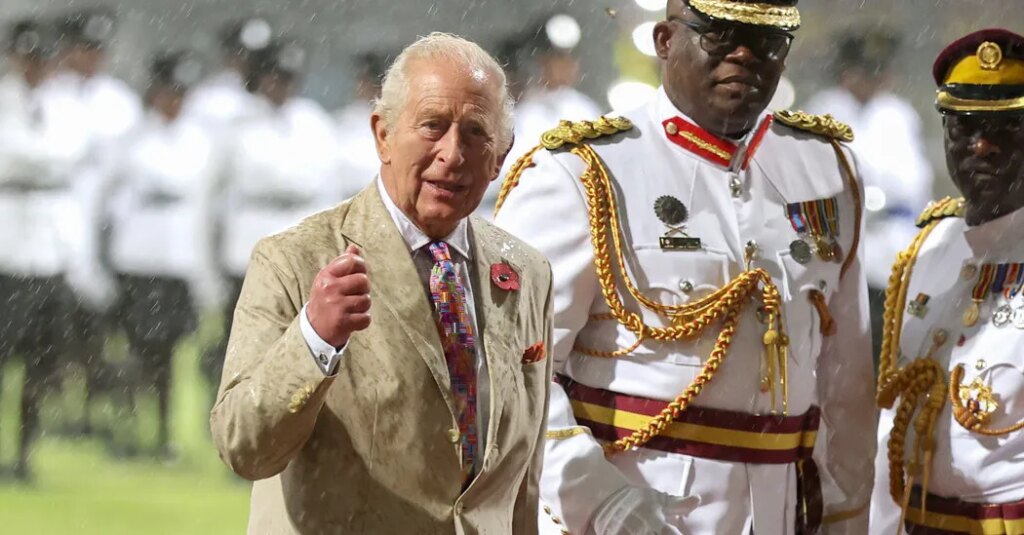
The 77-year-old British monarch, smartly dressed in a beige suit, had just stepped onto a dais in St John’s, in Antigua and Barbuda, for the former colony’s Independence Day parade. It was above 90 degrees and sticky. Suddenly, the heavens opened.
For several minutes, palace aides scrambled about in the heavy rain as the king waved his arms and scowled, as if to say: Where are the umbrellas? By the time his equerry, Major Ben Rigby, handed him one, it was too late. The king would later joke that he had gotten so wet, he was growing watercress on his trousers.
“I think that might be the last we see of that suit,” Charles quipped to his staff.
The brief downpour was followed by two hours in which Charles, still soaked, walked through the wet grass of the cricket stadium where 5,000 people watched the parade. It was one of about 40 events — Buckingham Palace calls them “engagements” — that the king held during a weeklong tour of the Bahamas, Guyana and Antigua.
The trip was part of Britain’s attempt to sustain its bonds to other countries in the Commonwealth, the voluntary group that brings together nations that were once part of the British Empire. The Palace says such visits can boost investment and strengthen cooperation on tackling global issues like climate change.
To the frustration of the king’s senior aides, the trip was dogged by questions about whether Charles would apologize for Britain’s role in the trans-Atlantic slave trade during the 1700s and 1800s. Palace aides repeatedly pointed out that an elected government runs Britain, and that the monarch could not apologize on behalf of the state unless the prime minister asked.
Such tensions are not uncommon as Charles, like his mother, Queen Elizabeth II, before him, navigates the almost entirely symbolic role of being a modern British monarch. As head of state in Britain, but not head of the government, he is constitutionally bound to remain neutral on politics and statecraft. Of course he has his own opinions, too.
“We have to tread quite a careful line sometimes between government policy and the king’s role,” a senior Palace adviser told reporters, speaking on the usual condition of strict anonymity that is also common across the British civil service.
Inside the British government, the monarchy has long been viewed as a uniquely effective diplomatic weapon whose genial projection of soft power can help close a deal, settle a negotiation and spread good will when he is dispatched on a government-directed mission.
People close to Charles say he is more than happy to oblige. It is, after all, the job he was born to do.
And for the king, personally, the trips seem to energize him and bring him delight. Despite his cancer diagnosis in 2024, for which he continues to receive treatment, Charles rarely seems to tire on such outings. He lingers to talk to an artisan or a C.E.O. as palace staff and journalists half his age swelter in the heat. He listens as local residents describe their cultural heritage and admires their handiwork. He watches dance recitals, Indigenous parades, military marches and athletic competitions.
For nearly six decades, most of it as the Prince of Wales, this has been Charles’s life. By the time he became king four years ago, he was already a global diplomat, having traveled the world many times, even if that role at times took a back seat to the palace intrigue that dominates headlines.
In the Bahamas, the first stop on his Caribbean tour, the king surprised his staff during the city’s Junkanoo celebration, which features a carnival and festive street parade. With little notice, Charles grabbed some homemade cowbells.
“I think I’m going to get involved,” he said, and started dancing alongside the Bahamians marching in the parade. Afterward, organizers asked for the cowbells back so they could display them in a museum.
When the king arrived in Guyana the following day, he was greeted by President Irfaan Ali, who had just given an interview to a British television network that was hardly on message. Mr. Ali told ITV News that Charles had “rightfully recognized slavery as the darkest days in human history,” adding, “Now, moving to the apology is the next step.”
Still, at a reception that evening, the king and president appeared in good spirits after Mr. Ali offered Charles some specially blended rum.
The king took a small swig and declared it “Very good!” When the president told the monarch that he just had to “drink it down,” Charles managed one more sip before announcing: “That’s very kind. Somebody else will have to finish it.”
The next day it was on to Antigua, where the king held several days of events before meeting with the leaders of the 56 nations that make up the Commonwealth, most of which were once British colonies. On the royal schedule: a church service (complete with a steel drum band outside); an independence day parade (the one that got rained on); and several local conservation initiatives.
As the king landed in Antigua, The Guardian newspaper published an article penned by Prime Minister Andy Burnham of Britain. For the first time, Mr. Burnham wrote, the government would be open to discussions about a formal apology for the country’s role in the slave trade.
Once again the palace fielded a barrage of questions. Did this mean the king would apologize now? (No.) Had the palace and the Foreign Office talked before the article was published? (Yes.) “Burnham’s shock stance on slavery puts pressure on the King,” The Telegraph newspaper wrote.
If he felt that pressure, the king did not show it publicly.
The two men greeted each other warmly at the Sticky Wicket, a bar and restaurant alongside a cricket ground. Asked by ITV News whether he had “made things more difficult” for the king, Mr. Burnham said: “No. We are reaching out and listening.”
Charles also bumped into Idris Elba, the British actor, during a visit to a historic naval base. “Sorry about the rain,” said Mr. Elba, who was scheduled to host a Commonwealth concert that evening.
“What are you doing here?” the king asked.
“I get around,” Mr. Elba said, affectionately patting Charles on the arm.
Throughout his trip, the king did not avoid the topic of slavery. At the Government House Museum in Antigua, he studied a display case including shackles used on enslaved people and ceramic medallions made in support of abolition.
The British monarch took pains also to broaden the focus of his visit. In his opening speech for the Commonwealth meeting, he drew laughter when he praised Antigua, a nation of about 100,000 people, for punching above its weight.
“Small island, big vibes,” he said.
Charles made clear what he felt about the legacy of slavery that was left by his ancestors and the people who governed Britain hundreds of years ago: “That shameful chapter of history is one that fills my heart with horror and my soul with the most profound personal sorrow.”
But he also pointedly referenced Britain’s efforts to end the slave trade. “History also teaches us that evil need not have the last word,” he said. “Character and courage can combine to overcome the most monstrous injustice, as they did with the determination to end international trade in enslaved people, in which the Royal Navy played such a leading role.”
Some critics question the value of the Commonwealth’s loose assembly of nations.
Unlike, say, the United Nations, it has no power to try and manage war and peace. It does not hire scientists to advance global well-being like the World Health Organization. It has no experts on global trade or economics. Its primary public output is a statement every two years that avoids getting specific about the big issues facing the world.
Like his mother, however, the king has been a steadfast supporter of the group, which was born from the remnants of the once-vast British Empire. For medium powers like Britain, whose interests are under threat from hostile powers including Russia, China, Iran and at times recently, the United States, experts say there is value in maintaining even loose alliances with other small and medium powers around the world.
“What unites this extraordinary and unique group of countries even more deeply is our values: of democracy and the rule of law; of respect, equal dignity and human rights; of sustainable development; of peace and security,” Charles told the group’s leaders on his last day in Antigua. “These values have never been more important, contested as they are on so many fronts.”
That evening, the king joined other leaders for a three-course dinner, including a papillote of Mahi-Mahi and Antiguan Black Pineapple Tarte Tatin. In his toast, Charles praised the Commonwealth as an organization that can unite people from countries famous for snow, deserts and “countries whose citizens are utterly convinced they enjoy perfect weather all year round!”
He smiled, cheekily, and then added: “Although, I was just thinking, ladies and gentlemen, perhaps part of my role as head of the Commonwealth is to act as an umbrella for you all.”
The post King Charles Was Umbrella-Less but in His Element on Caribbean Tour appeared first on New York Times.