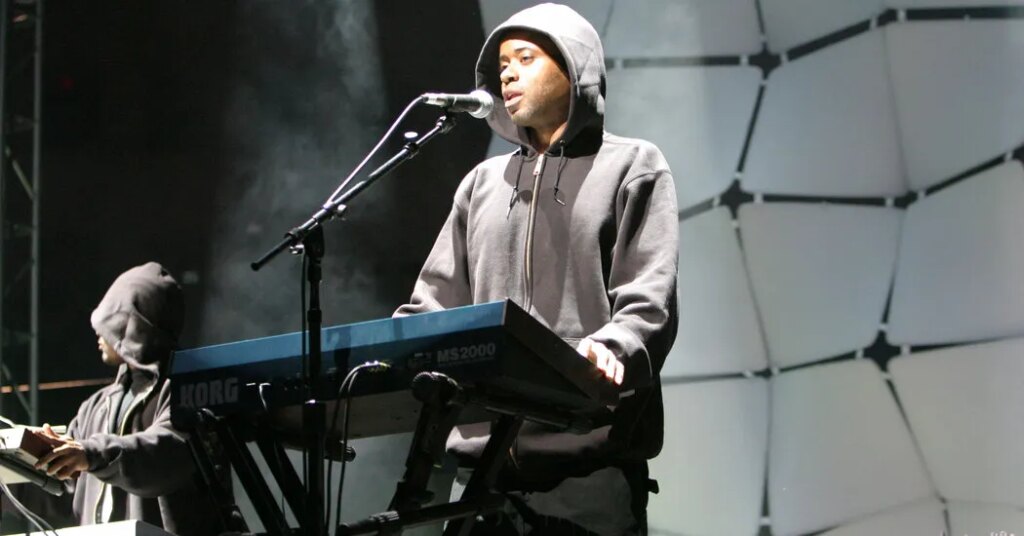
Though the innovations of the Detroit-area electronic music producers Juan Atkins, Derrick May and Kevin Saunderson — often referred to as the Belleville Three — are forever linked in the early development of techno, it is Atkins who is widely acknowledged as the music’s progenitor.
“Juan was the originator of Techno,” Saunderson wrote in a social media post on Sunday after Atkins’s death at age 64. “A true visionary who opened the door for so many of us, myself included.”
As a D.J. and producer, Atkins brought a conceptual vision and bootstrapping determination that willed techno into being. He even coined the genre’s name.
In the early 1980s, before post-disco house music emerged from Chicago, Atkins, who went to high school in the Detroit exurb that gave the Belleville Three their name, pumped up funk’s electronic content and added a forward-thinking, defiantly cosmic worldview derived from the writings of the futurist Alvin Toffler and his own ruminations.
Here is a sampling (no Akai MPC needed) of some of his most crucial work:
Cybotron: ‘Alleys of Your Mind’ (1981)
As a 19-year-old attending music class at Washtenaw Community College in Ann Arbor, Mich., Atkins met Richard Davis, a Vietnam veteran a decade older. Davis, known as 3070, had already self-released the 1978 single “Methane Sea,” an electronic fugue of what he called “multitrack noise.” The pair bonded over a shared enthusiasm for synthesizers and formed the group Cybotron. Davis used his military earnings to finance a seven-inch single released on Atkins’s imprint Deep Space. A synth melody in “Alleys of Your Mind” lightly resembles Ultravox’s 1980 track “Mr. X,” but Cybotron’s song possesses decidedly more paranoid stylings, as Davis’s ominous arpeggios and Atkins’s hypnotic handclaps and bouncy bass lines create sinister-sounding electro-funk.
 Listen on Spotify, Apple Music or YouTube
Cybotron: ‘Cosmic Raindance’ (1981)
On the shimmery, snaking instrumental “Cosmic Raindance,” the B-side of Cybotron’s debut single, Davis explores the limits of the ARP Odyssey analog synthesizer. A Detroit dance-floor staple, the song also reportedly remains popular in the city’s gentlemen’s clubs, vividly illustrating the fusion of the cosmic and the carnal that was always central to techno’s appeal.
Listen on Spotify, Apple Music or YouTube
Cybotron: ‘Cosmic Cars’ (1982)
While Davis wrote the lyrics for most of Cybotron’s songs, the words to “Cosmic Cars” were Atkins’s idea, a pulsing paean to the Motor City’s automotive obsession: “Stepping on the gas / accelerating fast.” Like “Alleys of Your Mind,” “Cosmic Cars” received extensive airplay from the Electrifying Mojo, the influential Detroit radio D.J., and sold between nearly 15,000 copies in the city alone. A contract with Saul Zaentz’s label Fantasy Records soon followed.
Listen on Spotify, Apple Music or YouTube
Cybotron: ‘Clear’ (1983)
Cybotron’s 1983 debut album, “Enter,” often sounds more like spacey, new wave funk-rock than ur-techno, with the notable exception of its lead single “Clear” with its breakdance-conducive electro that orbits the same solar system as Afrika Bambaataa and the Soul Sonic Force’s “Planet Rock.” That year, a remix of “Clear” by Jose “Animal” Diaz became a hit nationally, reaching No. 52 on what was then called Billboard’s Black Singles chart. But the song’s groove is probably most familiar to lay audiences thanks to Missy Elliott’s sampling of it in her 2005 hit “Lose Control.” Despite the sales success of “Clear,” Atkins and Davis clashed in 1984 over the follow-up single. When Davis opted for “Techno City” (despite its title, the song is heavy with guitar effects), Atkins decided to strike out on his own.
Listen on Spotify, Apple Music or YouTube
Model 500: ‘No U.F.O.s’ (1985)
Atkins’s debut release under the moniker Model 500 on his own Metroplex label proved to be a landmark. “No U.F.O.s” is considered techno’s “shot heard round the world” stylistically, in terms of instrumentation (Roland TR-909 and TR-808 drum machines provide rhythm and percussion) and acceleration (125 beats per minute). Beyond the hardware, though, Atkins imbued what snobs and rock critics initially dismissed as lightweight “party music” with an intellectual depth and a subtext of self-empowerment. Detroit techno reflected an African American version of punk rock’s D.I.Y. spirit: In the decade after Atkins’s example with Metroplex, dozens of Black-owned, artist-run independent labels — including Saunderson’s KMS Records, Mike Banks and Jeff Mills’s Underground Resistance and Carl Craig’s Planet E — flourished. Over four decades later, newer companies like Max Watts’s Limited Network and Huey Mnemonic’s Subsonic Ebonics continue the lineage.
Listen on Spotify, Apple Music or YouTube
Model 500: ‘Night Drive (Thru-Babylon)’ (1985)
The second single released on Metroplex arguably outshines the first in terms of irresistible funkiness and insinuating earworminess, thanks in part to Atkins’s use of speech synthesis software on an Apple IIe computer to create the robotic sounding “Time Space Transmat” chant heard over squelchy synths. When May launched his own label in 1986, he named it Transmat in honor of Atkins’s futuristic ethos.
Listen on Spotify, Apple Music or YouTube
Channel One: ‘Technicolor’ (1986)
Electro and rap were intimately intertwined early in hip-hop’s infancy. The first release by Channel One, Atkins’s electro project with Doug Craig (an older cousin of the Detroit techno producer Carl Craig), “Technicolor” is both Atkins’s most overt Kraftwerk homage and his most widely disseminated sample. The rapper Sir Mix-a-Lot borrowed a silky synth loop and a punchy 808 drum machine barrage for his posterior-positive 1992 chart-topper “Baby Got Back.”
Listen on Spotify, Bandcamp or YouTube
3MB featuring Magic Juan Atkins: ‘Jazz Is the Teacher’ (1992)
While techno was birthed in Michigan, it found mass acceptance in Europe, particularly the newly reunified Germany. Consider it returning the favor for giving rise to Kraftwerk, the enormously influential West German group that had a formative impact on Detroit techno. Another milestone in the back-and-forth Detroit-Berlin connection was the first album from 3MB (3 Men in Berlin), a collaboration between Atkins and the producers Moritz von Oswald and Thomas Fehlmann. “Jazz is the Teacher” is an exuberant romp, with galloping bass lines and clattering hi-hats suggesting a fusion of hard bop and hardcore.
Listen on Spotify, Apple Music or YouTube
Infiniti: ‘Game One (1994)
In a bittersweet coda to Atkins’s career, the Berlin label Tresor released a remastered and expanded 30th anniversary version of the 1996 compilation “The Infiniti Collection” on Oct. 30, just before his death. It included “Game One,” Atkins’s 1994 collaboration with the Dutch producer Orlando Voorn, on which the chiming keyboard hook sounds like a Morse code message commanding the listener to dance.
Listen on Spotify, Apple Music or YouTube
Model 500: ‘Starlight’ (1995)
In 1993, von Oswald and Mark Ernestus founded Basic Channel, a production duo and label that innovated the minimal techno and dub techno genres, which provided a template for the next decade of electronic music. On his 1995 track “Starlight,” Atkins expanded his palette to absorb the Germans’ immersive, echo-laden throb, and then marinated it in his own funk. He later released four records with von Oswald as the duo Borderland between 2013 and 2017. Their live set together at the Movement festival in Detroit this year, playing outdoors to a crowd of thousands in a downtown riverfront park — something altogether unimaginable without Atkins’s trailblazing — ended up being his final hometown performance.
Listen on Spotify, Apple Music or YouTube
The post Juan Atkins: 10 Essential Songs From the Techno Pioneer appeared first on New York Times.