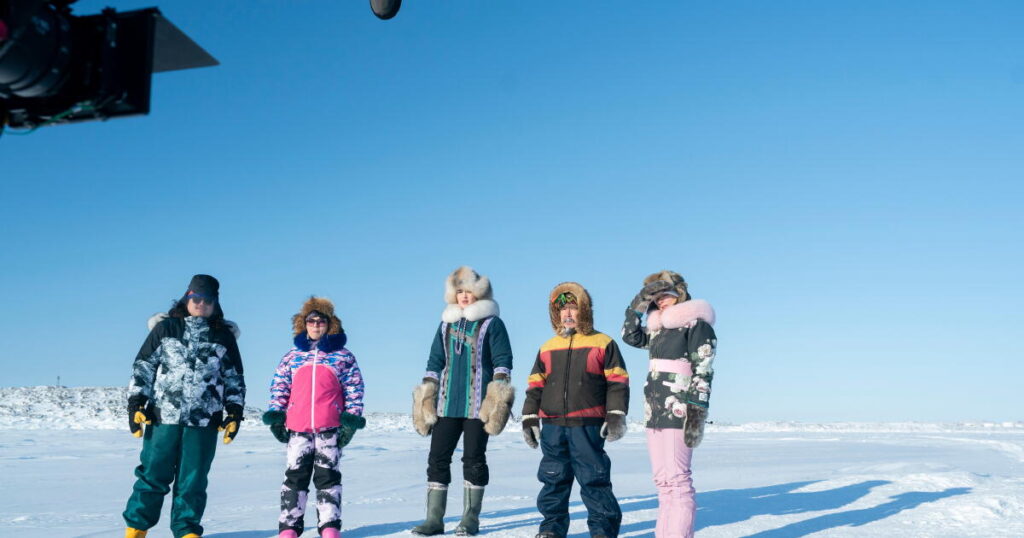
To make “North of North,” creators Stacey Aglok MacDonald and Alethea Arnaquq-Baril had to do what no one had done before: build a full-scale scripted TV production in the Arctic, where infrastructure is scarce and costs are high.
Co-commissioned by CBC, Netflix and Indigenous network APTN, the acclaimed comedy stars Anna Lambe as Siaja, a young Inuk mother who leaves an unfulfilling marriage to reinvent her life in the close-knit fictional Arctic community of Ice Cove. For the creators, the series could only be filmed in Iqaluit — the capital of Nunavut, the northernmost territory of Canada.
“As soon as you visit the Arctic, you’re like, ‘Northern Manitoba’s not going to cut it. Northern Ontario’s not going to cut it,’” Arnaquq-Baril says. “And it’s not just the landscape — it’s also all the people, the houses. Everything is just a little different and unique and well worth all the logistical challenges of shooting up here.”
While CBC, Netflix and APTN all immediately saw the value in shooting in the Arctic, Aglok MacDonald says the executive producers still had to conduct their own “feasibility study” to prove it was possible. They had to demonstrate that local hotels could house the crew and that service providers and truck rentals were available. They also needed the city council’s permission to rent the Iqaluit Curling Club and convert it into a temporary studio for Season 1 — though it was big enough only for some of the sets, with no room for department or producer offices.
After “North of North” was officially ordered to series in March 2023, Aglok MacDonald and Arnaquq-Baril hired a producer, a year before prep would normally begin, to plan the procurement and transport of specific items months in advance. Wherever possible, materials were sent by sea during the annual short thaw to avoid expensive airfreight. For example, building materials and boxed water — which, Arnaquq-Baril says, was chosen over plastic bottles to leave “less toxic garbage in the Arctic” — were shipped by sealift.
Most sets were built in Toronto, disassembled and palletized to fit the cargo plane’s fuselage. Generators arrived drained of fuel and had to be restarted by a local. The pipes in portable washrooms would have frozen, so the production hired extra drivers to shuttle crew to their hotel bathrooms. Costume designers even used social media to ask travelers to bring items from Ottawa or Toronto.
What couldn’t be shipped had to be improvised. “Our grip department were like MacGyver,” Arnaquq-Baril says. For instance, the crew built the “Nunavut arm,” a jib mounted on a pickup truck’s flatbed to capture wide outdoor shots. A camera operator built a custom housing that kept his hands warm at –40 degrees Celsius while he maintained enough dexterity to fly a drone. Even hair and makeup had to adapt, since traditional hair spray stops working properly in that cold.
A lack of hotel space, however, nearly derailed “North of North” entirely. Production paused in Season 1 when a mining symposium took over the town’s hotels. In Season 2, premiering Thursday, a hotel renovation forced the producers to ship sets to Toronto and shoot those scenes on a soundstage, and pushed the Arctic shoot later in the year, leaving less time for postproduction. When the Iqaluit shoot finally began this March, Lambe and the creators recall, the temperature was also 20 C colder than in Season 1 — a jarring drop even by Arctic standards.
Aglok MacDonald says that many cast and crew members actually lost weight during the shoot. “Often, we’re standing still, but our bodies are still really working so hard to keep warm, and we’re out there for 13 hours a day in –39 C,” she explains. “Thankfully, our craft services [team] is feeding us warm food. Every time we call ‘cut,’ people are starting to do jumping jacks and doing what they can to keep their bodies moving. Even Inuit from our community would be watching us outside through their windows and being like, ‘Oh my God, you guys are crazy. Are you guys OK?’”
“We have a taste of what hunters do every day now,” Arnaquq-Baril quips. “They go out in the cold every single day, all year round, year after year, and we’re just doing it for six weeks at a time. It was grueling. I don’t know how they do it.”
“North of North” has been a boon to the local and national economy. In Season 1, 500 Iqaluit locals (from a population of around 8,000), including the mayor, appeared as background actors, while the production employed more than 300 Canadian crew members and over 225 vendors, more than 60 of them from Nunavut. Netflix estimates the first season generated more than $23 million in economic activity.
Having seen non-Indigenous filmmakers come to the Arctic and offer little in return, the Inuit co-creators, who both live in Nunavut, were determined to give back to their community. Most notably, they created apprenticeship programs across various departments — including camera, sound, production design, catering — to teach Inuit and other local northern residents about the filmmaking process.
Lambe, raised in Iqaluit, grew up with many of the people who are now working on the show. “When you’re on the outside of [the industry], you have no idea that lighting tech or grip is a job, or that craft services are an integral part of a production,” she says. “If they don’t want to be in front of the camera or writing or directing, there’s so many other spaces that they can work in and dream about and pursue.”
After the extended Season 2 stint on a Toronto soundstage, Aglok MacDonald and Arnaquq-Baril secured funding for a new studio from the Indigenous Screen Office, the Government of Nunavut, the Canadian government and local Inuk businessmen. Construction is now 75% complete, and the “North of North” team hopes to have it ready in time for a potential Season 3. “We’re so excited for it to be done, adding to the infrastructure of the community instead of just straining it so much,” Arnaquq-Baril says.
The post ‘Are you guys OK?’: Making a TV show is hard. Making it at -39 degrees Celsius is ‘crazy’ appeared first on Los Angeles Times.