Michael Novak, the artistic director of the Paul Taylor Dance Company, welcomed the opening-night crowd with a curtain speech about how he has been drawn, of late, to dances that feel urgent, that need to be seen now.
But after the first three nights of the company’s fall season, it was apparent, to varying degrees, that the company’s two resident choreographers, Lauren Lovette and Robert Battle, aren’t up to that difficult task. And this weekend, a third new work, by the well-regarded contemporary choreographer Pam Tanowitz, will have its New York premiere.
Lovette, a choreographer with a robust imagination and the gumption to to take chances, fares better. The beginning of “30 Incoming,” set to songs by the American-Dutch indie rock band the Books and performed Thursday at the David H. Koch Theater, was immediately arresting. Elizabeth Chapa, bathed in a spotlight, sat on the floor as the white ruffles of her skirt spread around her, making it look like she was sitting in a pool of swans.
The Books were known for experimenting with sounds, including answering machine messages, and the opening number starts with one: “‘Hello Mary. Called to, um, wish you good evening.’” Chapa, showing the angles of her face and shoulders, was like a phantom. (Brandon Stirling Baker’s lighting gave her lithe figure a painterly glow.) Holding the folds of her skirt, she spun. She walked to the back of the stage and paused, assertively flicking her shoulders.
She unfastened her hair and raced across a dramatic diagonal where she pulled off her skirt — made of Tyvek, a paper-like material — and dipped her head into a seemingly bottomless backbend. Now in a sleek leotard by Mark Eric, who designed the costumes and set, she was a striking windswept sight.
But the rest of the dance had a hard time finding its footing. Lovette gave her cast moments to shine, but their spins and falls to the floor, no matter how heartfelt, failed to turn “30 Incoming” into a cohesive world.
Emmy Wildermuth appeared in a paper suit — which the dancers detached in pieces, leaving them onstage like clumps of snow — as she bounced up and down from the floor. She was joined later by Jessica Ferretti and Chapa, a committed threesome intent on excluding Payton Primer. But why?
“30 Incoming” was like a bunch of tiny dances strung together — a mix tape of music with not every choice supporting the mood of the work’s bigger picture, however fleeting. The final song, “I Am Who I Am,” began with laughter and a word: “nuttiness.” The dancers, led by Ferretti, wore sunglasses. It was like the wedding photographer said, “Let’s do a fun one.”
But their unison jumps packed a galvanizing punch, a bright spot in a dance that was too prone to breeziness. Lovette can move dancers on a stage, but at this point she needs to develop more complex structure and pacing. During her time with Taylor, she has shown an ability to make use of the dancers’ technique, but never to deepen it. Still, “30 Incoming” was a swing. A swing deserves respect.
Battle, the former artistic director of Alvin Ailey American Dance Theater, has had a harder time proving his worth in the company founded by Taylor, a modern master. It’s not only that Battle’s works become monotonous, like classroom exercises, but that they gloss over the distinct qualities of dancers — even those that he features. Structurally, Battle plays it safe and flat, rarely exploring the depth of the stage. His choreography is full of force and drive, but its power falters like an illusion. What is its destination?
If his new “A Starling,” shown Wednesday, had a star, it was the set by Anne Patterson featuring curtains of suspended ribbons that quivered across the stage like sheets of rain. Along with Patterson’s costumes, blue and green unitards, the setting had an opalescent sheen.
The choreography sent dancers buzzing around the stage and in front of or behind the curtains, but soon wrung itself out with too much repetition, especially in persistent shapes and poses. Fingertips grazed shoulders; arms stretched high like railroad tracks until bent torsos brought them forward. Fists clenched overhead as if in prayer. There were fluttering fingers and a plethora of outstretched arms. Wings of every size.
Set to a new score by John Mackey — it was pounding and blandly cinematic, constantly building to a peak before losing steam — “A Starling” included a frenzied solo for Madelyn Ho, a sentimental one for Devon Louis and a rolling-around-on-the floor duet for Austin Kelly and Wildermuth. None of these sections revealed much about the soul of the work.
Also programmed this season was the company premiere of Battle’s “No Longer Silent,” created for the Juilliard School in 2007. Set to a driving score — forgotten ballet music from the 1920s by the Austro-Czech Jewish composer Erwin Schulhoff, whose career ended with the rise of Nazi Germany — the dance owes much to Martha Graham, taut walks and all.
There is some “Rite of Spring,” or something like it, as groups march, run in circles, roll on the floor and raise their arms in anguish. In one moment, a group of ominous men surround a woman. After they leave, her pants are pulled down, a harsh reminder that this is a man’s world — even in a dance.
The season also features the company premiere of Alwin Nikolais’s “Tensile Involvement,” a modern work from the 1950s, in which dancers create designs with a web of elastic ribbons. It’s an entertaining package of light, sound and movement. But it’s also a diversion, another dance that seems soulless next to the work of Taylor.
Novak’s artistic vision is confusing. His taste in new choreography is questionable and hasn’t produced much worth keeping. His overly jovial curtain speeches are a strange shade of cringe. Yet he continues to oversee the Taylor repertory with care.
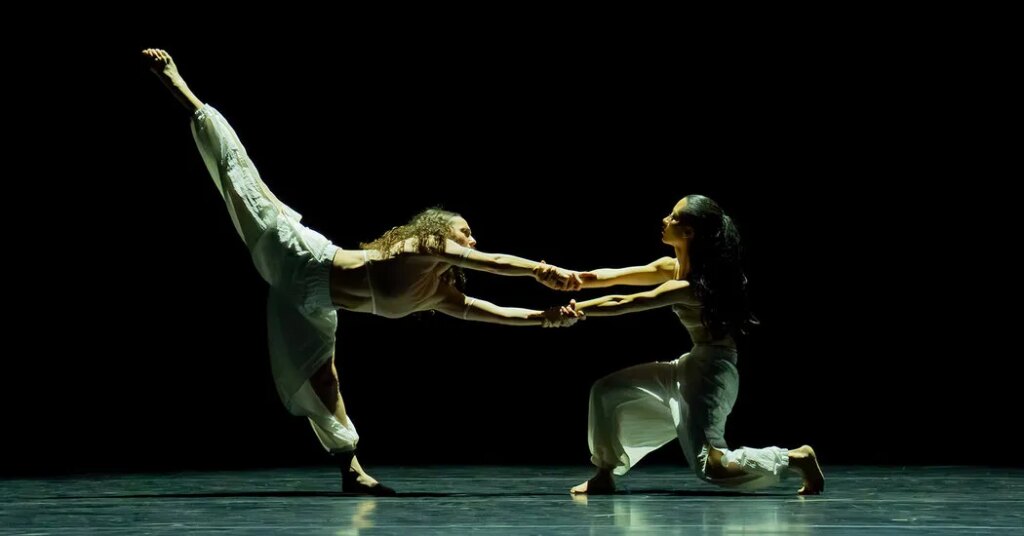
“Brandenburgs” (1988), “Airs” (1978), “3 Epitaphs” (1956) and “Piazzolla Caldera” (1997) were in fantastic form, showing the dancers off — finally! — as individuals. Gabrielle Barnes is so open, so gracious; Ferretti, featured in nearly everything, can finally grow into the fullness of her statuesque grace. Lee Duveneck and John Harnage bring such fluidity to their sculptural muscularity. And Primer, especially in a duet with Kenny Corrigan in “Piazzolla” is daring, dynamic and precise, she is electrifying. Basically, everything a Taylor dancer should be.
Paul Taylor Dance Company
Through Nov. 22 at the David H. Koch Theater; paultaylordance.org.
The post Premieres at Paul Taylor: An Emotional Swing and a Hollow Miss appeared first on New York Times.