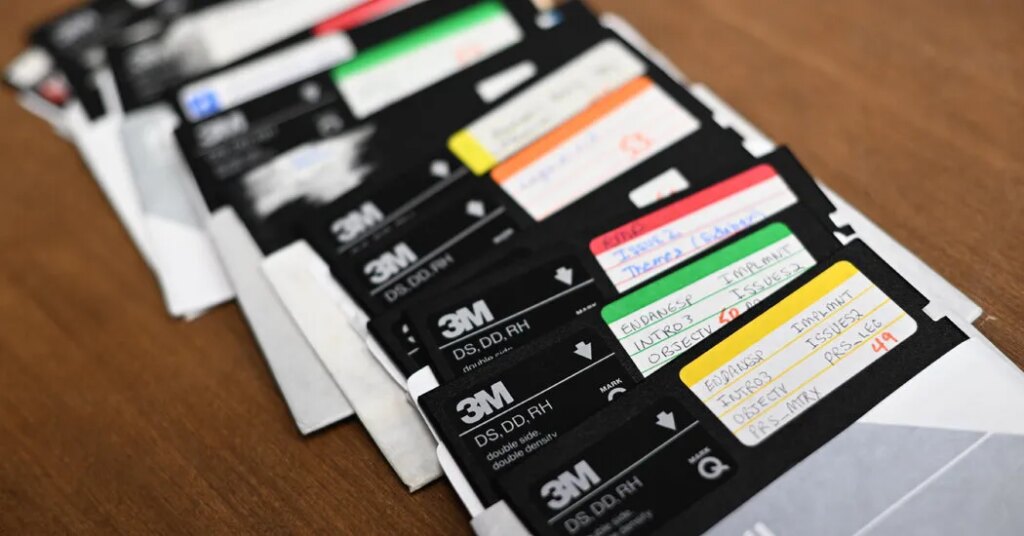
When news arrived this week that the Federal Aviation Administration would phase out floppy disks used in air traffic control at the nation’s airports, the general reaction was: “Wait, someone still uses floppy disks?”
But there once was a time, decades ago, when the now-obsolete floppy was exciting new technology, heralded in The New York Times as “the cornerstone of the office of the future.”
The F.A.A. has been using systems for air traffic controllers, including floppy disks, that date to the 1980s. A planned new system will include a digital display board that will put in one place the information controllers need, with data about disruptions, weather conditions and advisories.
Airports in Atlantic City, N.J., Nashville and Rochester, N.Y., will be among the first to get the new tech, known as the Brand New Air Traffic Control System.
“The greatest nation in the world deserves a state-of-the-art air traffic control system,” Sean P. Duffy, the transportation secretary, said in a statement.
President Trump had promised to upgrade the F.A.A.’s equipment after a plane crash near Washington in 2025. Government officials at the time noted that flights were still tracked on strips of paper, and that some computers ran on the Windows 95 operating system.
At the moment, air traffic controllers use floppy disks to upload some data, including pilot reports and advisories, into their consoles, the F.A.A. said.
Most adults barely remember floppy disks, even if they are old enough to have used them. And the idea that such antiquated technology is still used for important jobs two decades into the 21st century seems laughable.
They were originally produced in the early 1970s at an eight-inch diameter, they shrank to 5 ¼ inches and then 3 ½ inches.
The original disk was indeed “floppy,” with a soft plastic case. Later versions that became popular in the mid-80s had harder plastic shells, and didn’t flop anymore, but the name stuck.
The disk inside, containing the data, was circular, but the casing around it was square.
In 1978, The Times breathlessly hailed floppy disks as an exciting new technology. It enthused that the disks held tremendous quantities of information: no fewer than 300 pages of manuscript on a single $8 one-megabyte disk.
Now people regularly download a megabyte of information, or much more, without a second thought. One standard high-resolution photo on a phone could blow past that mark.
“I think one megabyte is going to prove to be a magic number in this industry,” a manufacturer of drives retailing for $1,000 in 1978 was quoted as saying then. “Everybody and their brother are going to decide that now is the time to switch to floppy disks.”
Long ago, everybody and their brother abandoned floppies.
Still, the technology has been resilient in some places beyond air traffic control towers. Japan dropped regulations requiring floppy disks be used for administrative purposes only in 2024, even though the last disk was made there in 2011. (Fax machines and cash have also hung around in that country.)
As time has marched on and storage methods have shifted, older technologies like floppies have produced distinct problems.
A Times article sounded the alarm in 1993, noting that libraries were increasingly getting manuscripts in different formats: floppy disks of various sizes, cassette tapes, even rolls of perforated paper. Should readers of the future want to access the material, libraries “may need to preserve the software to run it. And not just the software, but all the obsolescent hardware as well,” the article said.
As it turned out, some libraries were able to mitigate this by digitizing old floppy-disk data. But concern about loss of archival material remains to this day. (In contrast, books from a millennium ago remain readable.)
As for the F.A.A., it plans to fully install the new system at 400 sites by the end of 2028.
The post F.A.A. to Phase Out Floppy Disks From Airport Control Towers appeared first on New York Times.