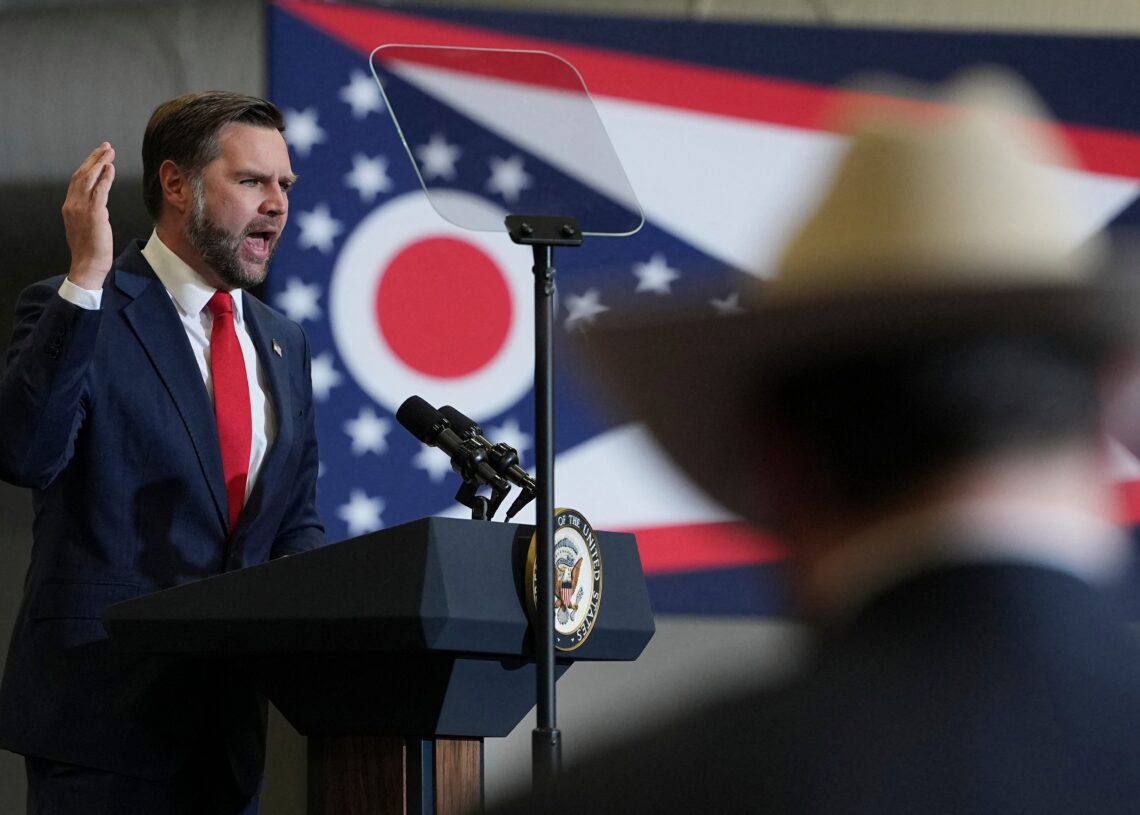
JD Vance wants to blame the war in Iran for his party’s midterm shellacking. That is “obvious to almost everyone,” the vice president wrote Wednesday, assessing the political debris. The Trump administration’s abandonment of decency and normality in politics had nothing to do with it, apparently.
The war was no doubt a major factor in voters’ rebuke of the Republican Party. Roughly six weeks after President Donald Trump ordered military strikes against Iran in February, 69 percent of respondents told Pew Research that they were “very” or “extremely” concerned about gas prices. That persisted through Election Day, when 87 percent of voters in NBC’s exit poll said they were “very” or “somewhat” concerned about the price of gasoline and diesel. (Both had risen roughly 40 percent and 67 percent, respectively, since the war began.)
But voters had plenty of other grievances, not least the increasingly dark turns the GOP has taken since Trump’s reelection. Nowhere was that more evident than in the vice president’s home state. Ohio became a barometer of what the electorate would tolerate in political debate: not merely how much economic distortion they would accept but how much they would allow the country’s moral fabric to fray.
Texas also had such a reckoning this week, which earned more attention. Republican candidate Bo French’s explicit racism toward Indian Americans celebrating at a football game in Austin played a role in handing the railroad-commissioner job to Democrat Jon Rosenthal. The blatant corruption of former Texas attorney general Ken Paxton helped deliver the Senate seat to a Democrat for the first time since 1988. Their collapse also helped drag down three-term Republican Gov. Greg Abbott.
But until Tuesday, Texas had been a reliably red state. Ohio had been something stronger and more ideological: a MAGA redoubt. The swing state that Barack Obama won by low single digits had moved decisively toward a different brand of politics, defying the more than half-century-old adage that “as Ohio goes, so goes the nation” when it backed Trump by eight points in 2020, despite Joe Biden winning the election.
For the past decade, Ohio has been MAGA territory. Regardless of Trump’s policies or conspiracies — including his baseless claim during the September 2024 presidential debate that Springfield’s Haitian immigrants were eating dogs and cats — Ohioans kept sending Republicans to the governor’s residence, electing GOP supermajorities to both chambers of the General Assembly, and returning a largely Republican delegation to Washington. The latter included JD Vance, elected senator in 2022 before Trump chose him as his running mate.
That loyalty ended this week. Former U.S. senator Sherrod Brown returned to the Senate, defeating incumbent Republican Sen. Jon Husted, while Democrat Amy Acton resoundingly defeated Republican Vivek Ramaswamy for governor. By voting like so, Ohioans did what the vice president could not muster the courage to do: reject some of the ugliest campaign tactics and worst impulses of the MAGA movement in recent memory.
“I’m a little bit disgusted,” Vance told reporters when asked about the Ramaswamy campaign ad in which Acton’s estranged mother called her a liar. (Her mother had sided with Acton’s stepfather, who was charged with raping Acton when she was 12.) Vance was not expressing disgust at the TV spot, of course, but at members of his party for “whining” about the campaign’s decision to go so low in their attacks against Acton.
Perhaps it didn’t seem particularly low to a vice president who had grown accustomed to testing the limits of what the MAGA coalition would tolerate. During the final days of the midterm campaign, Vance echoed Trump’s claims about Haitian immigrants, telling voters in Swanton, Ohio, that he had seen a story about “illegal immigrant Somalis who are coordinating to flood the polls and drown out your vote.”
The administration has repeatedly favored indulging conjecture over evidence and flirted with the darker fringes of the American right. Unlike Trump, though, Vance often forgets to wink and nod when he ventures beyond the pale — a device the president has used to great effect, forcing even his fiercest critics to concede that he has a sense of humor. The vice president simply seems sincere when embracing the ugliest elements of MAGA ideology. That includes at times hesitating to condemn far-right streamers, defending the president against accusations that he has used the government to get richer, and referring to Renée Good — the 37-year-old woman that ICE agents killed in January — as “part of a broader left-wing network” targeting officers. Whatever his strategy, Ohio voters revealed it to be fruitless. Fifty-six percent told CBS’s exit poll that ICE had gone too far. Ninety percent said corruption played a considerable factor in their vote for Congress.
Before Tuesday, sensitivity to aggressive and abnormal politicking had been shrugged off as the product of the “blue-pill establishment.” Critics were told they didn’t know “what time it is.” Ohio said otherwise. It showed that Americans are still hungry for decency and normality in their politics. Ramaswamy eventually pulled his ad against Acton. Before its release, her lead was within the margin of error. In the end, she won by eight points. CBS’s exit poll showed that Vance and Ramaswamy each had a 47 percent “strongly unfavorable” rating in Ohio compared with 37 percent for Acton.
The war, and its effect on affordability, mattered this election. But before setting his sights on 2028, the former Ohio senator might want to look closer to home and consider the limits of what sympathetic voters were willing to tolerate. It was true once and is true again. As Ohio goes, so goes the nation.
The post JD Vance blames Iran. His home state saw something far uglier. appeared first on Washington Post.