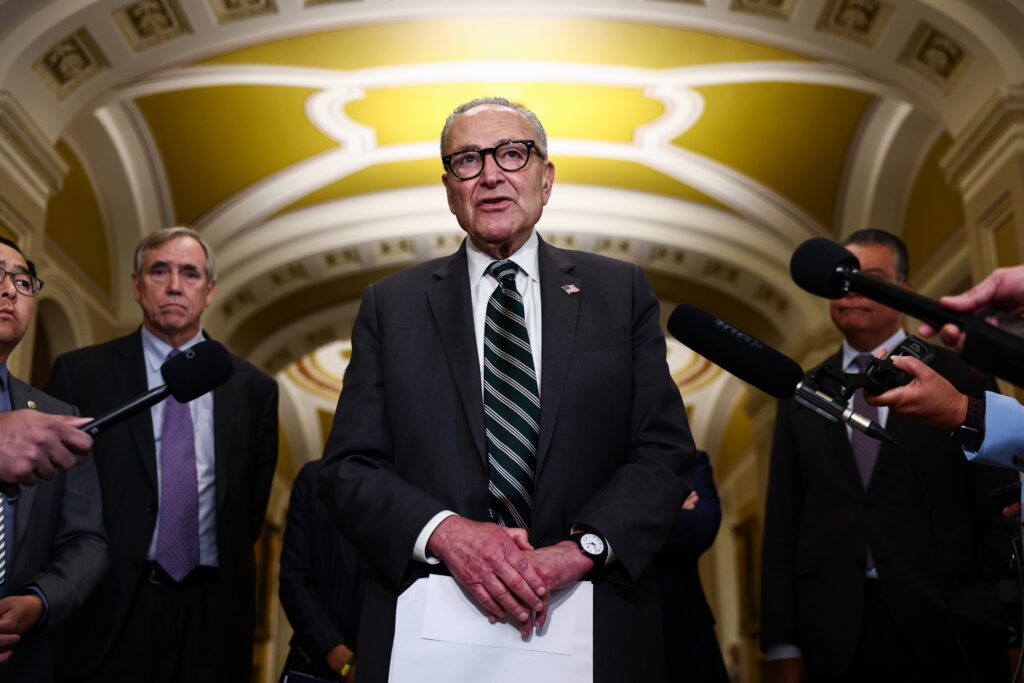
When Senate Minority Leader Chuck Schumer voted with Republicans to prevent a government shutdown less than two months into President Donald Trump’s second term, the New York Democrat faced a deluge of criticism from a Democratic base who saw his stance as a capitulation to Trump.
Less than two years later, Schumer (D-New York) is feeling triumphant.
Democrats recaptured the Senate on Tuesday despite a daunting map, winning seats in red states including Texas, Kansas and South Carolina as voters rebelled against Trump. Schumer is poised to become majority leader just two years after Democrats lost the Senate — with a bigger majority than his party has commanded in more than a decade.
In an interview Thursday, Schumer said the prospect of retaking the Senate sustained him last year as he endured the backlash against his decision to vote with Republicans to avoid a shutdown instead of forcing a confrontation over Trump and Elon Musk dismantling federal agencies.
The Democratic anger prompted him to cancel a tour promoting his new book and fueled questions about whether he would step down as Democratic leader.
“What kept me going is the only thing that matters is taking back the Senate,” Schumer said.
Schumer said every decision he made over the past two years was motivated by recapturing the Senate. He started strategizing how to win back the majority almost as soon as Democrats lost control of the chamber in 2024.
Schumer called former North Carolina governor Roy Cooper in January 2025 shortly after he left the governor’s mansion to try to persuade him to run. He flew to Ohio three times to recruit former Democratic senator Sherrod Brown, telling Brown that he would not enjoy his retirement if Brown did not run and Democrats fell one seat short of retaking the Senate.
There was widespread skepticism that Democrats could win in states that supported Trump by double-digit margins in 2024. Drew Savicki, an analyst at the liberal group American Bridge 21st Century, called Schumer “seriously delusional” last year for believing Democrats could win in Mississippi.
“I have never been happier to be wrong about something,” Savicki wrote on Wednesday.
Even Schumer did not expect the scale of Democrats’ victories on Tuesday, which extended far beyond the Senate. Democrats won a commanding House majority and victories in statehouses across the country.
Cooper won by 20 points — an enormous margin in a swing state. Democrats could hold as many as 56 Senate seats next year if they win races in Alaska and Mississippi that remain too close to call.
Schumer described Democrats’ victories as “a generational remake of the Senate map” — and he is already thinking about what it means for 2028, when he wants to expand Democrats’ majority even further. Republican senators are up for reelection in 2028 in several states where Democrats won this year, including North Carolina, South Carolina, Kansas and Iowa.
But not everyone is enamored with Schumer right now — or believes he deserves credit for delivering a Senate majority.
The progressive group Indivisible has urged Senate Democrats not to reelect Schumer as leader, arguing that “voters want a new generation of Democratic fighters.”
Several incoming Democratic freshmen have not committed publicly to supporting Schumer in an upcoming leadership vote. Sen.-elect Peggy Flanagan (Minnesota) called this week for new leadership in the Senate, and Sen.-elect Abdul El-Sayed (Michigan) said Thursday on CNN that he would support Sen. Chris Van Hollen (D-Maryland) if he ran for majority leader. But Van Hollen has said he is considering running for president, not majority leader, and there is no other apparent challenger on the horizon.
Other Democrats have said they plan to support Schumer for leader.
“Schumer delivering a Democratic Senate certainly justifies another term as leader,” Sen. Sheldon Whitehouse (D-Rhode Island) said in a statement.
Schumer helped elect the freshmen who have not committed to supporting him. Senate Majority PAC, a super PAC aligned with Schumer, and its affiliates spent hundreds of millions of dollars to aid El-Sayed and other incoming Democratic senators.
Schumer said he is confident he’ll prevail in a vote that requires a majority of incoming Senate Democrats.
“Our caucus is united and strong and really happy with where we are right now,” he said.
Schumer, who will turn 76 later this month, has led Senate Democrats for the past decade. He is up for reelection in 2028, and Rep. Alexandria Ocasio-Cortez (D-New York) has not ruled out running for his seat. Schumer declined to say whether he will run for a sixth term or when he’ll make a decision about reelection, saying he is focused on the party’s agenda next year.
He has started discussing with House Minority Leader Hakeem Jeffries (D-New York), who is expected to become speaker, which bills Democrats will take up when they regain control in January. Their first one will address the cost of living, Schumer said.
Democrats have also vowed to end the Iran war, investigate the Trump administration and tackle government corruption once they are in the majority. Schumer introduced legislation in July to create a new federal agency to investigate corruption, and he said he expects the Senate to take it up next year.
Senate Democrats’ power to pass their agenda will be restrained by the filibuster, which requires 60 votes to advance most legislation. Schumer declined to say whether he plans to scrap the filibuster, which many Democratic senators have called for.
Democrats could also try to pass some of their agenda through reconciliation, a process which would allow them to evade a filibuster as long as they abide by the Senate’s complicated budget rules. Several Democrats have said they favor such an approach, but it would not allow them to pass priorities such as the corruption bill.
Schumer suggested that Democrats would first give Republicans the chance to support their bills.
“If the Republicans are smart, they’re going to see the election results, they’re going to see the handwriting [on the wall] and they’ll vote with us on key issues like health care, like housing, like the war,” Schumer said. “Will they do that? I don’t know. But we’re going to do it with them or without them.”
If Republicans refuse to cooperate or Trump vetoes Democratic bills, Schumer said, it will only bolster Democrats chances of winning the White House and retaining control of Congress in 2028.
Republicans have not struck a conciliatory tone since Election Day. Senate Majority Leader John Thune (R-South Dakota) pledged this week that “Senate Republicans will not stand idly by as the far-left, socialist wing of the Democrat Party attempts to unwind everything we’ve done.”
Trump and Schumer have not spoken since Election Day, Schumer said, and he could not recall their last conversation.
Schumer has acknowledged that many voters who helped Democrats win the majority remain skeptical of the party. He has pledged to earn their trust by working to bring down the cost of living and address corruption in government, which he sees as essential to achieving his dream of Democrats holding the Senate for years to come.
“Winning the election is the first step, but if you want to expand the map — I want to create a durable majority — we have to deliver,” Schumer said. “We have to deliver in these red states.”
The post Schumer poised to lead Senate again after surviving Democratic backlash appeared first on Washington Post.