Republicans in Congress introduced over 100 proposals targeting D.C. in the past two years, explored ousting the sitting D.C. attorney general to install a presidential appointee and supported President Donald Trump’s law enforcement crackdown in the city. They cut the city’s budget by a billion dollars.
The sheer scope of GOP intervention led Mayor Muriel E. Bowser (D) to tread cautiously and caused council members to at times openly deliberate whether their policies might trigger retaliation against the city. But for Mayor-elect Janeese Lewis George (D), the picture changed overnight.
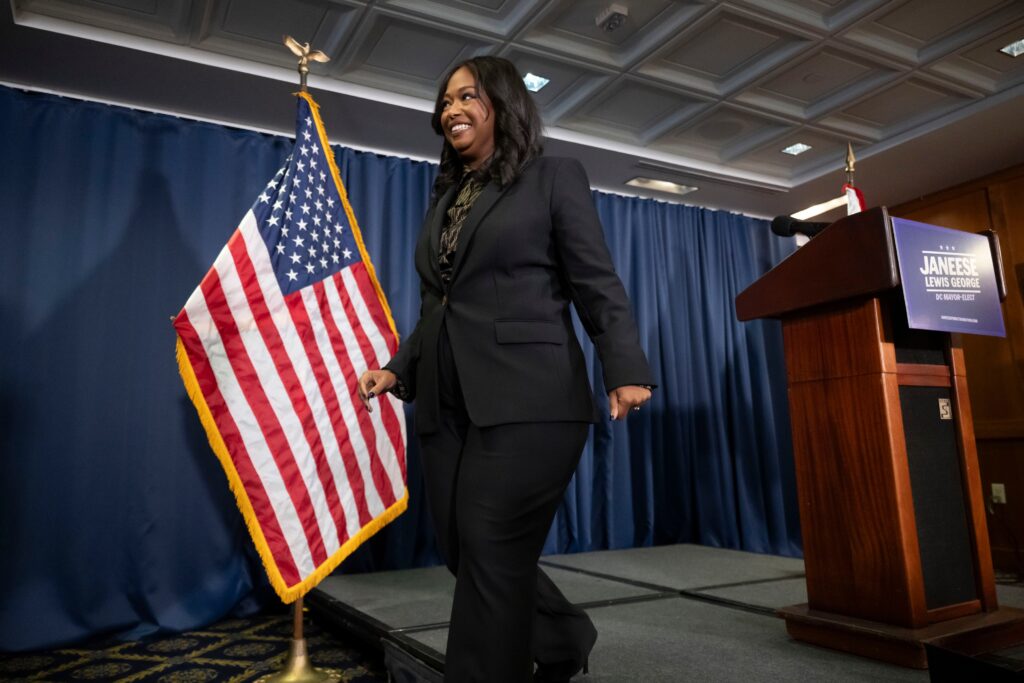
The Democrats’ historic blue tsunami Tuesday presents a political gift to D.C. during a major period of transition, leaving Lewis George, a democratic socialist, freer to pursue her agenda without threat of congressional swat-downs while creating opportunities to help the city, she and other leaders say.
With Trump still in the White House, further progress on marquee goals like D.C. statehood is unlikely. But Lewis George and Del.-elect Robert C. White Jr. (D), who is succeeding retiring Del. Eleanor Holmes Norton (D), say they will focus on lobbying members in both parties and the White House to support other practical requests. They’ll ask for more resources for the city’s bloated criminal justice system, help reviving the city’s downtown economy and control over more federal land and parks for city use.
Even with the Democratic majority, both White and Lewis George struck notes of caution. White said the loss of congressional power could turn Trump’s focus even more toward D.C.
“That could be a danger to us — but there could also be opportunities,” White said, noting areas of collaboration could include parks investment and development that might interest the president.
He said he was working on proposals that could invite federal partnership on reviving the downtown economy and redevelopment of underused federal office space. “We are going to get those in front of the White House to see if these are things they are interested in,” he said.
Even with the GOP bills that targeted D.C. policies, many of which involved crime and policing, major development that aids the city’s economy has been one area where Republicans have shown interest. After all, as Bowser noted Monday when she encouraged the new mayor to build relationships in both parties, it was a Republican from Kentucky — House Oversight Committee Chair James Comer — who championed legislation transferring control of the RFK Stadium land to D.C.
But D.C. leaders have struggled to find sympathetic ears on other long-standing concerns.
Lewis George said a top priority is pushing Congress to fully fund D.C.’s court system, which is federally operated. For the past several years, despite growing criminal caseloads, the court system’s budget has remained essentially flat, leading court officials to ring alarm bells and plead with Congress for more resources. Last year, Congress budgeted $18 million less than the courts requested for operations, and a House committee this year proposed cuts.
Lewis George said the problems extend beyond criminal court backlogs and include a clogged landlord-tenant docket at a time the city’s rental housing market is under duress. Fixing it is one of her promises.
Fully funding the courts means more magistrates to hear cases, she said. “That means our landlord-tenant court works more effectively and efficiently. Our criminal justice courts that are backed up work more effectively and efficiently,” she said.
Council member Brooke Pinto (D-Ward 2), who chairs the public safety committee, said she woke up Wednesday “feeling 50 pounds lighter.” She said the Democratic majority could be helpful in advancing Maryland Sen. Chris Van Hollen’s legislation to confirm D.C. judicial nominees more quickly, and to increase oversight for U.S. Park Police, which relaxed its policy under the Trump administration to allow car chases that D.C. police largely avoid out of safety concerns.
In addition to the blue wave in Congress, five historically red or purple states that have sent National Guard troops to patrol D.C. streets — at Trump’s request — elected Democratic governors on Tuesday. They are Texas, Iowa, Georgia, Ohio and Nevada, which Pinto said collectively have 628 troops patrolling D.C.
On Thursday, Pinto said she would lobby the incoming governors from those states to bring their troops home. And White — who defeated Pinto in the June Democratic primary race for the delegate seat — said he would re-up legislation to give control of the D.C. National Guard to the D.C. mayor. Trump’s National Guard deployment in D.C. appears to be escalating: Defense Secretary Pete Hegseth recently authorized the guard to use Humvees, boats and other tactical military trucks through the end of the year, The Washington Post reported.
“You have a little army in D.C. under the control of the same president who tried to overturn the results of the presidential election the last time we lost. That’s not the person I want controlling D.C.’s guard when the presidential election is certified two years from now,” White said.
Council member Elissa Silverman (I-At Large) said she was hopeful that a Democratic Congress would help the council prevent Trump “from trampling on our rights and trampling on our city.”
“This is a game changer because we’ve been in a defensive posture with the Trump-aligned Congress,” Silverman said.
She and other lawmakers said one practical step that could help D.C. would be to gain more local control of federal park space, an idea Lewis George said she plans to broach to Trump or his administration.
The National Park Service controls 90 percent of parklands in the District, but a recent report by a task force of current and former city leaders recommends transferring control over parks that primarily serve local needs to the D.C. government.
Former mayor Anthony Williams, who co-chaired the task force, said he was “thrilled” that Lewis George had agreed to make that vision part of her agenda.
“I think [these parks] have incredible potential because you’re talking about little gems scattered all over the city,” Williams said. “Properly maintained and supported, these parks are an economic value-add for the city because they make the city more livable, make the city more attractive, connect residents even more to their neighborhoods.”
Lewis George has promised to be more outspoken against Trump than Bowser had been during his second term, as Bowser contended with the GOP trifecta. Lewis George reiterated promises this week to sever any coordination between local police and federal immigration authorities. But since her election, she has avoided heated rhetoric, did not mention Trump by name in her victory speech and has emphasized potential benefits of working with the federal government.
Another item was her vision to redevelop Union Station and the surrounding area into a new neighborhood, which she floated on the campaign trail. Other development opportunities are already in motion in Southwest Washington, where hulking, underused federal buildings are being eyed for a major overhaul.
“When we go into that meeting, believe me, we’re going in there with some proposals that we hope the president will be excited about,” she said Wednesday, “because I know he has an interest in building more housing, and I know he has an interest in development. And apparently an interest in parks.”
On her transition team, White and national Democratic strategist Donna Brazile, a close confidant of Norton, are co-chairing a committee focused on D.C. autonomy.
Another member of the team, Alex Dodds, campaign director at Free DC, said that while the blue wave marks a rejection of the Trump administration, she cautioned against getting too comfortable during the lame duck congressional period. Newly elected lawmakers won’t be sworn in until January. During that period, Dodds is worried that Congress “might go out of its way to attack D.C.”
Even afterward, council member Charles Allen (D-Ward 6) said the Democratic majority in no way represents a panacea for D.C. With help from Democrats, Allen recalled, Congress voted to block two crime and policing bills in 2023 that Allen had shepherded as chair of the judiciary committee.
“We can’t even take Democrats for granted,” Allen said.
White and Lewis George said that was why they were focused on strengthening lines of communication with Democratic leadership and finding new allies now. Lewis George said she has already been in touch with House Majority Leader Hakeem Jeffries (D-New York) and said she promised to give Democratic leadership a heads-up any time she has a proposal that may “ruffle some Republican feathers.”
“We need them, not just to achieve D.C. statehood, but on so many other issues,” Lewis George said. “So I’m going to continue to take that cautious approach and have those conversations, because I think that is what sets the groundwork in 2028 for us to make a real case for D.C. becoming a state.”
The post What a Democratic Congress will mean for D.C. appeared first on Washington Post.