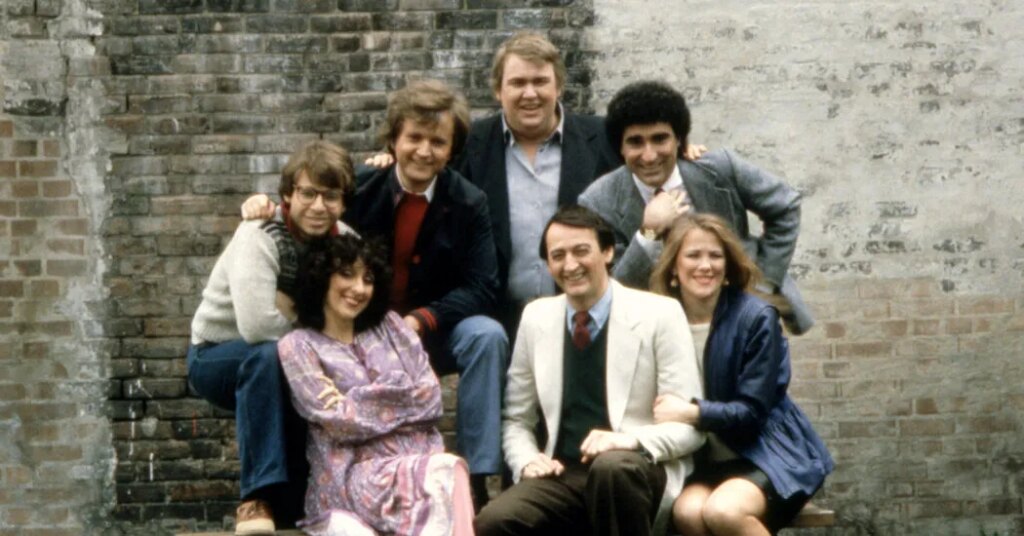
In “Sorry, We’re Funny,” his new book about Canadian comedy, Kliph Nesteroff argues that the sketch show “SCTV,” short for Second City TV, created “a recognized style” of national comedy
If so, what defines it? The new Netflix documentary “SCTV: The Greatest Show You’ve Never Heard Of” doesn’t go far enough to answer that question. It offers a surface-level history of the six-season-long series, which was created in 1976 in response to “Saturday Night Live” after it poached Canadian talent like Gilda Radner and Dan Aykroyd.
The core of the “SCTV” cast was a murderer’s row of comedy: John Candy, Catherine O’Hara, Eugene Levy, Joe Flaherty, Dave Thomas, Andrea Martin. But the show benefited greatly from the head writer Harold Ramis in the first two years, followed by two huge jolts of comedic energy with the entrance of Rick Moranis in Season 3 and Martin Short at the end of Season 4. Its inspired premise was that each episode was one day of broadcasting at a fictional network, which allowed satirical room for fake talk shows, sitcoms, news and more.
The “SCTV” archives (minus a few shows cut for political sensitivities) are now available on Netflix, providing a gold mine for comedy fans and new life for one of the funniest, most singular comedies ever on television. After bingeing the entire catalog, I’ve come up with a selective guide to 10 hallmarks of this peculiarly Canadian institution along with some suggestions of which episodes or sketches to watch.
Cultural Mash-ups
In comedy, “putting a hat on a hat” means an unnecessary bit that distracts from the core idea. It doesn’t seem like anyone at “SCTV” worried about that. The show veered from highbrow to low, preferring excess and unpredictability to tidy structures. It found a way to mix the TV show “Fantasy Island,” the classic movies “Casablanca” and “The Wizard of Oz,” and the comedy team of Hope and Crosby into one messy stew. No show leaned into as many unlikely juxtapositions like imagining Jerry Lewis in an Ingmar Bergman film.
Must-see episode: “Play it Again, Bob” (Season 3, Episode 59) pairs Woody Allen (Moranis) and Bob Hope (Thomas) in a parody of “Casablanca.”
Biting Celebrity Impressions
“SCTV” had the kind of take-no-prisoners showbiz spoofs that could have only been created by outsiders. One of its signature sketches was “The Sammy Maudlin Show,” with Joe Flaherty’s knee-slapping host vapidly gushing with fictional entertainers like Bobby Bittman (Levy as a proto-Krusty the Clown) and Lola Heatherton (O’Hara, whose sexpot catchphrase was a cackling “I want to bear your children”). What began as a satire of a Sammy Davis Jr. talk show now comes off as a topical sendup of countless podcasts.
Moranis was especially merciless. He mocked George Carlin’s early-1980s obsessive questioning of trivialities (Are beets underrated, Moranis as Carlin wonders). The impression was so cutting that it inspired the comic to change his approach, ushering in a weightier, more philosophical era of standup.
Must-see sketch: In “Gaslight” (Season 3, Episode 60), Dick Cavett (Moranis) is thrilled to interview himself.
Very Short, Dumb Sketches
Taking advantage of its broadcasting conceit, “SCTV” specialized in promos and trailers often based on nothing more than silly puns on titles. “The Texas Chainsaw Massacres” was a movie about rednecks who shoot up chain saws. And in “Undercover Policewoman,” O’Hara played a cop who chases criminals while staying under the covers of her bed. It’s deliriously ludicrous.
Must-see sketch: “Masterpiece Theater” (Season 2, Episode 41) features a promo for “Undercover Policeman.”
Or Preposterously Long, Smart Ones
The golden years of “SCTV,” Seasons 4 and 5, focused on intricately plotted, multilayered parodies tied together like narrative strands of a “Seinfeld” episode. Being too obscure never appeared to be a concern, as evidenced by a sketch about the minor Oliver Stone film “The Hand,” and another that conflates the ’40s comedy films of the Bowery Boys with the movie “The Boys in the Band.”
The most detailed spoof was a triumphantly acted half-hour retelling of “The Godfather” with a battle among television networks replacing gangland wars. (“Sonny got mad and hit PBS.”) What helped the ambitious sketches was the lack of a studio audience. The need to get a laugh in the room would have brought pressure to dumb down some of the comedy but you could tell the goal of these inspired comics was just to crack each other up.
Must-see episode: “The Godfather” (Season 4, Episode 93).
The Humor of Repression
Many great “SCTV” sketches run on the engine of muffled emotions. You see it in Thomas’s enraged critic, Bill Needle, or in any number of Martin’s eccentrically enunciating characters, like the insecure feminist talk-show host Libby Wolfson; the brassy, chortling station manager Edith Prickley; and the moody singer Connie Franklin. (“Singers this miserable only come along once in a generation,” trumpets one ad.)
But the longest simmering anger on the show is in the hilariously dysfunctional dynamic of its news anchors, Floyd Robertson (Flaherty) and Earl Camembert (Levy). They clearly loathe each other but can’t show it, which leads to throat-clearing, awkward silences and all manner of passive aggression.
Must-see episode: “Premiere” (Season 2, Episode 27).
Mean Game Shows
“SCTV” loved pairing strained amiability with desperate emotions bubbling underneath. It’s the core of “The Wacky World of Poverty” (Season 1), which brilliantly pokes fun at how game shows exploit the humiliation of poor people for entertainment. But no sketch in the series was funnier than “Half Wits,” a perfectly paced spoof of a trivia game show in which an exasperated host played with punishing dignity by Levy becomes unhinged dealing with the dumbest contestants imaginable. “S.N.L.” used the same premise for “Celebrity Jeopardy!”
Must-see episode: “A Star Is Born” (Season 5, Episode 112) features “Half Wits” and the debut of Martin Short’s character Lawrence Orbach, who would go on to star in the classic “S.N.L.” short, “Synchronized Swimming.”
Deep-Cut Martin Short
You can find here most of the popular characters Short played on “Saturday Night Live” in early form, albeit often in more bizarre surroundings. His beloved Ed Grimley is shoehorned into a spoof of “What Ever Happened to Baby Jane?” with John Candy playing a twin Grimley.
But the real joys here are discovering more obscure Short characters that are every bit as hilarious, like the tightly wound, acutely defensive failed candidate Troy Soren. When Martin asks him why he doesn’t talk about his personal life, his flared nostril and frozen stare in response made Martin laugh, one of the few times an “SCTV” performer broke.
Brock Linehan, a celebrity interviewer whose questions make a show of his considerable but incorrect research, is a great companion to Short’s more famous entertainment journalist character Jiminy Glick. Then there’s Rusty Van Reddick, a former child star who played an 8-year-old on a sitcom for three decades. This perverse blending of the worlds of child and adult is a more jaded version of Short’s work in the film “Clifford.”
Must-see sketch: “Indecent Exposure” (Season 5, Episode 107) features the debuts of Ed Grimley and Jackie Rogers Jr.
Cringiest Cringe Comedy
William B. Williams is yet another Ed McMahon joke: a talk-show second banana who laughs at everything. But since the sidekick to the knee-slapping Sammy Maudlin is played by Candy, an actor of unusual vulnerability, there’s a heartbreaking pathos to this fool that takes you by surprise. His laugh can sound like a cry.
In his lone attempt to make his own show, Candy delivers one disastrous failure after another, injuring himself in the monologue, botching every joke, lingering in the silence so long that it’s excruciating. The rest of the episode tells the grim story of the retirement of Bobby Bittman, featuring a moving but flashy cameo by the actor Ben Vereen. It’s the bleakest, most inspired televised portrait of show business outside “The Larry Sanders Show.”
Must-see episode: “Bobby Bittman’s Retirement” (Season 5, Episode 114).
It’s the Second City
Modern sketch shows often position themselves in opposition to the big dog of the genre, “Saturday Night Live,” but few attacked it as directly as “SCTV,” most elaborately in the second episode of the third season.
In a sly dig at the counter-culture hit created by Lorne Michaels, the performers try to be hip more than funny, embracing drug humor, pandering political jokes and foul language. There are also overhyped audiences laughing at catchphrases. (The “wild and crazy guys” take a few good hits.) A cutaway shot to a person in the crowd laughing is accompanied by a subtitle: “This guy is stupid!”
Must-see episode: “Thursday Night Live” (Season 3, Episode 54).
World Building
“SCTV” didn’t just present characters. It developed them, wove them together in narratives that spanned seasons, creating a fleshed out universe in a way that sketch comedy rarely does.
The most popular one involved the McKenzie brothers on “Great White North,” a cheap television show about dopey, beer-swilling Canadian brothers that anticipated comedy like “Wayne’s World.” It was far from the best sketch, but its success (amazingly, it’s the only “SCTV” one that became a movie, “Strange Brew”) caused tension among the cast members. That wound up being the subject of an episode in which the network owner, Guy Caballero (Flaherty), gets rid of some of the stars and elevates “Great White North.” Lola Heatherton (O’Hara) complains that Caballero has treated her co-workers like scum. “That’s fine. I can accept that,” she says, adopting a tone of reasonableness. “But I draw the line when it comes to me.”
Must-see episode: “The Great White North” (Season 4, Episode 87).
The post A Guide to the Comedy Gold Mine That Is ‘SCTV’ appeared first on New York Times.