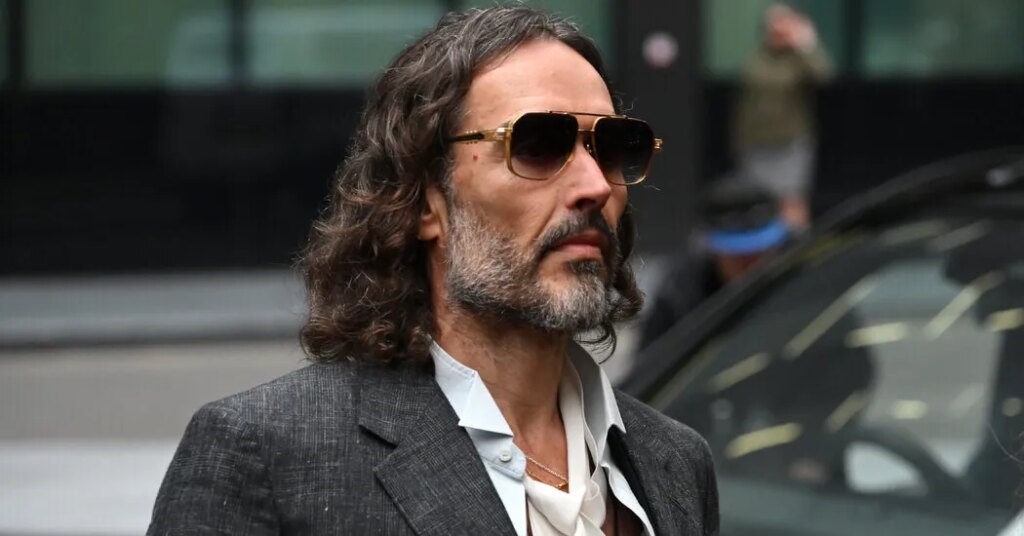
Almost every time I report on a British criminal trial, I receive emails from American readers unfamiliar with the rules that influence what some news organizations include in their coverage. This was the case in the trial of Russell Brand, the popular conspiracy-minded YouTuber, comedian and actor, who was found guilty on Thursday of one count of rape and three counts of sexual assault.
The reporting on the case may have lacked some details that readers are used to seeing in coverage of U.S. criminal trials: There was little information about the women who testified against Brand in court, for instance, or the previous assault allegations made against him in 2023.
The Brand case was tried in Britain, which has complicated rules governing reporting about criminal proceedings.
Here’s a guide to some tenets of the British legal system and how they likely influenced coverage of the Brand trial:
Accusers and victims in sexual assault cases have a right to anonymity.
In Britain, anyone who makes sexual assault accusations has the right to lifelong anonymity outside the courtroom, which means journalists following British law do not report details that might identify the accusers. Accusers who are 16 or older can waive their anonymity if they wish to make their identities known.
That’s why reporting on this case typically contained no identifying details of the six women who accused Brand of rape or assault.
Jury discussions are confidential.
In the United States, some reporters track down jury members to ask them how they came to their decisions, and that’s perfectly legal. Under British law, it’s illegal to disclose certain information about a jury’s deliberations, with a maximum penalty of two years in prison. The Times of London was fined in 2009 for publishing a dissenting juror’s concerns in a murder case. To some readers, British law around juries could seem bizarre: How can reporters better understand a jury’s deliberations if they can’t question its members afterward?
Steve Kuncewicz, a British media lawyer, said in an interview that the confidentiality of jury discussions is a key part of the British justice system. “Jurors need to be able to debate the evidence freely and change their minds without expecting those discussions to be picked over afterwards,” he said.
Journalists often report only what happens in the courtroom.
Under British contempt laws, once a person is arrested, there are limits on what can be reported during the case. The goal is to avoid the publication of information that could prejudice a judge or jury. In practice, this means that news organizations in Britain tend to stick to reporting on law enforcement press statements and what happened in open court while the jury was present. Even past convictions, which are public information, may be considered prejudicial.
Contempt could bring down a trial (it has done so), and in rare circumstances is punishable by jail.
In the past, that wasn’t always an empty threat. In 1949, a judge jailed the editor of The Daily Mirror, then one of the world’s largest-selling newspapers, after he published a front-page story about a series of murders committed by “the vampire.” The paper inferred “the vampire” was a man already in prison awaiting trial.
Even when readers have questions about the British justice system, it’s sometimes difficult to explain the reasoning behind omissions. For example, stating that “in Britain, it’s illegal to report details of a defendant’s past convictions,” could hint to readers — including potential jurors — that there is something in the defendant’s past they might want to look up independently.
Once a case is over, these limits are lifted. Often it’s not until a trial ends that readers can really understand the full context of the proceedings.
The post How British Law Informed Russell Brand Trial Coverage appeared first on New York Times.