In the lower 48 states, Democrats are exulting about election wins and Republicans are licking their wounds. But in the Last Frontier, they’re still counting the votes.
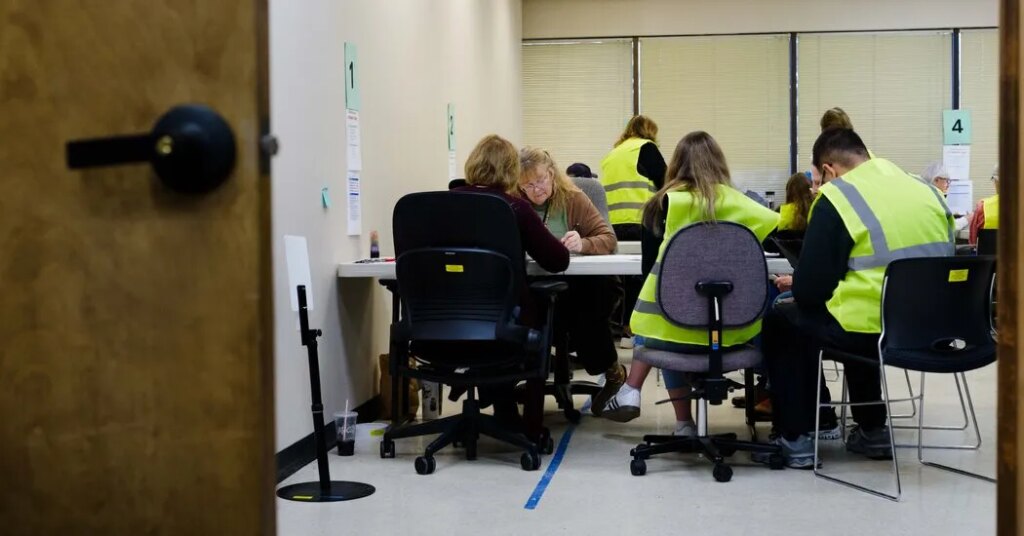
Alaska’s Senate race remained uncalled on Thursday, a product of a tight margin between the two leading candidates and the state’s 15-day grace period after Election Day to receive and count absentee ballots. Many of those ballots are arriving by mail from far-flung parts of the state. With 78 percent of the vote tallied, former Representative Mary Peltola, a Democrat, led Senator Dan S. Sullivan, a Republican, by just over 600 votes.
President Trump on Thursday injected new drama into the race’s final phase, which could stretch into next week or beyond if no candidate receives 50 percent of the vote. In a post on his social media site, Truth Social, the president took aim at the second Dan Sullivan on the ballot — a retired teacher from an Alaska fishing village whom The New York Times reported last month had been recruited into the race by allies of Ms. Peltola.
Votes for Dan J. Sullivan, as well as for Gerald Heikes, the fourth candidate on Alaska’s ballot, “should be immediately given to the REAL Dan Sullivan, and the Election is over — He easily wins,” Mr. Trump wrote. “There is no other fair solution!”
Mr. Trump’s call to interfere with the results of Alaska’s election stood in contrast to his relatively muted response to Democratic dominance in other elections this week. He told The Times that he was willing to accept the midterm results and was even looking forward to working with a Democratic-controlled Congress.
But in Alaska, Republicans have been furious for months over the presence of a second Mr. Sullivan on the ballot, an oddity that Democrats have repeatedly denied any involvement in. At Mr. Trump’s behest, the Justice Department sued unsuccessfully ahead of the election, arguing that the result should not be certified if the Republican senator lost and votes for the other Mr. Sullivan would have been enough to boost him over Ms. Peltola. The administration has filed an appeal in that case.
In Alaska’s ranked-choice voting system, candidates are ranked by voters and then eliminated in successive rounds until a winner surpasses 50 percent, with the votes for eliminated candidates reapportioned to voters’ subsequent choices. That means Republicans who mistakenly voted for the other Mr. Sullivan would still see their votes go to the incumbent once the other Mr. Sullivan was eliminated, as long as they ranked both candidates in some order.
But Republicans feared a scenario in which their voters ranked just a single candidate — the other Mr. Sullivan — and left the rest of their ballot blank, eliminating those votes once the challenger Mr. Sullivan was knocked out of contention. Data show that fewer Republicans than Democrats tend to choose second choices in ranked-choice voting.
A New York Times analysis of the available ranked-choice data from ballots tallied so far suggests that Ms. Peltola is on track to win. The remaining votes, about 60,000, are expected to favor Democrats. And the ranked-choice data suggests that the senator is unlikely to earn enough support from voters who ranked the other Mr. Sullivan or Mr. Heikes ahead of him.
In fact, voters who picked the other Mr. Sullivan as their first choice tended to select Ms. Peltola as their second choice rather than the senator, potentially undercutting the Republican argument that the other Mr. Sullivan’s backers were mostly G.O.P. voters who were confused. Still, 36 percent of voters for the other Mr. Sullivan left the rest of their ballot blank, which could include some potential Republican voters for the senator.
The Republican incumbent’s campaign expressed confidence in a memo analyzing the results on Wednesday, arguing that the senator was on track for a slim victory “despite the biggest election cheating scandal in the history of Alaska.”
The post Trump Takes Fresh Aim at Alaska, Still Counting Its Senate Results appeared first on New York Times.