Welcome to The Backstory, where we take you behind the scenes of Times journalism.
Today is all things midterms: Two Times reporters — the first to get President Trump on the phone on election night — share new details about their call. We also answer your questions about the polls versus results, the “blue wave” and honorifics for doctors-turned-politicians. And a critic of our investigation of ballot-stacking in the Alaska Senate race sounds off on the article. (If you need a break from politics, find some reprieve at the bottom of the newsletter.)
On the phone with Trump
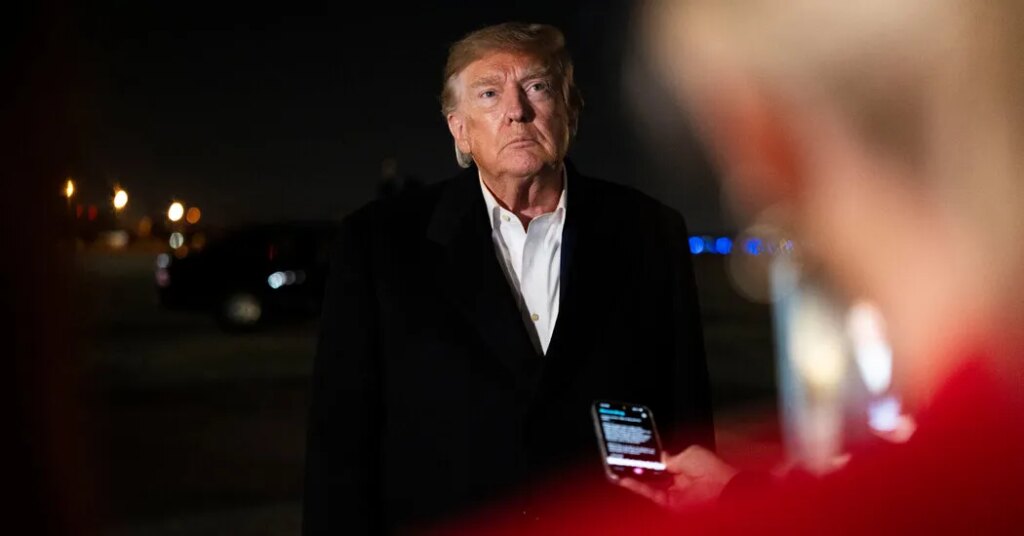
President Trump gets on the phone with reporters regularly. He sometimes makes news, but a lot of those interviews are journalistically unremarkable. So how do we try to get the most out of Trump when we call him up? Our White House reporters Erica L. Green and Tyler Pager decided with their editors that it made sense to call the president on election night. They were the first of a number of reporters to talk to Trump as the Republican shellacking was underway. I was curious about the backstory of their call and what they hoped to get out of it.
Why bother to call Trump in the first place? He is talking and posting on social media all the time.
Erica: It was worth trying to get his unvarnished, real-time reaction to the results as he absorbed them. And it would be more authentic and illuminating than what we would get on Truth Social.
Tyler: We’ve had many discussions about the usefulness of calling the president directly. We’ve done it sparingly. Here, we wanted to know if Trump was going to accept the results, given his history of casting doubt on election outcomes that don’t go his way. That would be news.
Is there such a thing as a successful interview with Trump? What does that look like?
Erica: I learned from listening to my teammates who have masterfully interviewed him that the best strategy is to ask him straightforward, direct questions.
Tyler: Yes, we want to be intentional and avoid questions that will yield answers that we’ve heard countless times before. To me, a successful interview with Trump generates something new.
Erica: So we hopped on the phone for about 30 seconds before we called him, and told each other the one question we wanted to prioritize and start with if we got him. And we decided that would be about accepting the results. The rest of the questions, we didn’t discuss beforehand, we just tag-teamed organically.
Minutes after your call, you debriefed your editors and fellow White House reporters as well as The Times’s executive editor, Joe Kahn, and Carolyn Ryan, a managing editor. It was a fast-moving conversation. What did you need to hash out?
Erica: We just needed to make sure everyone was on the same page about what the news was. It seemed everyone agreed that it was capturing his reaction to what was shaping up to be a stinging repudiation — which, considering how unpredictable the president can be, really could have been a range of emotions — and what he would do next.
Tyler, you’ve mentioned how relaxed Trump seemed on the phone. This was after a night of posting inflammatory remarks. Can you dive into this dichotomy?
Tyler: He is eager to lash out at The New York Times at rallies and on camera. He has sued us, and his administration subpoenaed me and my phone records. But when he’s engaging in an interview or a call — without TV cameras — his demeanor is different. He comes from the hospitality business and likes to host, even people that he rails against.
Erica, we were all sometimes talking at the same time in our conference room Tuesday night, and then you cut to the chase with a memorable comment to Tyler about the story. Let’s have it.
Erica: “All right, T, write that bad boy.”
Read the full interview and listen to part of the call.
Sound Off
As part of this newsletter, I’m talking to people about their questions, feedback and criticism of our journalism. Today I’m joined by Amy Siskind, who wrote the book “The List” and now has the podcast and website “The Weekly List,” which tracks broken norms during the Trump administration. She took issue with our article last week on Democrats stacking the ballot in the Alaska Senate race, and its timing before Election Day. We caught up Wednesday morning, after the election. You can watch our full exchange by clicking the play button. An edited excerpt follows.
Amy: Breaking the story on Alaska when you did, how you did, without the context, was a failure and potentially a dangerous failure. It could have been a dangerous way of enabling Trump and what he had been doing since 2020, which was sowing doubt about our elections. It could have been a real danger point for our democracy if things had gone a little differently last night.
It felt like you finally felt like you had your “gotcha” on the Democrats.
The chicanery has been on both sides. Whether it’s right or wrong, it’s not illegal, right? But that lack of context in your story made it more explosive.
Patrick: I think the story did an excellent job of making clear why this was different than the usual kind of ballot-stacking that you’re referring to and that is commonly legal. In this case, the Democratic campaign was making an effort to find candidates with the exact same name of the sitting senator of Alaska. It was to sow confusion among voters. I’m struggling to understand why you think that is OK and is not something that’s newsworthy for people to know.
Amy: To address your point there: Just because Democrats did it in a better way, and were more creative to actually find someone with the same name, as opposed to the fact that Republicans did it in this very race — they had sought in this very election to do exactly what Democrats did, setting aside whether it’s ethical or not.
Patrick: But journalists aren’t thinking about whether the Democrats are doing it in a better way or a worse way. It’s what voters deserve to know. In terms of the timing, we publish stories when we have the facts confirmed. We had the story ready a week before the election. Ethically, for us to have the reporting done and verified, and then to bury it because it might help or hurt one side, would be journalistic irresponsibility.
Dr., Gov., Ms., oh my
Susan Wessling, our Standards editor, with a quick P.S.A. about honorifics:
The many careful readers of The Times will see that we’re no longer using the title “Dr.” to refer to politicians with a medical degree who were elected this week. That includes Amy Acton, the governor-elect in Ohio; Annie Andrews, who won her Senate race in South Carolina; and Abdul El-Sayed, elected to the Senate in Michigan. For medical doctors, The Times’s longstanding policy is to use the “Dr.” title for those whose primary job is in the field. The primary job of these professionals has been cemented, for now, in politics and government.
Election night in the newsroom, by the numbers
-
More than 400 Times reporters, editors, data analysts, video journalists and photographers covered thousands of races. About 100 reporters were in at least 30 states on election night.
-
We published the Needle and the model estimates that power it in Senate and House races, writing more than 200 data scrapers and data pipelines to capture an overwhelming amount of results data.
-
More than 100 data journalists crunched the election results.
-
Patricia Mazzei, a political correspondent, drove more than 1,525 miles through Florida, Georgia, North Carolina and South Carolina this year while reporting on midterm races.
-
We introduced Times Voter Trends to break down estimates for the results of House and Senate elections by age, race, education and gender in every state. To make this project as authoritative as possible, we have recontacted more than 7,000 of the nearly 30,000 people we interviewed this year for Times/Siena polls to verify whether they voted and for whom.
-
We ordered 125 pizzas and about 120 poundsof barbecue to fuel our newsroom through the day and night. Many (many) M&M’s were also consumed.
Your questions about our journalism
This week, I answered reader questions and comments before and after the midterms. Read one exchange below and click for more.
How we got that shot
My colleague Hiroko Masuike, who photographs scenes around New York City, was among the spectators at the New York City Marathon on Sunday. She shares how she managed to get an aerial shot of the runners making their way up Fourth Avenue in Brooklyn.
I’ve covered the marathon many times, but Sunday was my first time photographing a specific stretch of Fourth Avenue, from Bay Ridge to Park Slope. Looking at Google Maps, I noticed the avenue offered a long, straight view of the race, heading north, and I envisioned capturing the runners from an elevated viewpoint.
I began searching for the perfect spot. My first attempt was the elevated F and G subway station at Fourth Avenue and Ninth Street, but opaque glass panels blocked the view. I spotted spectators on rooftops and terraces and tried waving, shouting and jumping to get their attention. No luck.
By then, I had walked four or five miles carrying heavy camera gear. Still, I was determined.
I spotted a couple entering an apartment building and rushed over. They were visiting a friend, but a building staff member came outside. When I identified myself as a Times photographer and explained what I was trying to do, he kindly offered to take me to the 12th-floor rooftop. The view was spectacular: a colorful stream of runners and spectators stretching toward Downtown Brooklyn. I finally got the shot.
Pop quiz
Which sentence below is correct, per Times style? Click the right word in bold to see the answer and read the essay; check out the reason in the P.S. at the bottom of this newsletter.
-
Over the centuries, the arches of Titus and Constantine became archetypes replicated around the world for a gamut of glorious purposes.
-
Over the centuries, the arches of Titus and Constantine became archetypes replicated around the world for a gantlet of glorious purposes.
-
Over the centuries, the arches of Titus and Constantine became archetypes replicated around the world for a gauntlet of glorious purposes.
We welcome your feedback. Email us at [email protected]. And see you next week. — Patrick
P.S. A gamut is a scale of notes, or any complete range; someone can run the gamut literally or figuratively. A gantlet is a flogging ordeal in which an offender runs between lines of tormentors bearing sticks. A gauntlet is a long glove, the kind duelists wore; it can be thrown down to issue a challenge, or taken up to accept one. (Some authorities, but not The Times’s style guide, accept gauntlet to mean the ordeal also.)
The post Calling Trump appeared first on New York Times.