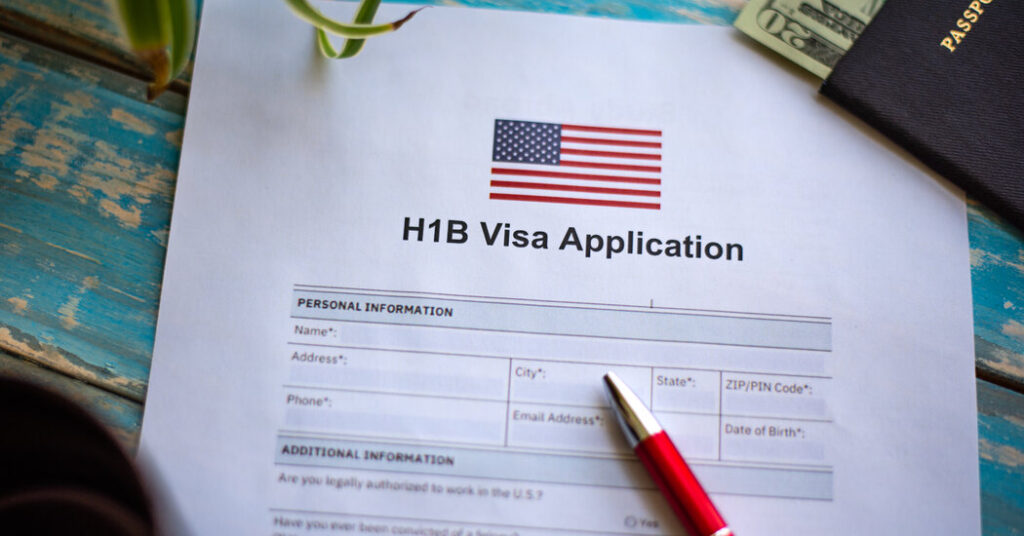
Take a quick trip through online spaces where young conservatives gather, and one somewhat clunky term is likely to appear again and again: H-1B. The characters refer to the relatively obscure immigration policy that allows up to 85,000 foreign workers to fill specialized roles in the United States every year, and it has become a hyperfixation for MAGA’s youngest minds.
In recent weeks, “H-1B” has tumbled through social media in viral posts, on right-wing podcasts like “The Charlie Kirk Show” and as a talking point bolstered by prominent young political commentators like Brett Cooper and Natalie Winters.
In stark terms, these “zoomercons” — a portmanteau gaining traction to describe Gen Z conservatives — have vilified the program as “rigged” and “abused,” a “scam” perpetrated by the Republican Party’s corporate-friendly wing and a rapacious Silicon Valley.
Young Americans with STEM degrees, Ms. Cooper said, are getting “passed up for cheap foreign labor.” In a November episode of Stephen K. Bannon’s podcast, “War Room,” Ms. Winters described the idea that America needs foreign labor as the “core lie” propping up the H-1B program, signed into law by President George Bush in 1990 as part of a policy to encourage the immigration of “exceptionally talented” people to meet the country’s economic needs.
Nalin Haley, son of Nikki Haley, the United Nations ambassador during the first Trump administration, appeared on Fox News last month and called for a total ban on both the H-1B and legal immigration. “We need to punish companies who are not putting American workers first, who are putting foreigners first,” he said. The comments created a buzz on the right in part because Mr. Haley, a 25-year-old who works in the financial industry, descends from an Indian American mother whose parents immigrated to the United States.
As young conservatives discuss cost of living as a top concern, the H-1B issue has become a purity test of one’s nationalist bona fides, and by extension, one’s commitment to the America First agenda promoted by conservative figures including Nick Fuentes and Tucker Carlson.
To some observers, the debate reflects what they see as a “zero-sum” mind-set of many MAGA conservatives, as well as the racial attitudes of the far-right flank of the party.
“‘If there are more jobs for immigrants, then there must be less jobs for natives,’” said Ilya Somin, a professor at George Mason University who focuses on immigration. “It’s a combination, really, of nationalism and economic ignorance. They don’t understand the benefits and gains from the policy.”
Those benefits can include economic growth and innovation that leads to more jobs, including for U.S.-born workers, according to some studies.
The staunch opposition by many young conservatives appears to be out of sync with MAGA’s more business-minded interests, which generally support issuing visas for their potential to boost productivity and reduce consumer prices.
It’s also a stance that is contentious among young Americans more broadly: In a Harvard Youth Poll released this month, 48 percent of Americans aged 18 to 29 reported feeling that immigration posed no threat to their job prospects, compared with 31 percent who felt that it did.
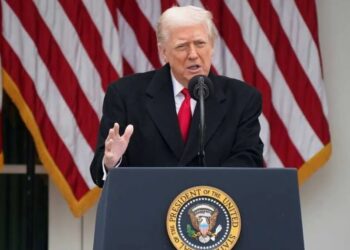
On the right, however, discontents over President Trump’s handling of H-1B have long been simmering. A flashpoint came last month, when Mr. Trump, appearing on Laura Ingraham’s show on Fox News, defended the visa. “You have to bring in talent,” the president said. “You can’t take people off the unemployment line and say, ‘Go make missiles.’”
The comments set ablaze corners of the conservative media sphere and found particular resonance among some of MAGA’s youngest members, who have increasingly hard-line appetites on immigration and say their views have been shaped by dismal first encounters with the American job market.
Take Mitchell Boone, a 27-year-old Trump supporter. Five years after leaving a computer science program at the University of Missouri, and what he says are over 1,000 job applications later, Mr. Boone claims he has landed just a single job interview.
Today, he says he keeps three part-time jobs in Greenville, S.C., and grows his own food to cut down on expenses. Having abandoned hopes of working in tech, Mr. Boone says he is exploring alternative fields like construction or farming.
Mr. Boone, who said he voted for Mr. Trump in the last two presidential elections, spoke of his post-grad years with an air of exasperation. But he’s finally settled on an explanation for his bleak economic straits: the H-1B.
“We’re getting screwed over by our government,” he said. “We need to end it entirely.”
Like many young conservatives, Mr. Boone first latched on to the issue last year, learning about the H-1B program after comments by Elon Musk in support of the policy set off an intra-MAGA debate over foreign workers. Since then, Mr. Boone has come to view it as “one of the biggest, if not the biggest, issue” afflicting Americans. Mr. Boone has become a vocal opponent of the H-1B at the Turning Point USA events he frequently attends at nearby Clemson University.
His experience — if not his views — is one shared by recent computer science grads across the country, a generation lured to the tech sector by the promise of high wages and steady career work only to be confronted with some of the highest unemployment rates among college majors.
Still, it’s not just STEM graduates who say they are experiencing this frustration.
“There are virtually no job openings,” said Emma MacCutcheon, 24, a recent graduate from the University of North Florida who studied psychology. “And when I do find jobs, every single one asks if I need a visa sponsorship.”
Ms. MacCutcheon, who said she fully supported the America First agenda, expressed similar frustration about what she viewed as Mr. Trump’s lack of urgency to end H-1B, especially as she worries that artificial intelligence will put a further squeeze on job prospects.
Her trust in President Trump’s promise to fix immigration, she said, has been “severely damaged” since the start of his second term.
For the young conservatives within the America First wing, the policy is not just an emblem of economic instability and chaos, but also one of political dysfunction and betrayal.
“My generation, we have no trust for the politicians,” said Jarrod Wright, 25, a political commentator who hosts an America First-themed podcast called “The Wright Wing.”
Mr. Wright, who calls himself the “redneck Nick Fuentes,” referring to the 27-year-old white nationalist, said he thought MAGA “meant caring about American jobs,” and singled out Chinese and Indian workers as the competition.
Between two-thirds and just over three-quarters of H-1B recipients are from India, according to data from U.S. Citizenship and Immigration Services. Many of the workers who receive these visas work in the tech industry; big tech giants including Amazon, Google and Meta are among the companies that employ the most H-1B visa holders.
Some younger conservatives can see the merits of the program, though they tend to be a generation older than the zoomercons who have taken it up as their cause célèbre.
When Liz Ruh, a millennial accountant in Brooklyn, first heard Mr. Trump’s comments on the H-1B program, she said she thought: “Don’t be a punk. Don’t diminish the American worker.”
“But from a practical standpoint, it does take time to train up American workers,” said Ms. Ruh, 32. “I do support visas from a practical sense.”
Daniel Kishi, a policy adviser with American Compass, a conservative think tank, suggested that the H-1B debate might soon spread beyond Republican circles. He noted how Senator Ruben Gallego, Democrat of Arizona, recently urged the White House to increase oversight on the special workers program, of which H-1B is part.
He said he had a “strong suspicion” that “bases of both parties are going to have increased appetites for restrictions on foreign workers moving forward.”
The grumbling on the right over the visa may well be the latest plot point in a narrative that the MAGA movement is drifting away from its populist aims.
Despite signaling support for the program, the White House announced in September that it would impose a $100,000-a-year fee on each visa given to skilled workers. However, it quickly clarified that the fee would instead be a one-time cost.
Last week, the White House announced additional restrictions on the program, saying it would block H-1B visas for tech workers involved in content moderation, a move it described as “enhanced vetting.”
In a statement on Tuesday, a White House spokesperson said that the $100,000 fee on H-1B visas was a “significant first step to ensure American workers are no longer replaced by lower-wage foreign labor.” (This week a coalition of Democratic attorneys general announced it was suing the Trump administration over the proposed fees.)
The H-1B program requires employers to pay workers with this visa either the average wage for the job and the city where it is based, or the average wage of U.S.-born workers in the same role, though a majority of the positions paid below the local median wage for the occupation as of 2019.
As the 2026 midterm elections approach, the H-1B issue has already emerged as a central talking point in some races. In Florida, James Fishback, a 30-year-old investment chief executive running for governor as a Republican, has described the H-1B system as an “anti-American scam.” He vowed to “eliminate” the program, if elected, and fire the H-1B workers currently employed by the state.
Such proposals might be the only way to engage MAGA’s youngest voters, said Ms. Cooper, the conservative YouTuber.
“Something has got to give if MAGA hopes to keep their support. They need to offer tangible solutions for Gen Z,” she wrote in an email. “Either way, MAGA could be in trouble.”
The post The Young People Fixated on Who Gets to Work in America appeared first on New York Times.