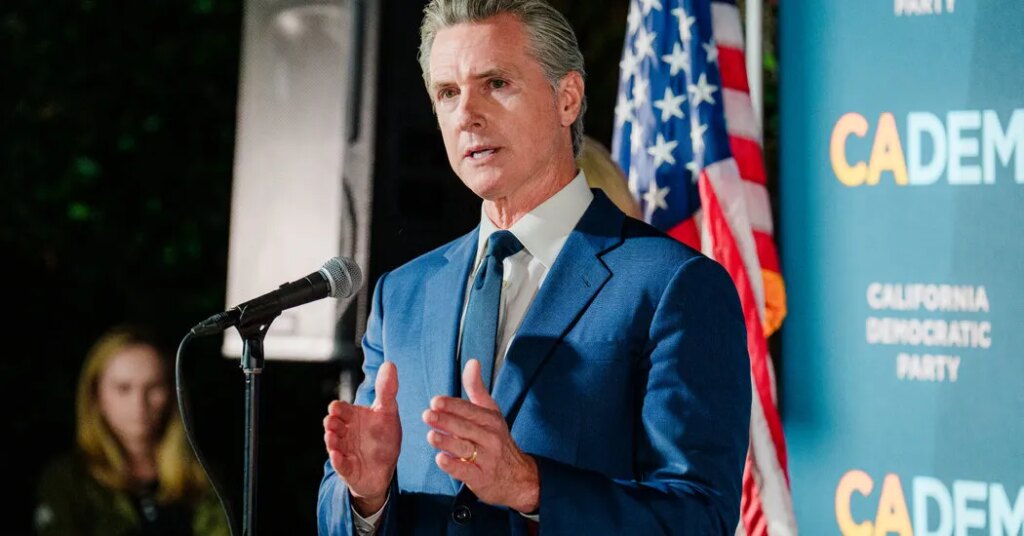
Gov. Gavin Newsom of California spared the lives of all 548 prisoners on the state’s death row on Thursday in the largest mass commutation of death sentences in modern American history.
Mr. Newsom said he made the decision because he finds capital punishment morally objectionable. He reduced every death sentence to life in prison without parole, a sweeping move that will require a review by the state’s highest court in some cases and could draw legal challenges.
“State-sanctioned killing is incompatible with California’s values, undermines the foundations of our legal system and diminishes each of us,” Mr. Newsom wrote in an open letter to California residents. “I know we cannot execute people in our imperfect legal system and remain true to our core values, first among them justice and human decency.”
Mr. Newsom is not the first governor to empty a state’s death row. But the large number of people sentenced to death in California makes his decision especially significant. California has more death row inmates than any other state, and Mr. Newsom’s action cancels approximately one-fourth of all death sentences nationwide.
Mr. Newsom acted just two months before he will leave office and as he considers a run for president. The act could make him a more compelling candidate to liberal voters in a Democratic primary, but likely would open him to attacks in a general election.
Death penalty opponents have planned a national ad campaign praising him for the move. The minute-long commercial casts the governor’s decision as an act of courage and leadership inspired by the Rev. Dr. Martin Luther King Jr., Dolores Huerta and Robert F. Kennedy. It will air on dozens of news and political shows nationwide, said Dan Newman, a Democratic strategist who advises both Mr. Newsom and the anti-death penalty groups sponsoring the ad.
Mr. Newman said that the governor had been motivated by personal conviction. But the ad could also help Mr. Newsom in a 2028 presidential campaign.
“We’ve entered a post-Trump world,” said Mr. Newman, the strategist. “And Democrats have to show what we’re for, and not just what we’re against.”
Mr. Newsom acted after months of lobbying by death penalty opponents and counter arguments from prosecutors and victim advocates. Those against Mr. Newsom’s move are expected to file a challenge arguing that he violated the law with a blanket commutation and that each case must be considered on individual merits.
They recently sent Mr. Newsom a seven-page letter, written by Anne Marie Schubert, a former Sacramento district attorney, that included photos of people killed by prisoners now on death row and detailed descriptions of their crimes. The cases included an 8-year-old boy who was severely abused for months before he died from torture in 2013 and another 8-year-old who disappeared while walking home from school in 1996.
California’s death row includes notorious killers such as Richard Allen Davis, who murdered Polly Klaas, a 12-year-old, after kidnapping her from her home in 1993. It also includes Cary Stayner, who killed four women near Yosemite in 1999, and the 1980s serial killer Charles Ng.
Ms. Schubert said that she had heard from the families of many victims who were distressed at the idea of commutations.
“These are people that have suffered unimaginable losses and were given some sense of finality through the justice system,” Ms. Schubert said in an interview before Mr. Newsom acted. “That is all being reopened and rehashed.”
Ms. Schubert, who leads the Criminal Justice Legal Foundation, a victims rights group, said she plans to sue Mr. Newsom. Under California law, a governor can unilaterally grant clemency to offenders convicted in only one felony case. The California Supreme Court, however, must approve a governor’s clemency request for prisoners with convictions in multiple felony cases.
More than half the sentences Mr. Newsom seeks to reduce must now be reviewed. A state Supreme Court spokeswoman declined to comment on how long that could take.
Ms. Schubert contends that the court must review each case individually. Other legal experts have said that the court could consider them en masse if Mr. Newsom sought clemency based on a moral objection to the death penalty.
“When a governor is moved to be merciful, the courts recognize that’s between the governor and the Almighty,” David A. Carrillo, executive director of the California Constitution Center at the University of California, Berkeley law school, and Brandon V. Stracener, a research fellow, wrote in 2024.
Marc Klaas, the father of Polly Klaas, whose kidnapping and murder prompted an era of tough-on-crime policies in California, is livid at the idea of Mr. Newsom granting mercy to his daughter’s killer, or anyone else sentenced to death.
“We’re talking about serial killers, spree killers, cop killers, baby killers,” said Mr. Klaas, who is not Ms. Nichol’s father. “We’re talking about absolutely the worst people in our society, without a doubt. And he’s putting his energy into commuting these characters?”
Mr. Newsom had already placed a moratorium on executions, a decision that upset Mr. Klaas when it was made seven years ago. The idea of a mass commutation revives his fury.
“It regurgitates the horrible emotions,” he said. “It just leaves me feeling raw and angry.”
Mr. Newsom recently met with other family members of Polly Klaas. Jess Nichol, her stepsister, said that she and another sister met with Mr. Newsom in October and encouraged him to commute all death sentences.
“We used to think that having a vengeful death penalty sentence is going to be what gave us justice,” Ms. Nichol said. “We’ve discovered that it doesn’t.”
Their meeting took place at the San Quentin prison that once housed all of California’s death row inmates, including Mr. Davis, who killed Polly.
Ms. Nichol, who was the same age as Polly, at first felt the killer deserved death, she said. But, Ms. Nichol said, she came to think that capital punishment would not help crime victims as much as resources to aid their healing. Ms. Nichol now facilitates rehabilitation programs at San Quentin.
“I want to live in a world where I am well, and not haunted by the hungry ghost of vengeance,” she said.
Mr. Newsom’s action echoes a similar move by President Joseph R. Biden near the end of his term. In December 2024, Mr. Biden commuted the sentences of all but three prisoners on federal death row.
Other Democratic governors have also used their executive power during the 2020s to reduce death sentences, albeit on a much smaller scale. Gov. Roy Cooper of North Carolina commuted 15, Gov. Kate Brown of Oregon commuted 17 and Gov. Jared S. Polis of Colorado commuted three.
Until now, the largest mass commutation in modern history was in 2003, when Gov. George Ryan of Illinois, a Republican, nullified death sentences for 167 inmates just before he left office.
Celinda Lake, a Democratic pollster who has conducted surveys for anti-death penalty groups, said she sees little political downside for Mr. Newsom because Democratic voters and Black voters who are influential in the party overwhelmingly oppose the death penalty.
“The chattering class will say this makes you vulnerable,” she said. “But I think that sounds like old establishment arguments.”
The post Newsom Spares Everyone on California’s Death Row in One of His Final Acts appeared first on New York Times.