Kehinde Wiley had the meteoric rise any painter would envy. Just three years out of art school, in 2004, he was given a major exhibition at the Brooklyn Museum. Still in his 20s, his ornate portraits of Black subjects in historical poses drew collectors from New York to the White House. By midcareer in 2018, the artist unveiled his official portrait of President Obama and became a household name.
He seemed unstoppable. Then, a vortex of doubt descended.
Starting in 2024, five individuals accused Mr. Wiley of sexual assault or rape. He has denied any wrongdoing and has never been charged with a crime. Nonetheless, several museums canceled his exhibitions; an auction house pulled his paintings from sale; and a lawsuit filed in 2025 by one of his accusers is still going through New York Supreme Court.
With the allegations unsettled, Mr. Wiley took a step back from public engagements, though he still appeared at events with celebrity friends like Alicia Keys and Kevin Hart.
In May, he became a single father, welcoming a son into the world through surrogacy and an anonymous egg donor. He started painting again in New York — vibrant portraits that, as before, overturn the European old-master hierarchies of power, race and privilege. He even followed his old process, casting his models from chance encounters on the street.
Then, in August, Mr. Wiley found himself back in the public eye, this time thanks to the Trump administration. The State Department announced that it had removed one of his paintings from the U.S. embassy in the Dominican Republic because it was “aesthetically terrifying.”
An official had at first justified its removal on the basis of the sexual misconduct claims against Mr. Wiley. However, the U.S. ambassador to the Dominican Republic had said on a radio show that she disliked the 2015 portrait for its subject matter — what she had perceived as a lesbian picnic. (Mr. Wiley said she was wrong; it is of four art students.) Another official referred to the artist as “the gentleman who did Obama’s portrait.”
The comments inadvertently turned Mr. Wiley into a target of political censorship.
“To be considered ‘aesthetically terrifying’ by this administration is high praise if I am to read my DMs correctly,” the artist said.
Stalwarts of the museum world rallied to his defense.
“This is some playbook that’s been written in Washington, particularly because of Kehinde’s portrait of Obama,” said Arnold Lehman, the former director of the Brooklyn Museum, who gave the artist his 2004 exhibition and started personally collecting his work. “If the administration could burn that portrait, they would.”
A New Chapter?
This week Mr. Wiley will show a new series of more than a dozen artworks at Sean Kelly Gallery in Manhattan, an exhibition called “What the Light Becomes.” Visually, the paintings remain in his signature style: triumphant Black figures set against lush, intricate floral backdrops. Prices for the life-size works range from $275,000 to $450,000. During the height of his career, his larger paintings could sell on the private market for as much as $1 million. Mr. Kelly denied that the allegations had affected the artist’s prices, though Mr. Wiley said there was a lack of demand in the market for the wall-size paintings he prefers to make.
“People tell me I should try to incorporate this experience into my work,” Mr. Wiley said of the allegations. “I don’t particularly want to see my practice affected by that.”
Inside his Williamsburg studio during an October visit, there was his close circle: one assistant; the gallery’s communications director; and the artist’s son, who was being entertained by the nanny in a backroom. Mr. Wiley’s new paintings were getting his finishing touches on easels while older, monumental paintings the size of trampolines lean against walls.
The men and women in his new paintings wear puffy coats and bright colors. One woman holds an iPhone inside a unicorn case, which shows her playful side, despite her confrontational look.
When asked if he would ever consider making a self-portrait, he shot down the question. “I don’t do self-portraiture, because I’m the one looking.”
“Vanity — or the particulars of what make you so hot or special — can sometimes get in the way of what makes a cool image,” he continued. “I don’t think I would be very good at self-consciously trying to say I’m being an uninterested party.”
What about artists like Diego Velázquez, the 17th-century Spanish master, whose self-portraits do emanate a profound self-awareness? Mr. Wiley said he was the exception. He tries to plan a yearly visit to see his monumental group portrait “Las Meninas” at the Prado Museum.
Being ‘Aesthetically Terrifying’
Mr. Wiley was born in 1977 into a working-class family in South Central Los Angeles that prized intellectual achievement, and there were early signs that he was destined for success. He was raised by his mother, who ran an antique shop that her six children lovingly referred to as a junk shop. Wiley and his twin brother enrolled in art classes when they were 11; he studied painting at the San Francisco Institute of Art, selling some of his early artworks to cover his tuition. He went on to earn a masters at the Yale School of Art, where he struck a close friendship with the artist Mickalene Thomas.
“I was the only Black kid there for my first year; luckily, Year 2, Mickalene Thomas shows up,” he recalled in a promotional video for a 2023 exhibition at the de Young Museum in San Francisco — his last major U.S. museum exhibition. “We were both on this life raft and we chose each other as a means of flotation.”
Mr. Wiley was the product of a fleeting romance; his father, Isaiah Obot, had already moved back to Nigeria when his mother gave birth to him. Father and son met in 1997, when the artist traveled to Lagos, and spent several weeks searching for him. He found his father working as the architecture department head at the University of Calabar; he also met his half-siblings.
Today, about half of Mr. Wiley’s life plays out in West Africa. He owns a 15-acre estate in Nigeria and has a long-term boyfriend, a model, who lives there. He has a studio, residency and foundation based in Dakar, Senegal, that he’s built into an international star maker for artists of the diaspora such as Tunji Adeniyi-Jones and Zohra Opoku. He speaks fluent French when he’s there, but can also switch to Mandarin whether he’s speaking with assistants at his studio in China, where some of his artworks are made, or singing a nursery rhyme to his son.
Over the last few years, some friends questioned whether Mr. Wiley could keep Black Rock, his artist residency, going in Senegal, which is mostly funded out of his own pocket. It’s been hard to raise money while he is under scrutiny, and plans to open a second residency program in Nigeria fizzled. And in Senegal, legislators recently passed a law that increases prison sentences and fines for same-sex acts in a crackdown on homosexuality that was a campaign promise of that country’s president.
Mr. Wiley is in a difficult spot — not only as an openly gay man operating in the country’s elite circles but as something of a court painter. He spent a decade preparing a series of portraits of African presidents, unveiling them in a 2023 exhibition. He deliberately chose not to talk about politics with his subjects — some of whom had presided over violent crackdowns on demonstrators.
“I don’t see myself as an agent of direct political change,” Mr. Wiley said.
But he is noticeably more direct when talking about the Trump administration. His request to President Trump last month, asking for the opportunity to buy back his painting from the Embassy, has gone unanswered. (The State Department did not respond to a reporter’s requests for comment.)
“There is no response,” Mr. Wiley said. “Although I can’t say that I am too terribly surprised.”
He has also turned the phrase “aesthetically terrifying” into a floral graphic tee offered for $120 on his web store.
Returning to Form
Mr. Wiley would like to become the darling of New York again.
“I’ve been out here in these global streets for years painting heads of state and capturing the temperature of places like Mumbai, São Paulo and Lagos,” he explained.
He has missed the chaotic energy of New York, where he has lived since joining the Studio Museum in Harlem’s artist residency program in 2001, several months before the Sept. 11 terrorist attacks. But his return comes with baggage.
The first sexual assault allegation emerged in May 2024 when Joseph Awuah-Darko, a Ghanaian artist, accused Mr. Wiley of groping and attacking him during a 2021 encounter. Over the next year, three other men claiming to know the artist came forward on Instagram. Their allegations covered more than a decade. In February 2025, a female artist named Ogechi Chieke filed a lawsuit in New York, claiming that Mr. Wiley grabbed her genitals at a restaurant after a 2007 exhibition opening; a judge denied Mr. Wiley’s motion for dismissal in January. The other accusers have not filed lawsuits.
Mr. Wiley has consistently denied the allegations, saying that the encounters with certain accusers were entirely consensual, and, in other cases, that he did not know his accusers. He said last week that some accusers have asked for financial settlements. “I have letters from lawyers asking for money,” he said.
In a statement to The New York Times in October, Mr. Awuah-Darko said he stood by his claim. “To this day, I still struggle with PTSD linked to the sexual abuse I experienced that night in 2021,” he said.
Derrick Ingram, who identifies as a social justice activist, wrote on Instagram in 2024 that Mr. Wiley raped him when the pair dated. In a recent interview, Mr. Ingram said that he’s never asked Mr. Wiley for a financial settlement. “I felt a moral obligation to say something,” he said. “Somebody of Kehinde’s status can afford private investigators, personal researchers and some of the best lawyers, which makes coming forward very intimidating.”
In his studio, Mr. Wiley began crying when discussing the allegations.
“I’ve been through more pain — it’s really hard to imagine what it’s like to have people believe that. To look at you and think you’re a predator,” he said, gathering himself. “In my life, there has always been, by hook or by crook, some sense of grace that comes out of even the most challenging situations.”
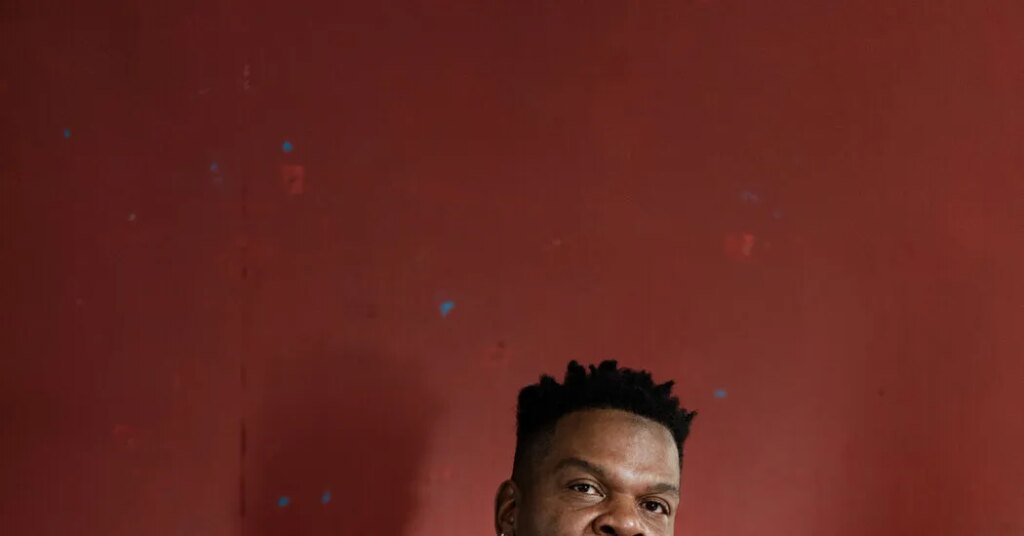
The artist took us to another room for a photo shoot for this article. During the setup, we talked about Marlon James’s new novel, “The Disappearers,” which he devoured, approving of its complex depictions of how sex, race and violence collide in contemporary life.
The nanny came with Mr. Wiley’s baby. The artist changed out of his camouflage fatigues into his painting clothes for a round of pictures: a ragged cotton shirt with splotches of red across his chest, like Impressionist wounds. He sat in a chair that’s followed him throughout his career, an uncomfortable, rolling office chair with his name painted green on the back: KEHINDE.
“I’m incredibly aware of the blessings that I have, the role that I’m able to play in terms of storytelling, mythmaking,” the artist said. “It’s something that I look forward to showing my son.”
Mr. Wiley held the baby, who started drooling as they smiled into each other’s eyes. Together they faced the camera and posed.
The post Kehinde Wiley in the Vortex appeared first on New York Times.